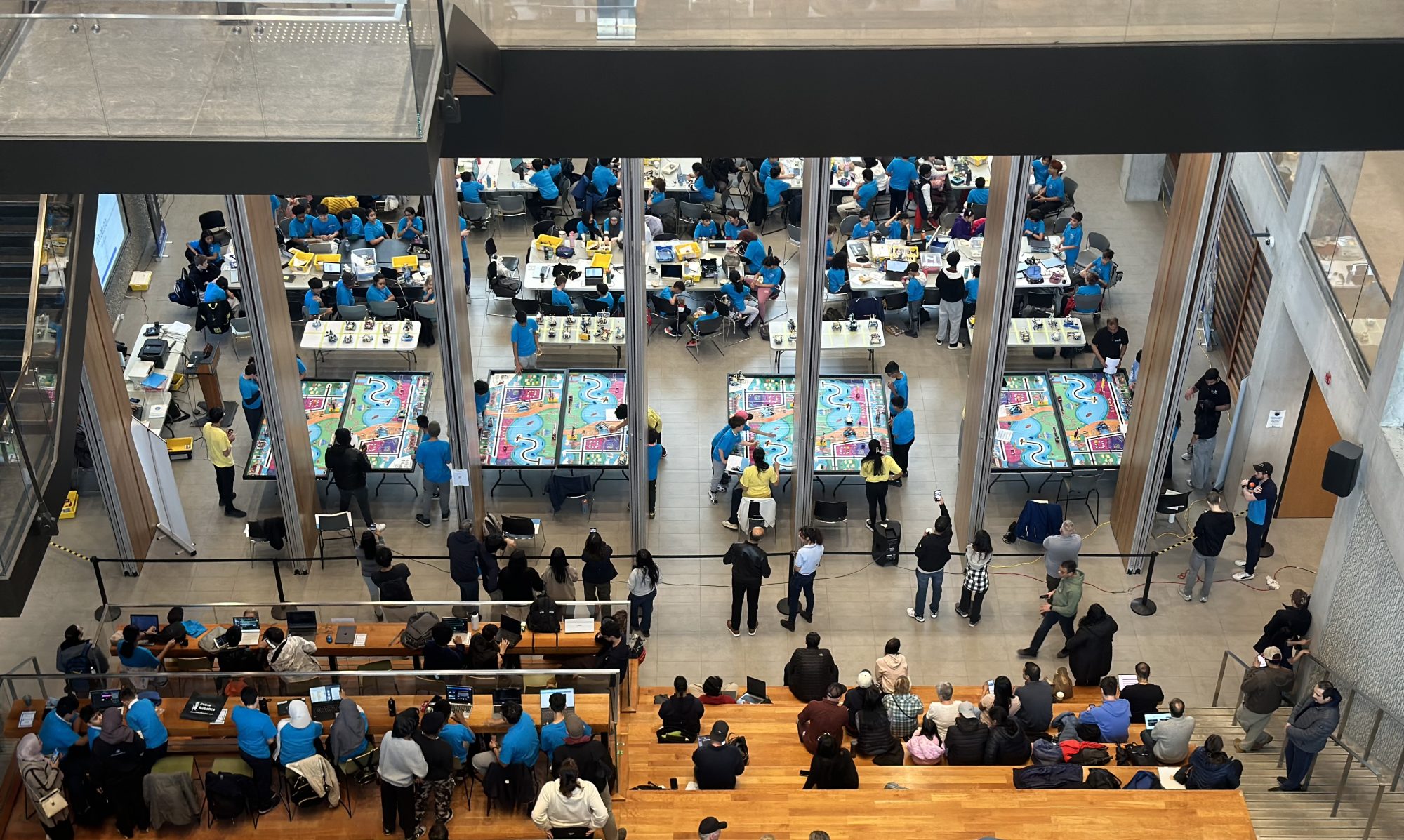
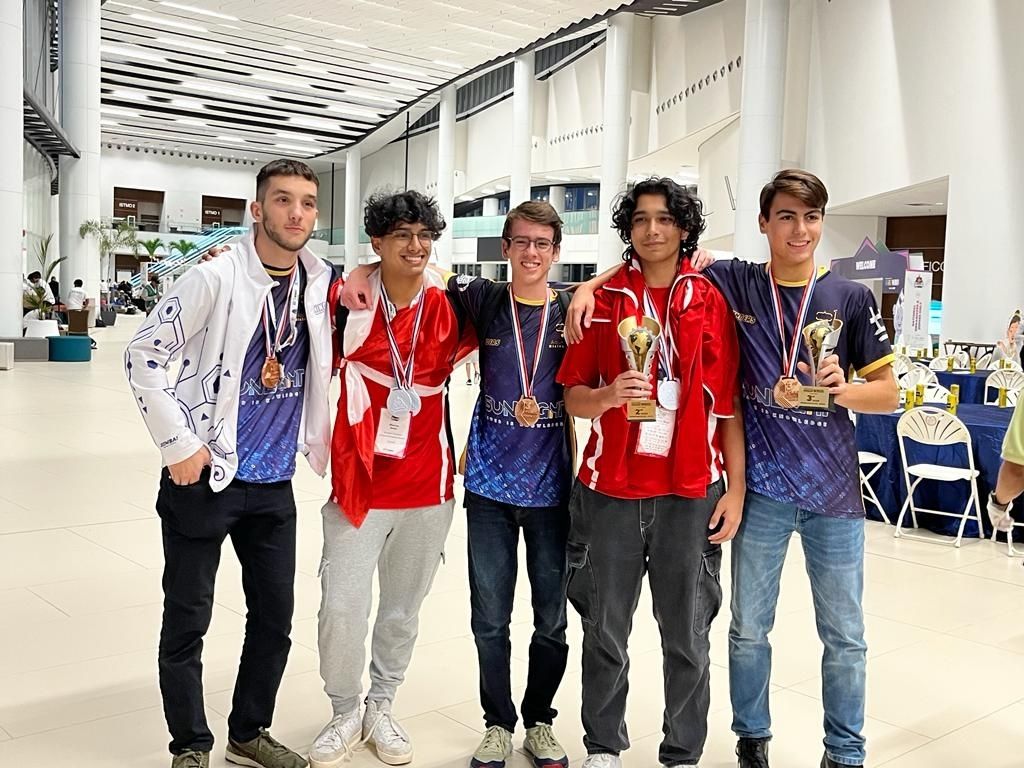
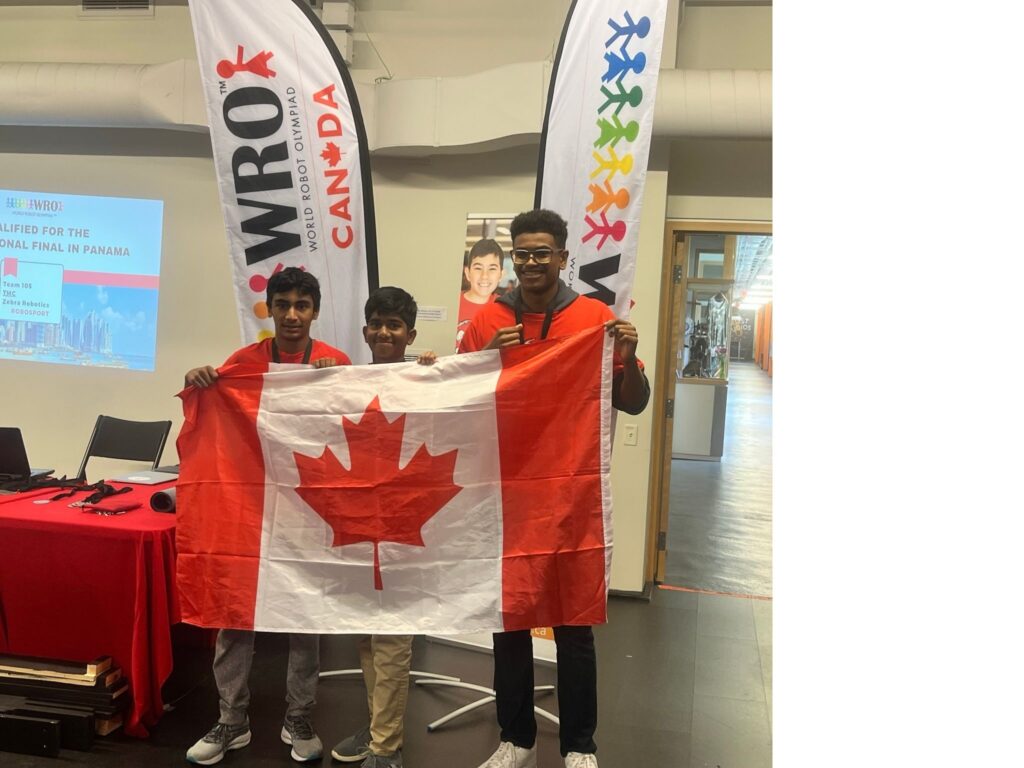
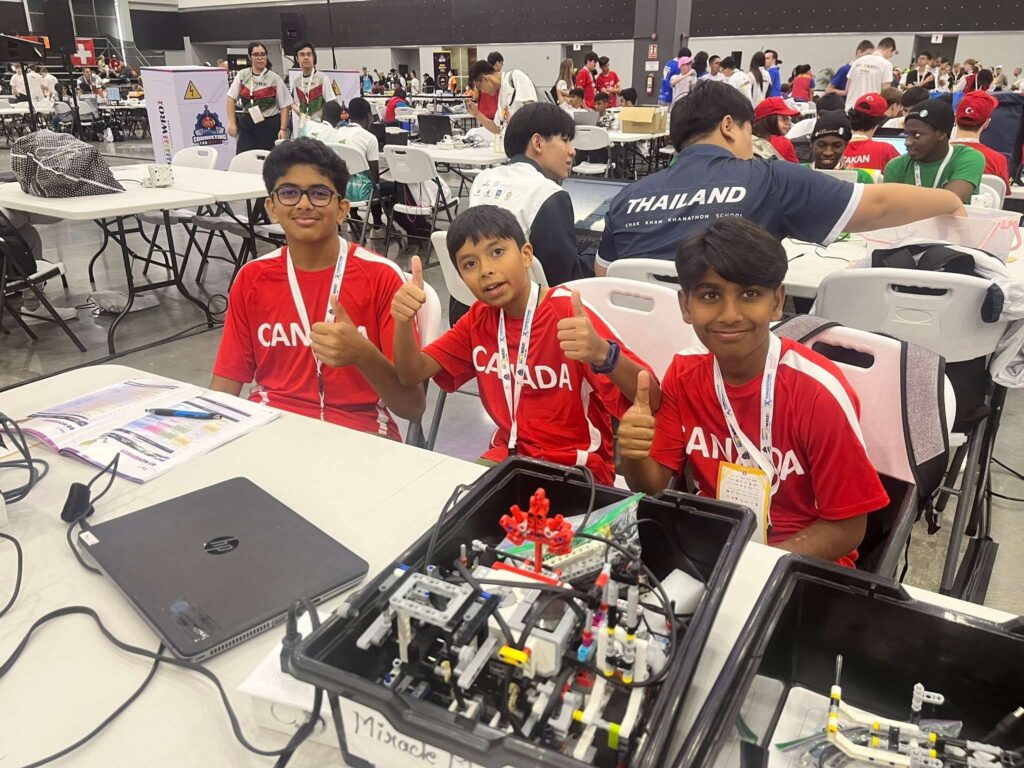
The robots have been run, and the points have been totaled. It’s official: four Zebra Robotics teams are going to Turkey for the International World Robot Olympiad (WRO) in November! These teams have been working hard since regionals to make their dreams a reality. This work has paid off, as ALL FOUR TEAMS got first place in their respective categories!
WRO Teams Celebrate in Montreal
Team Agribots came first in the Elementary Future Innovators category! They redesigned their robot after the regionals to a more sleek-looking, polished design.
The Woodchucks came first in the Junior Future Innovators category! They spent a ton of time at Zebra knuckling down on their design, ensuring it would run well on the day of the competition.
Team -0.618 came first in the Senior Robomission category! This team set its sights high early in the season and has been studiously perfecting a robot based on advanced math and with an innovative, efficient design.
The Miracle Monkeys came first in the Junior Robomission category! No strangers to competition, they knew that if they put in the work, they would come out on top. And they did!
We are proud of all our teams, as they all took what they had learned over the years and skillfully applied their knowledge to design the best robots possible. We know they will represent Canada well on the world stage.
But the fun isn’t over yet! We have four more teams who may make it to international competition. We will know on Friday if two of our high-scoring teams will be able to compete in either Puerto Rico or Italy at WRO Open Invitationals. Zebra is also fielding teams in two additional categories whose regionals are in September: Future Engineers and Robosports. Stay tuned to our socials to see we are sending more teams to international competition!
Big wins at Zone01 Nationals!
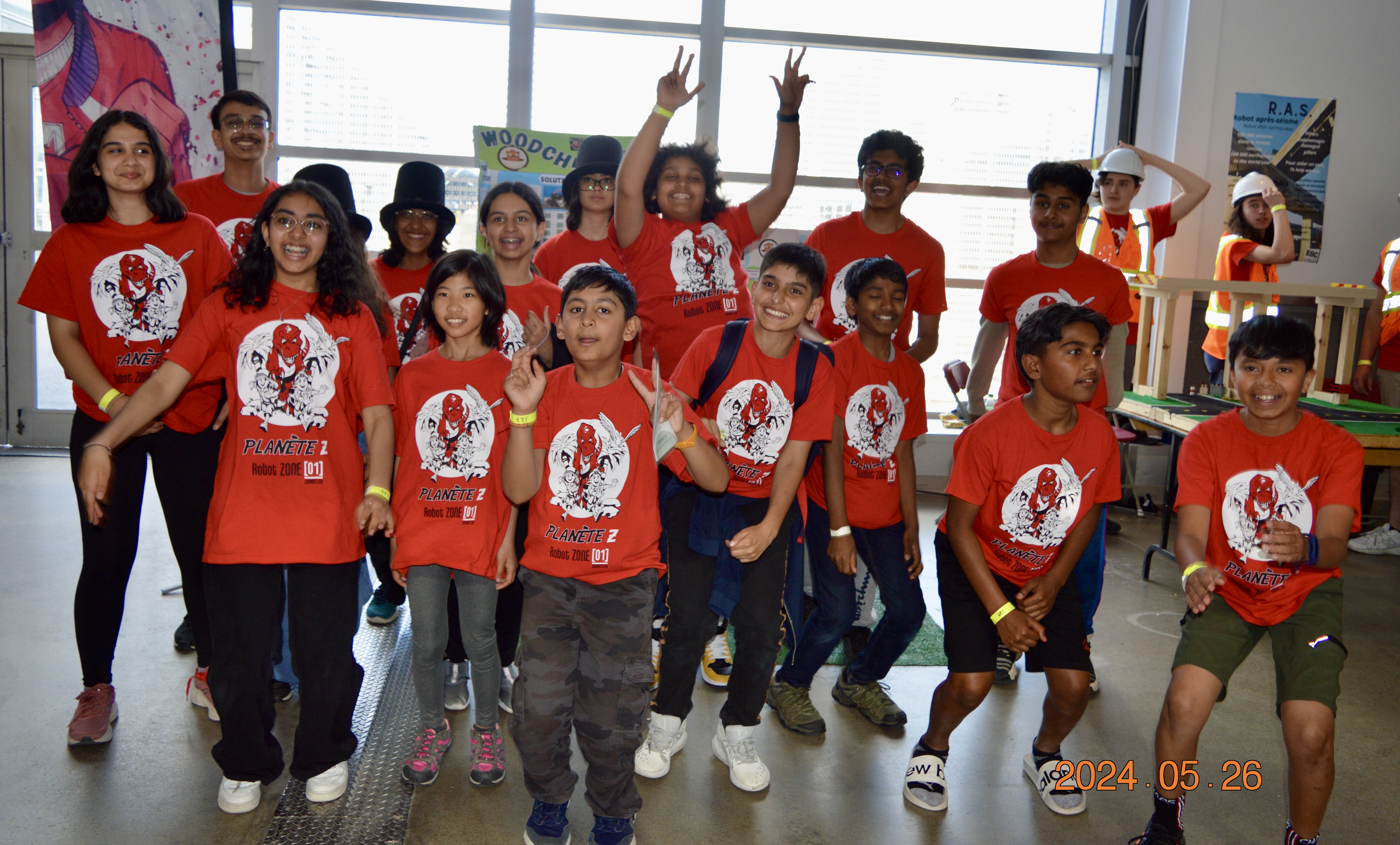
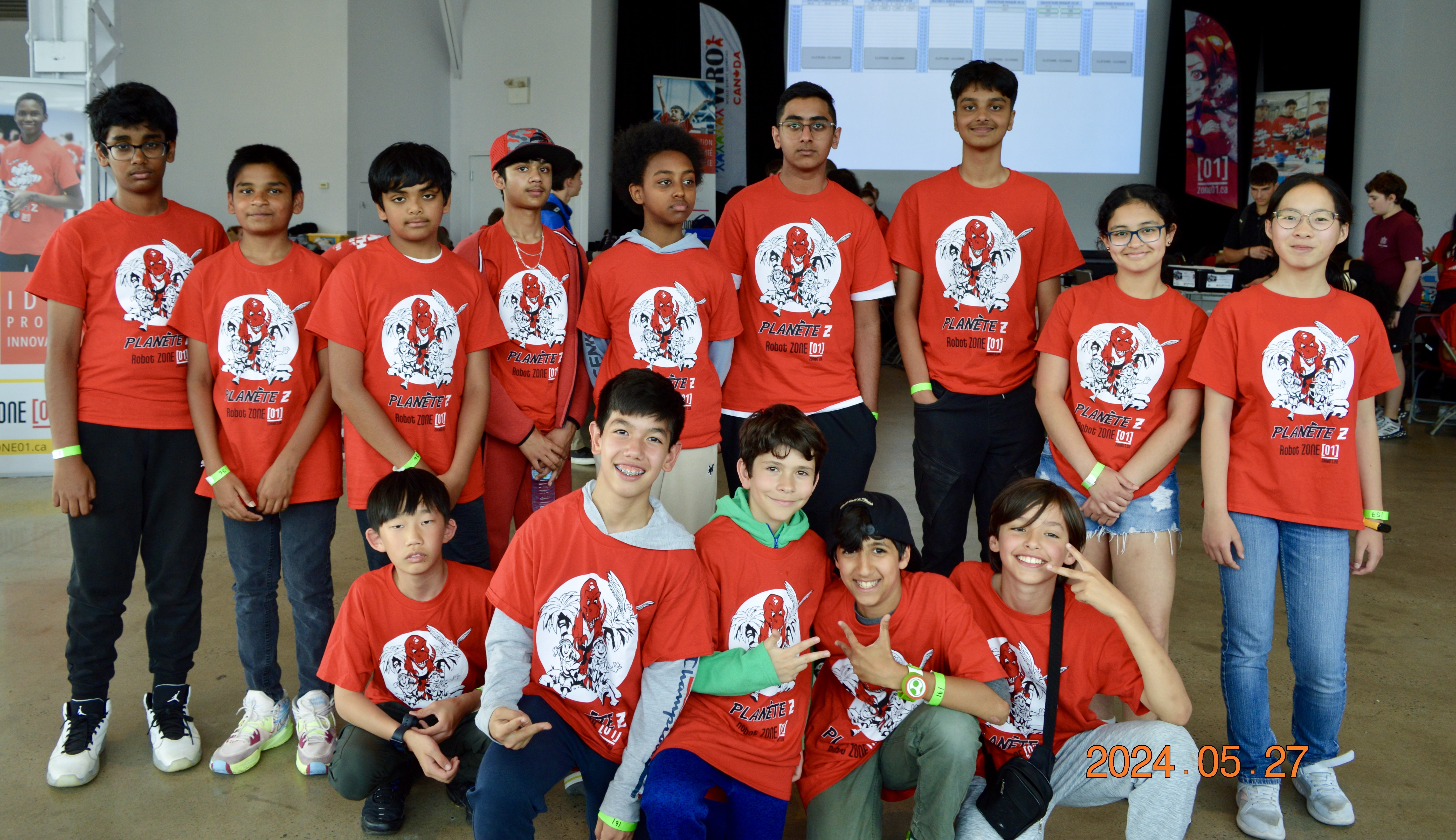
Zone01 Teams Posing in Montreal
Also this week, Zebra teams competed in Zone01 Regionals. This Canadian competition ends at the national level, and since Regionals at the Ontario Science Centre, the teams have been hard at work engineering and recoding their robots. Focusing on bringing their times down and preparing for surprise challenges, our teams were excited to perform. And perform they did!
Team 2πR earned first place in the Junior category! Having scored first in the regionals with 110 points, they wanted to maintain that positive trend in the Nationals, and they most certainly did.
Team Untitled earned second place in the Elementary category! This team has been particularly focused this season, and they worked to ensure that their efforts wouldn’t go to waste.
Team JMX Robots earned third place in the Junior category! This team put a ton of time and effort into their robot, and that dedication helped them secure their first ever Nationals award.
We are proud of the teams that competed. Competition takes courage, as months of learning and preparation is distilled into three tiny runs. Competition teams learn a lot about themselves and how to meet challenges with persistence and resolve. And that, to us, is the purpose of competition.
Zebra Robotics is working with Zed Jamaica and Mars Business Solutions to teach robotics and technology courses to students in Jamaica
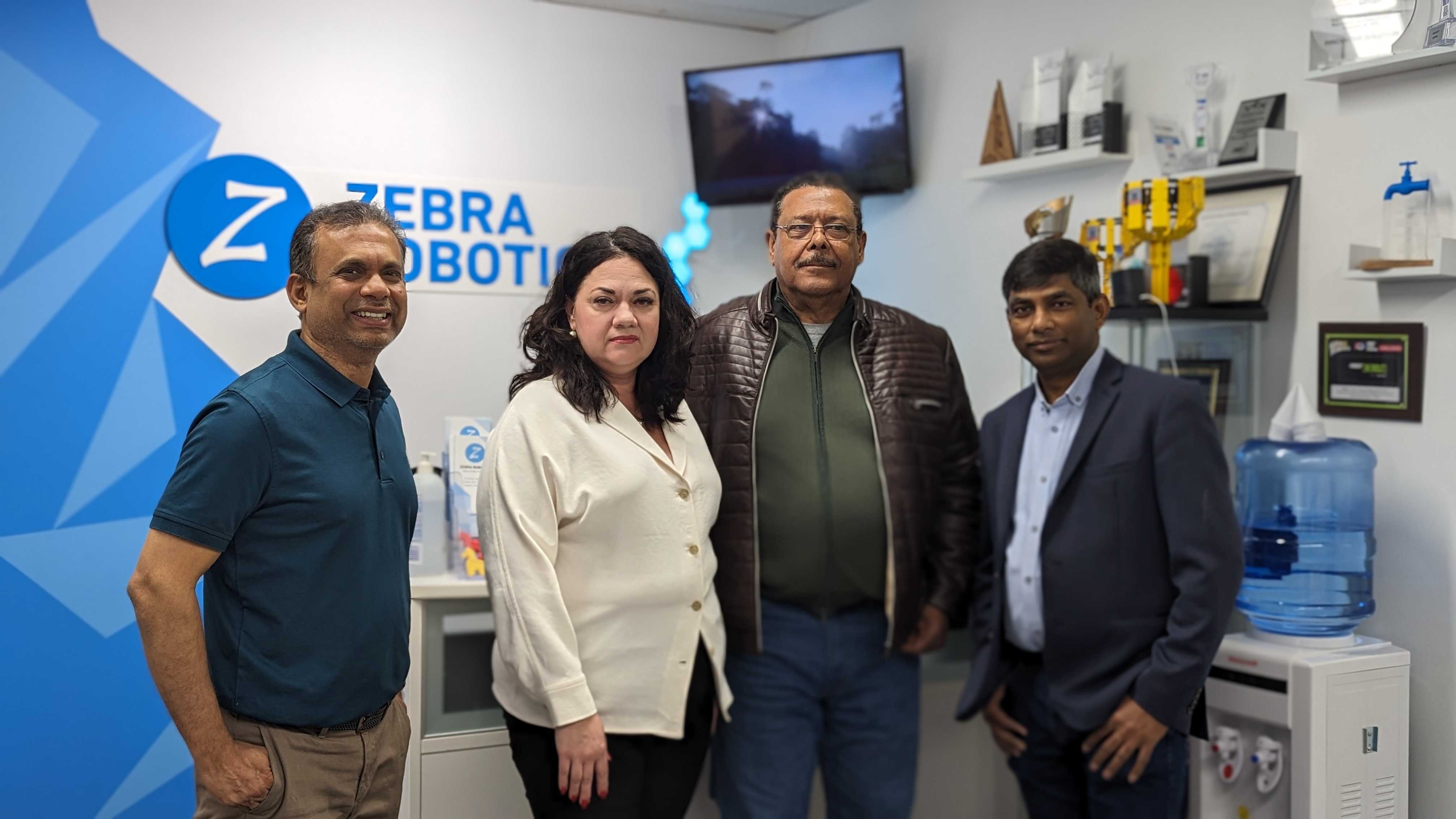
Zebra Co-Founder Satish Thiyagarajan with Mars Business Solutions
Zebra Robotics will be partnering with Zed Jamaica and Mars Business Solutions to bring robotics and technology education to youth in Jamaica this summer. The collaboration is the result of months of planning and brings Zebra’s innovative STEM curriculum to Jamaican students.
One of the key partners is Zed Jamaica, an organization that currently works with schools on the island to distribute resources and technological solutions. Mars Business Solutions is another partner based in Canada that is providing logistics support for the classrooms in Jamaica.
“We all have the same goal of taking education to kids and wanting them to learn and grow from there,” said Jayendra Balasubramanian, Co-Founder of Zebra Robotics. “We feel we have a really good curriculum and a proven model that has worked in Canada and the U.S.”
After training with Zebra coaches, the staff in Jamaica will work with a pilot group of students learning to build robots and code them with Python in addition to working on basic electronics, circuits, and CAD design.
We all have the same goal of taking education to kids and wanting them to learn and grow from there. We feel we have a really good curriculum and a proven model that has worked in Canada and the U.S.
Jayendra Balasubramanian, Co-Founder of Zebra Robotics
The pilot program runs for a month, with students attending 4 days a week during July. Each student receives a technology kit that they can bring home to show their families and extend their learning beyond the classroom.
A key part of the partnership is a robust training program to equip teachers in Jamaica with the skills to keep students engaged while also meeting them where they are. Not only will students in Jamaica gain access to important STEM skills, but also the local educational community will get a chance to develop its knowledge base.
Zebra is excited for the opportunity to bring a proven STEM curriculum and model for education to the international community beyond North America
Ontario offers many regional learning choice programs for elementary students heading into middle school. Finding a program that keeps your child engaged and empowered can help avoid some of the academic pitfalls of the transition from elementary to middle school. It may seem like a lot of pressure to apply for a special program when your child is in elementary school, but there is research that suggests that working with motivated peers in a challenging environment can keep students moving toward success.
It’s important to keep up student interest when transitioning to middle school.
Programs for students interested in STEM include the Middle Years Programme of the International Baccalaureate and the SciTech program. Students whose interest in STEM is entrepreneurial would thrive in the International Business and Technology (IBT) program.
The Middle Years Programme from the International Baccalaureate (IB) is the program designed for students from ages 11–16. It’s a 5-year program, but in most Ontario schools this program runs from grade 6–8, which is common for the curriculum. This program introduces students to a cohort of highly-motivated peers working on learning that is attached to real world applications, in addition to following Ontario’s standard curriculum. There are 8 subject areas for students to focus on, and they must spend at least 50 hours on instruction in each area. The areas include: language acquisition, language and literature, individuals & societies, sciences, mathematics, arts, physical & health education, and design. The IB Global Research department has studied the impact of their Middle Years Programme and found that IB students were “on-task” 87% of the time, compared to 73% of the time for general education students. That equates to 8.4 minutes more time on task per hour, and almost an hour for a whole day of school.
The sciences and mathematics programs will be most interesting for STEM students, but the middle grades are also a time to develop core competencies in a wide range of subject areas. Language, design, and social sciences (individuals & societies) are helpful to even the most die-hard STEM enthusiast. Communicating your ideas and seeing how they impact others is crucial for any field. Global contexts and critical thinking are all core components of the Middle Years Programme.
Being accepted to the IB Middle Years Programme does not guarantee acceptance into the IB Diploma Programme in secondary school. However, students who study in the Middle Years Programme will likely be better prepared for the Diploma Programme if they’re not ready to move on to something else.
For a more hands-on experience, students can choose a Sci Tech program. This program also follows Ontario curriculum standards but focuses on technological inquiry, including robotics, coding, 3D printing, and video editing/animation, where facilities allow. The program focuses on stewardship, competence, and insight as driving ideas for inquiry-based education. Where the standard curriculum would build one model or test one application, the sci tech program spends much more time on complex building projects and invests more time in hands-on activities. Students build and then re-design based on feedback so they can continuously improve their designs. Students in SciTech often compete in local competitions like the Beaver Computing Challenge at the University of Waterloo.
Just like the IB Middle Years Programme, being placed in the SciTech program in the middle years does not guarantee placement in secondary regional learning choice programs. Similarly, not getting into the elementary program does keep a student from being accepted into the secondary SciTech program. The two are independent of one another.
Students who like to innovate may thrive in the IBT program.
A program that combines technology with entrepreneurial skills is the International Business and Technology (IBT) program. Students are encouraged to have their own device to use daily for hands-on, collaborative learning with a business focus. In this program, technology is used to further business inquiry and facilitate risk-taking like public presentations and videos. There is less focus on the nuts and bolts of building and designing as there would be in the SciTech program, but if your child loves to design new plans or innovative responses to problems, the IBT program might be a good experience. Marketing, social media, and communication are big elements of this program as well.
Applications for Elementary programs are due at the end of January in the Peel Region, but check your local school for details. Information sessions are being held now. Here is a link from the Ministry of Education for finding your elementary school: https://www.app.edu.gov.on.ca/eng/sift/index.asp Admission is often based on marks and feedback from grade 4 and 5 teachers, among other factors.
For competitive programs, any student who meets the requirements for special elementary programs is put in a drawing for a place in the program. Your child could meet all the requirements and do well on the assessments but still not get a place in their chosen program. These are situations to remember that such programs are helpful and interesting but not deal breakers for your child’s future.
Since the elementary and secondary programs of choice are not linked, families might consider layering special programs to target the interests of their children. For example, an entrepreneurial STEM student might benefit from the IBT program in middle school and a more comprehensive Advanced Placement or IB program in secondary school.
Choosing a special elementary program is a balancing act between your student’s interests and inclinations and their emotional and social wellbeing. Your child’s happiness and motivation is the most important metric for making educational decisions in the middle years.
At Zebra Robotics, students can start learning about STEM as early as grade 1, with the basics of coding, robotics, and technology. Being involved in competition helps keep students invested in learning and can bridge the achievement gap between elementary and middle school. For more information, see www.zebrarobotics.com.
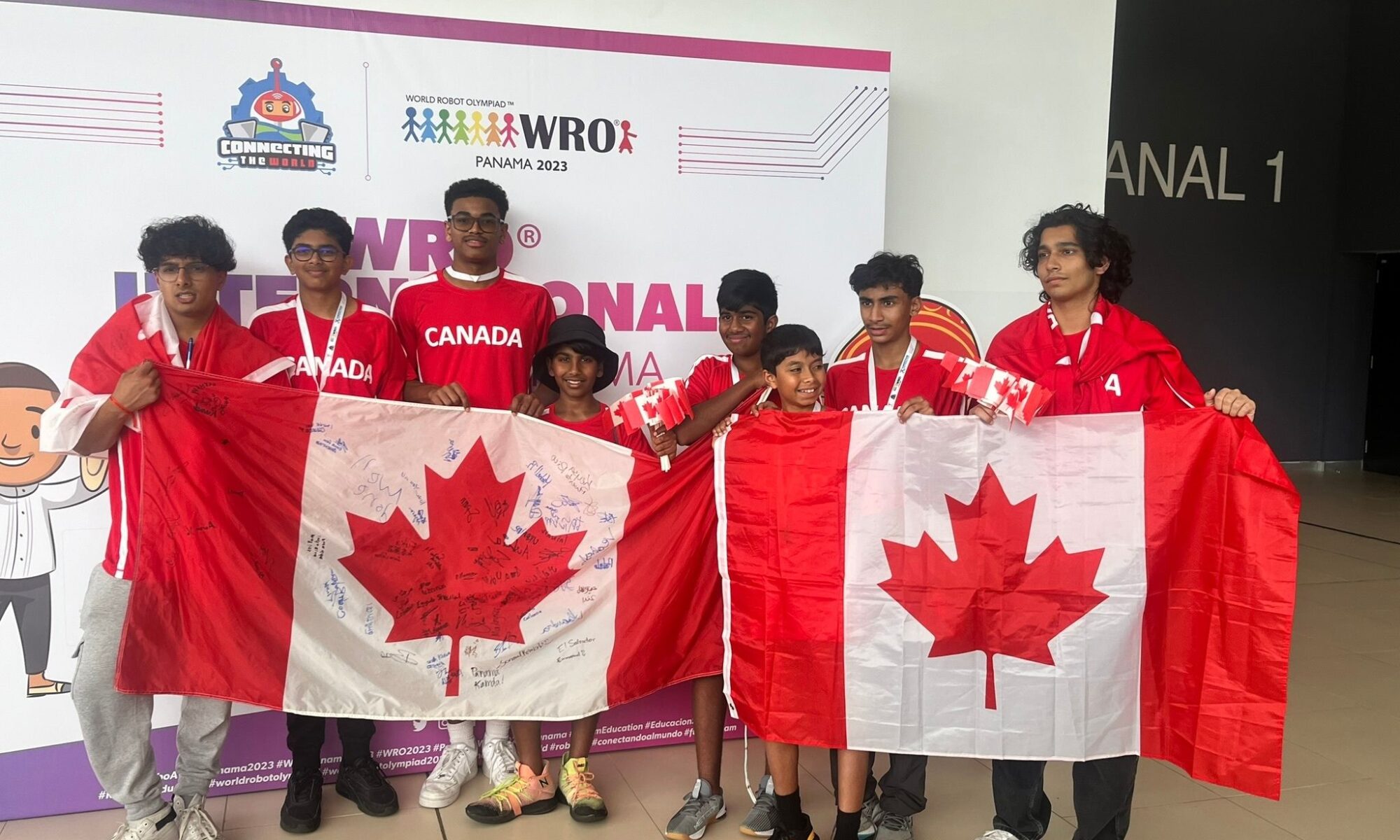
In 2023, Zebra Robotics brought three teams to Panama City, Panama for the World Robot Olympiad Internationals — and the results ranged from a historic, country-first podium finish to hard-fought lessons that set the stage for next season.
The Oceanic Pioneers — Dave Grewal and Shourya Seth — competed in the Future Innovators category with a project tackling a real-world maritime problem: a magnetic robot capable of climbing a ship’s hull vertically to clean it while docked, cutting cleaning time enough to save up to 30% in fuel costs. The idea resonated at every level. The team took first place at both Regionals and Nationals, then went on to win the Silver Medal at the World Finals — marking the first ever podium finish for Canada at a WRO International event. Zebra Robotics is proud to have been the team that brought that milestone home.
The Energizerz — Christian Dal Dosso, Madhes Kamal, and Tej Shah — took on RoboSports, one of WRO’s most physically demanding categories, where robots compete head-to-head in real time. The team finished first at Canada Nationals to punch their ticket to Internationals, where they advanced all the way to the quarterfinals — going up against teams stacked with university-level competitors. For a team built entirely of Grade 9 students, reaching that stage of the bracket was a remarkable result, and a sign of real things to come.
Miracle Monkeys — Vishnu Jeyakumar, Advik Bhagavatula, and Shlok Raval — competed in Robo Mission Junior, bringing real consistency to the competition. They opened strong on Day 1, finishing in the top 30, then came back on Day 2 to complete more than half the mission, closing out the event in the top 40% overall. For a young team, it was a result packed with lessons — and a clear sense of unfinished business heading into next season.
A historic podium finish, a deep playoff run against older competitors, and a strong learning experience — together, the three teams captured exactly what Zebra Robotics aims for at every WRO: ambitious ideas, real engineering, and the drive to keep improving.
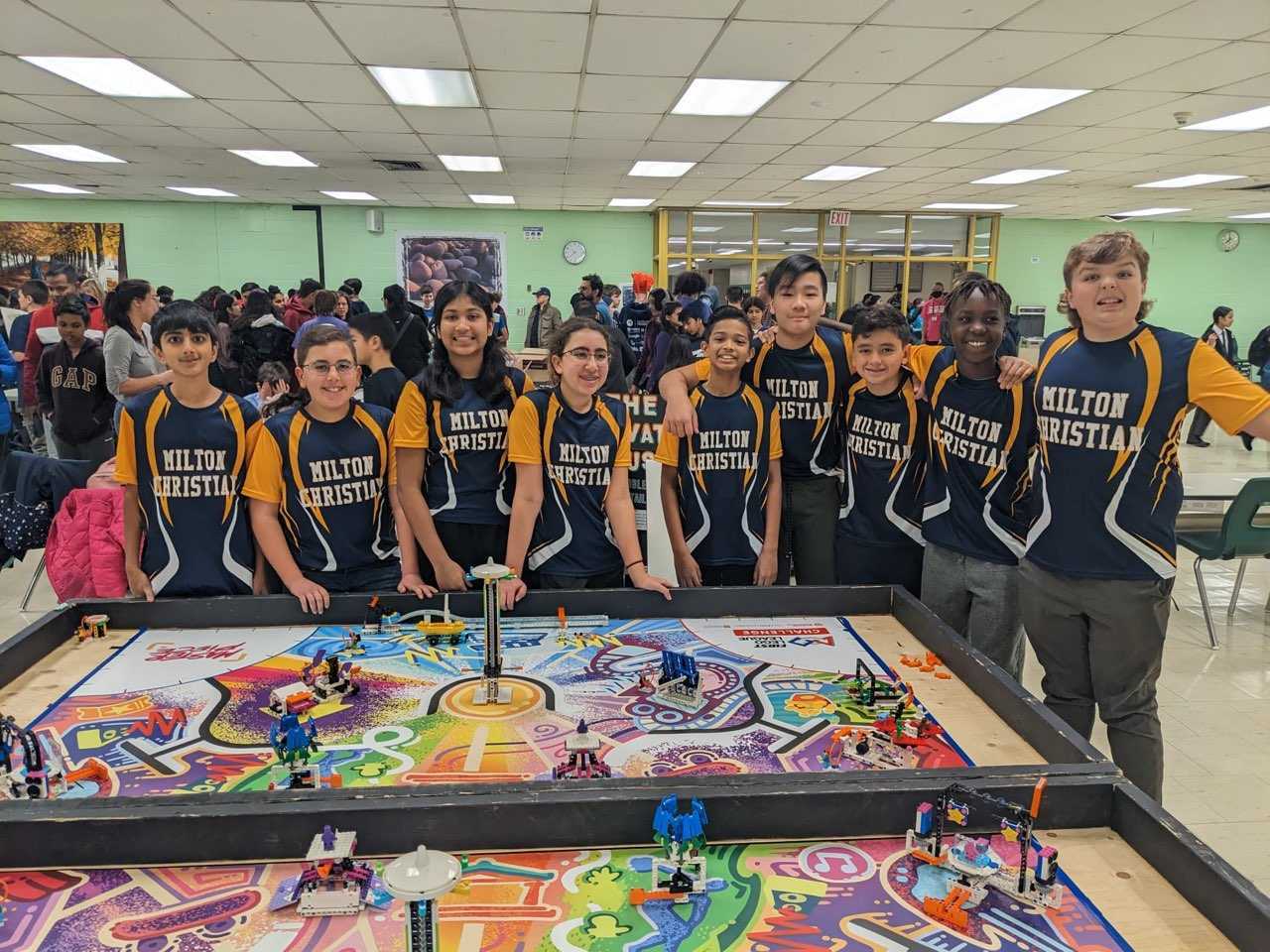
At Zebra Robotics, we are proud of all of our robotics teams, but we are especially delighted when a team first reaps the rewards of their collaboration and determination. Milton Christian School (MCS)’s Republic of MCS is just such a team.
Republic of MCS is advancing to provincial competition in First Lego League (FLL) after their first-ever win at regional competition on December 9, 2023. Provincials will be held at Durham College in Oshawa, ON on January 20, 2024.
Republic of MCS at Regionals
“I knew the students and coaches were working hard these past few months,” said MCS Principal Howie Martin. “It was nice to see their hard work pay off.”
Throughout their preparation, the team worked most on collective problem-solving skills. Teamwork is an essential element of doing well at FLL competitions, and Republic of MCS honed those skills over months of work.
“The chief strength of our FLL team lies in our collaborative and innovative approach to robotics challenges,” said Coach Tahmoor. “Since the MCS team has members from grades 6 to grade 8, each member brings a unique perspective and set of skills to the table.”
Initially, each grade had its own approach to solving the problem, but it was only after the team worked together and refined a solution that they could beat the competition and win the Robot Design Award for a robot that is “mechanically sound, durable, efficient and highly capable.”
“I definitely think that this win will have an incredible impact on STEM education at our school,” said Catherine Magat, MCS teacher and coach. “I also hope that we would see STEM education be a positive influence on the students, particularly in encouraging them to explore STEM fields.” Principal Martin agrees that he hopes more students will participate in robotics next year and beyond.
The team is proud of the win and eager to get to work for provincials. The wider MCS community is rallying behind the team as well. According to Magat, “The school has been so supportive of the team and are proud of what they have accomplished.”
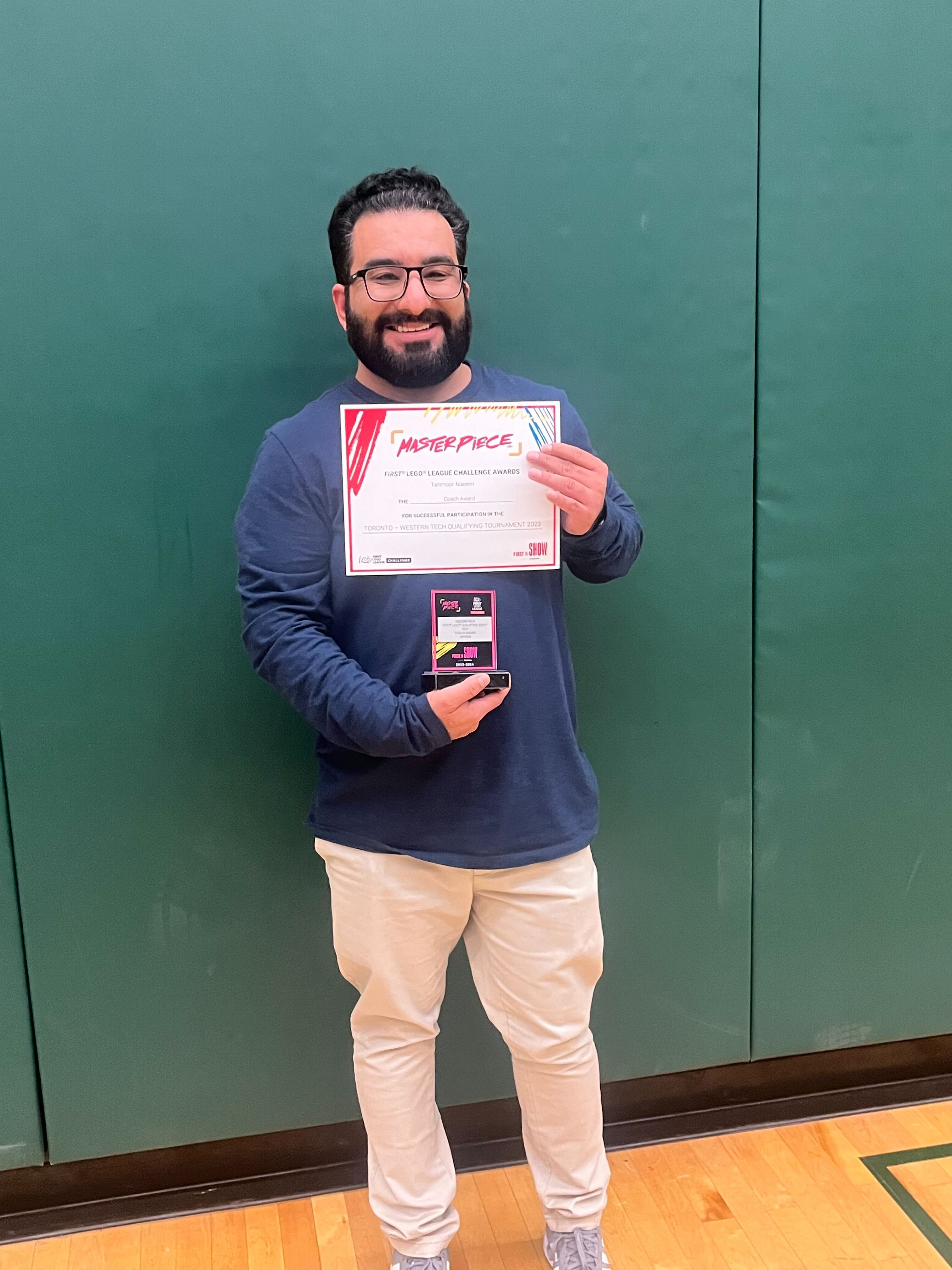
Coach Tahmoor wins the Coach/Mentor Award
Republic of MCS is now practicing the various challenges to perfect their robot and increase their score to hopefully do well enough at provincials to qualify for nationals.
In addition to advancing to provincials and winning the Robot Design Award, the team celebrates Coach Tahmoor, from Zebra Robotics, who won a Coach Award for his mentorship and leadership for the MCS team.
Zebra has been partnering with Milton Christian School (MCS) for three years, offering robotics curriculum in the school and coaching a robotics team. Zebra Robotics offers courses in its many locations throughout the GTA, in addition to partnering with specific schools. Zebra also sponsors the STRIPE Competition to help students test and develop their STEM and collaboration skills.
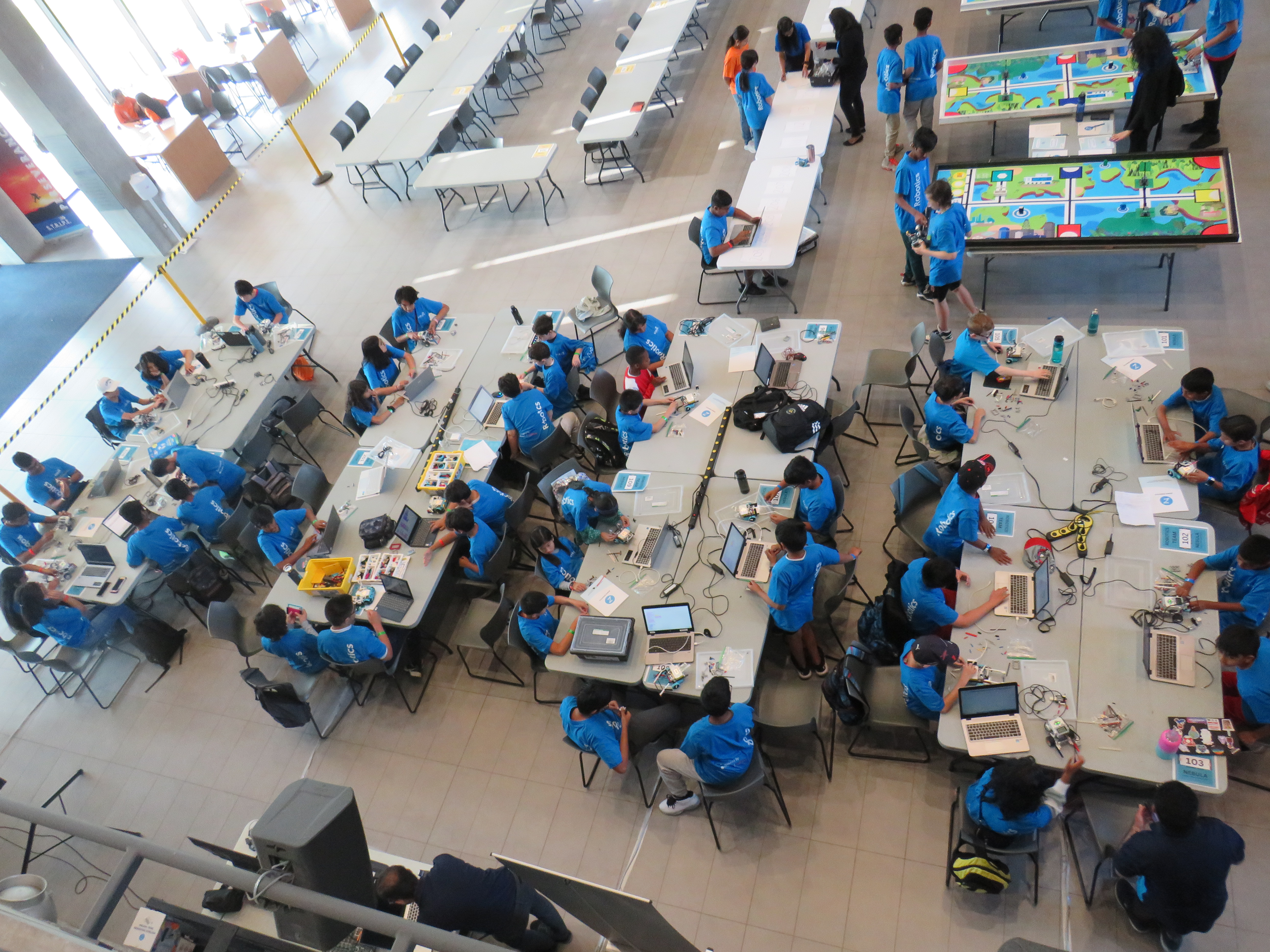
Months. It had been months of tweaking, tinkering, and labouring over their various robots in preparation for the World Robotic Olympiad (WRO) Internationals. The students would come in whenever they had the time to spare between school and clubs. They worked weeknights and weekends on their projects, readying themselves for the challenge ahead. But as November 7-9 approached, they finally felt ready to represent Canada on the world stage.
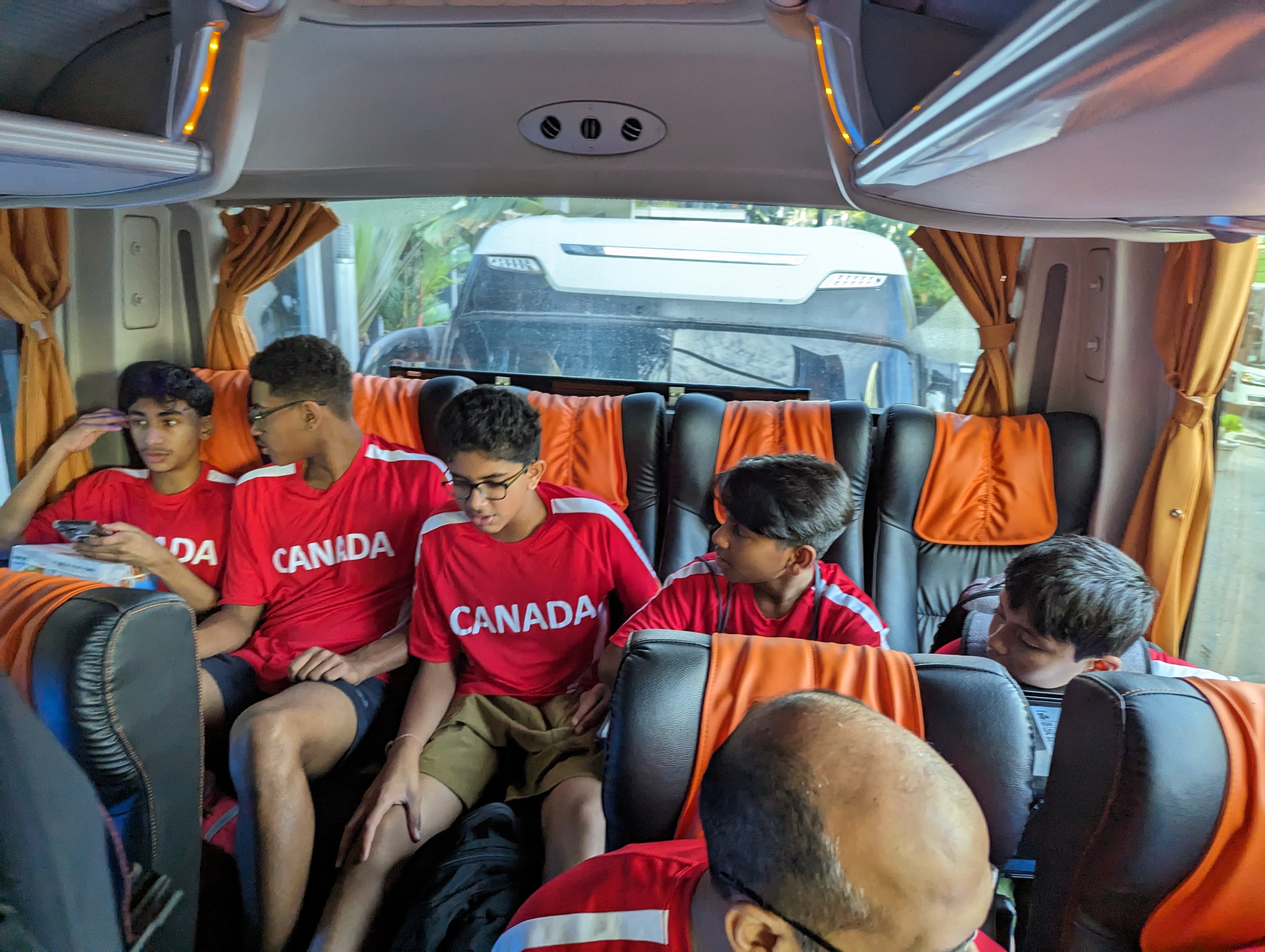
As the competition date approached, they traveled down by plane to Panama City, anticipating stiff competition. They pulled into their hotels and began tinkering and tweaking some more. Their families were behind them. Canada was behind them. Zebra Robotics was behind them. They were ready to perform.
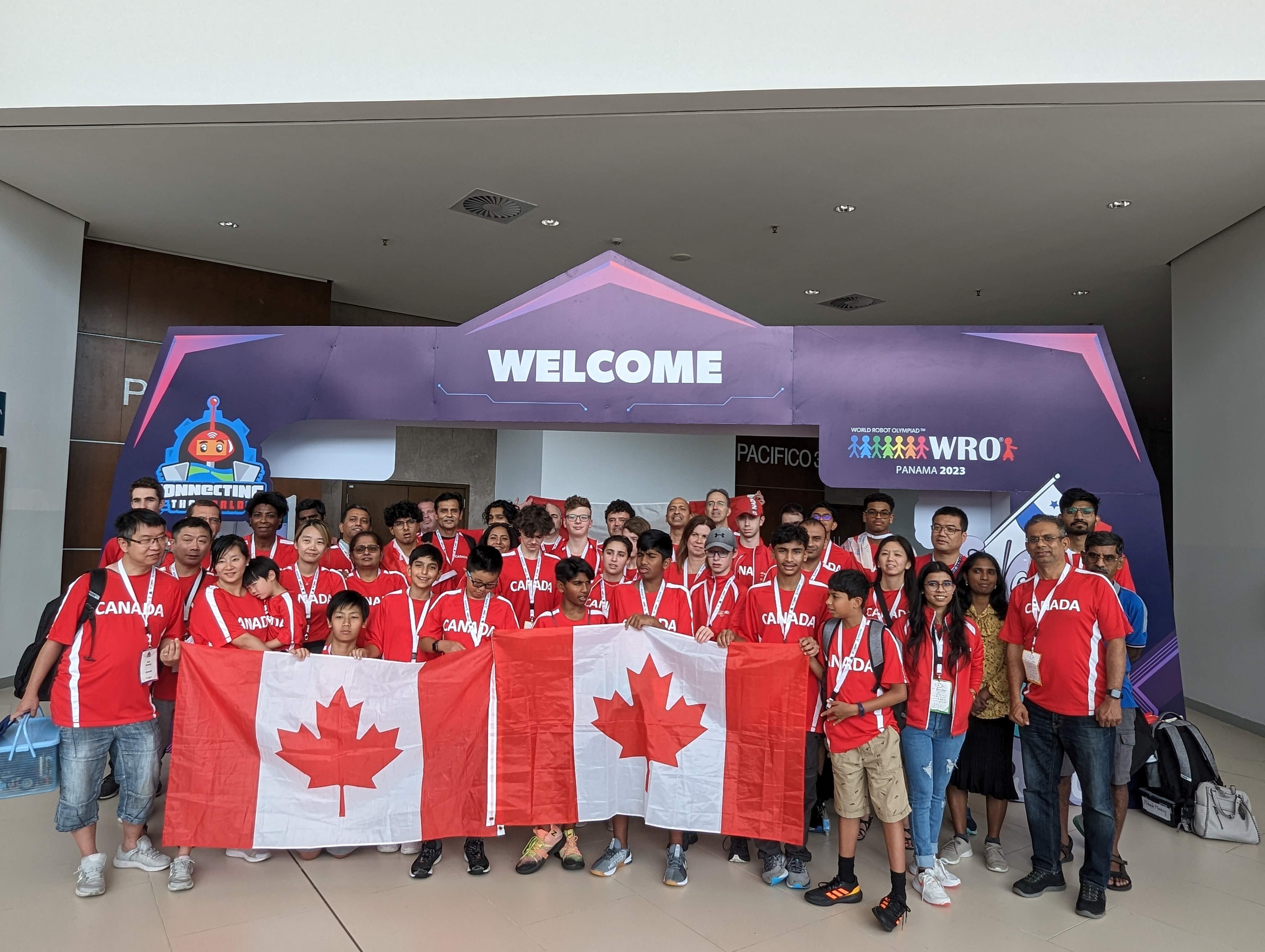
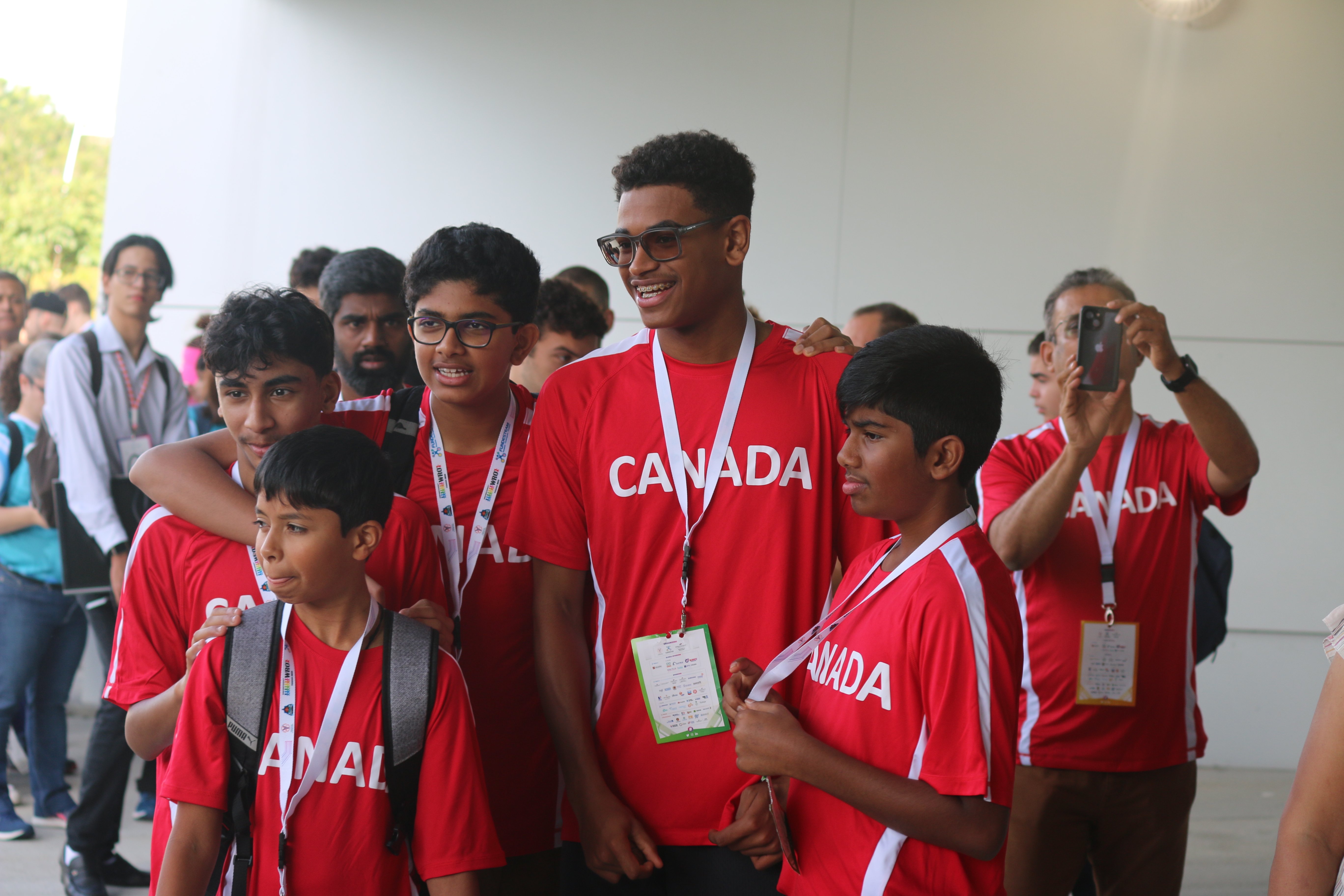
The RoboMission and RoboSports members travelling to the event.
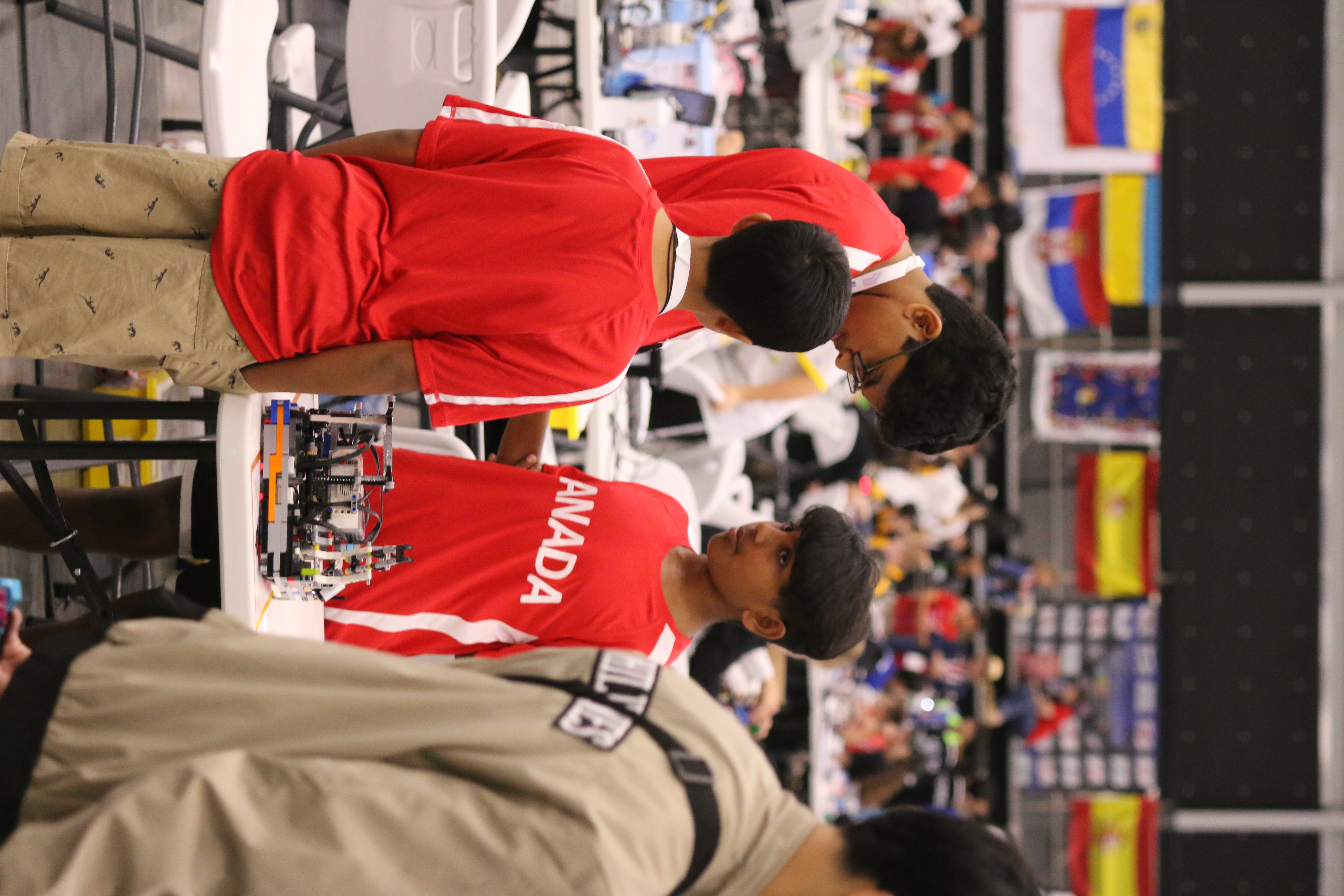
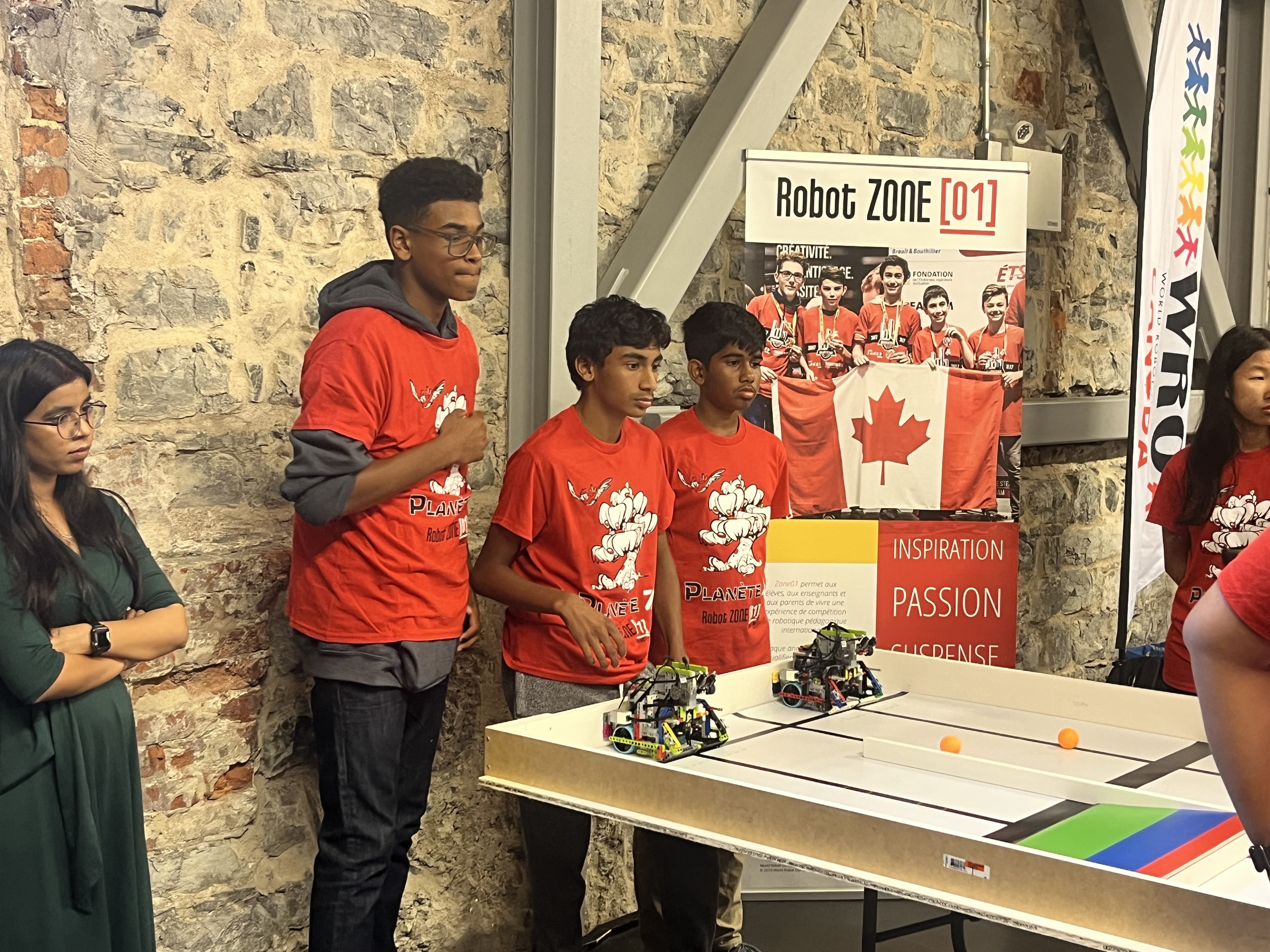
The WRO stage was electric. Teams from all over the world were primed, ready to show off the skills they’d worked so very hard on. The first up were the RoboMission competitors. This was our team’s first WRO International and they were grade 8 competitors in a sea of high schoolers. But the team wasn’t discouraged. They did some final tweaks, then set their robot to work on this year’s themed challenges. After a hard-fought battle, they were defeated. But our RoboMission team took it in stride and have learned from the experience. Nimbler designs, tighter programming, and an anticipatory mindset can be expected for next year, when they rise to the challenge again.
The RoboMission Team with their robot
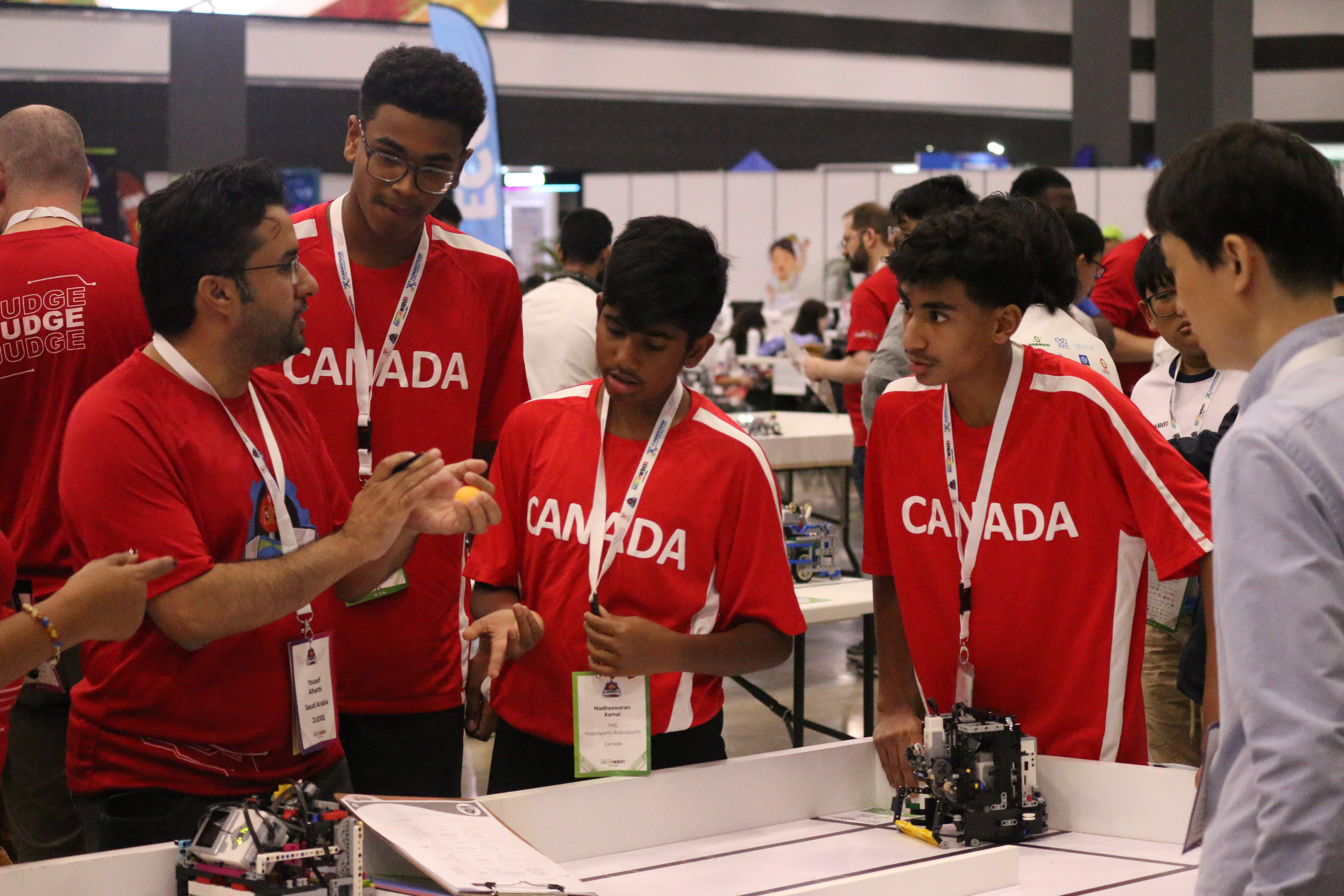
RoboSports were up next. Like the RoboMission team, they had never experienced a WRO International before. They too were also among the youngest in the category, going against university and college level students. With some final tweaks, they finely tuned their robot. The game? Table tennis. Throughout the first day, they were nigh unstoppable. They won match after match, carving out a 3-0 lead by the afternoon. But, as with RoboMission, experience tipped the scales more than expected. By day two, our RoboSports team fell behind, beaten back by more experienced teams. Placing 30th, they were proud to have made it that far. They felt that they had learned a lot from the experience and took notes on the losses they had so that they could come back next year, stronger than ever.
The RoboSports team talking to a judge
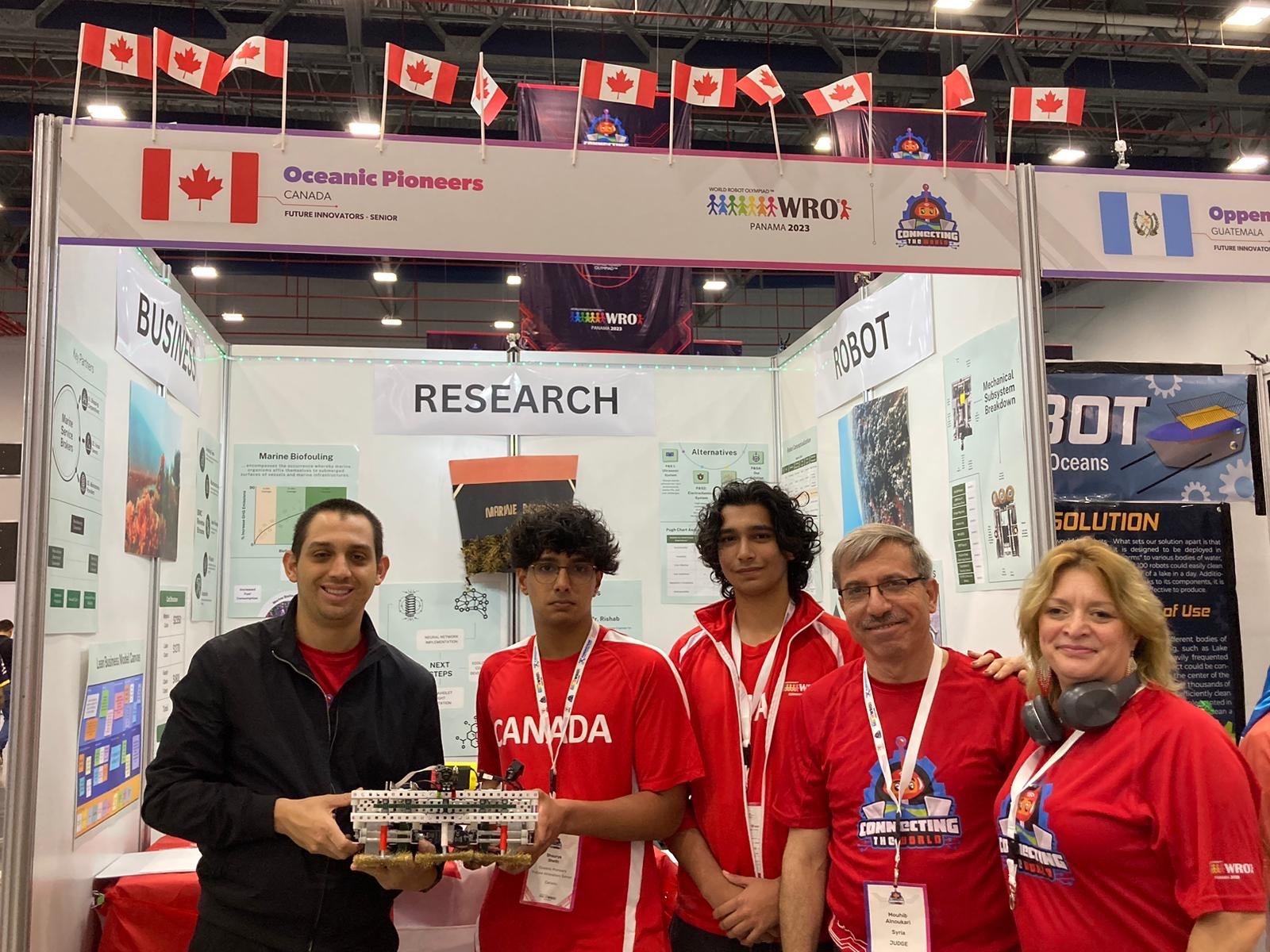
This just left our Future Innovators team of Dave Grewal and Shourya Sheth. If you’ve been keeping along with our blog, you know that they had designed a robot to help combat biofouling on cargo ships. The robot would scale the sides of the cargo ships, removing biomaterial. This, in turn, would help reduce the spread of invasive species and improve fuel efficiency on the vessel. The idea is incredible on its own, but the competition isn’t just judged on idea alone. The team also must effectively communicate the idea, present confidently, and push the benefits of their innovative project.
The team had practiced their pitch numerous times by this point. They even had hands-on experience presenting at an Oakville fair that Zebra attended, as well as at a celebration event for MPPs Nina Tangri and Deepak Anand. They were confident. They were ready.
As the competition kicked off, the judges milled about from project to project, assessing and critiquing. After a table was judged, other teams would flood the table, asking questions about the judges, what they were looking for, how hard their questions would be, etc. But our team was confident in their position and patiently waited at their table for judgement. When asked about the experience Dave noted, “Throughout the first day of the competition, I felt confident during three of the judging sessions…although there lingered a slight nervousness and intimidation from the impressive projects presented by others.”
The Future Innovators Team taking a photo with the Judges
The first pair of judges came and went. They were stoic, giving away nothing of their feelings about our Future Innovators’ idea. The only feedback came in the form of more judgement. Another pair of judges. Another set of hard questions. Scribbling on paper. A thank you. Moving on.
Day one finished, and our team was still in the running. They were ecstatic, proud of their ability to articulate themselves and their idea so thoroughly. As day two started, they put on their finest. Once more, judges passed through the booths, with tougher and tougher questions, testing the intricate knowledge of the teams. However, for the first part of the day, the judges steered clear of our competitors booths. Shourya said, “I was disappointed when we didn’t have callbacks because we felt our presentations went really well.”But as the day rolled on, eventually, the judges turned their sights on our competitors. Dave commented, “The unexpected turn of events heightened my confidence.” Steeled by their previous experiences, our team effortlessly answered any curveballs that came at them, demonstrating that they had thoroughly thought out their innovative design.
And then it was over. After 8 relentless rounds of judging, the day finished, and the winners would be decided after a long round of deliberation. They packed up their project and waited for several agonizing hours to see if their hard work prevailed.
And we are proud to say that it did.
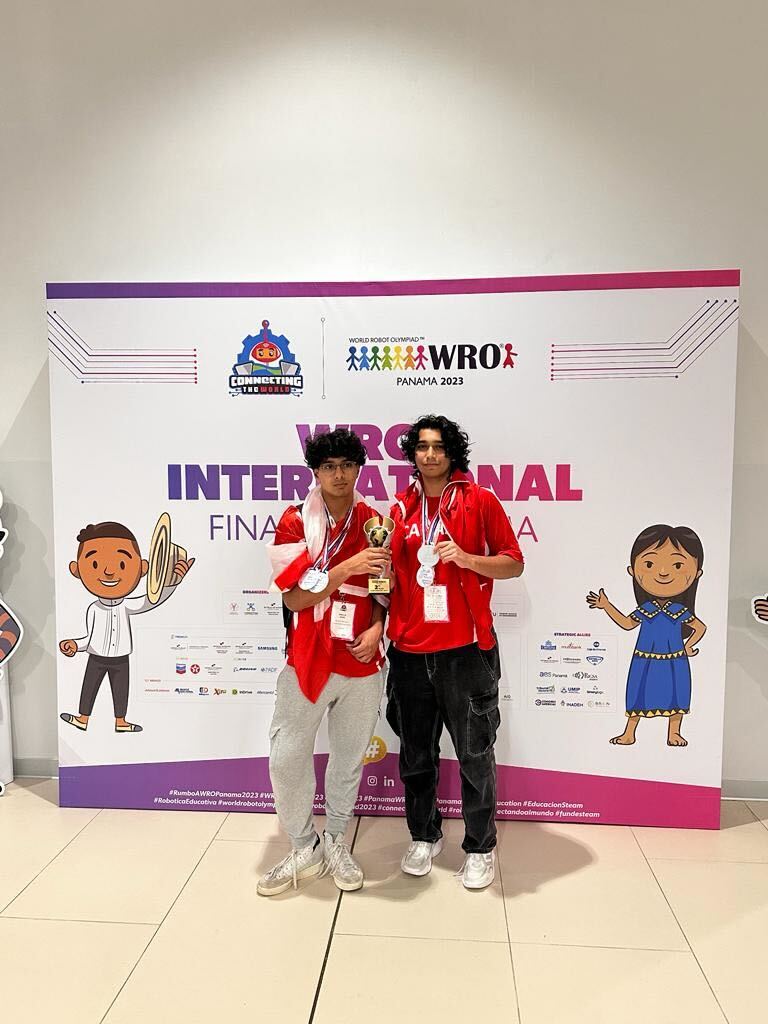
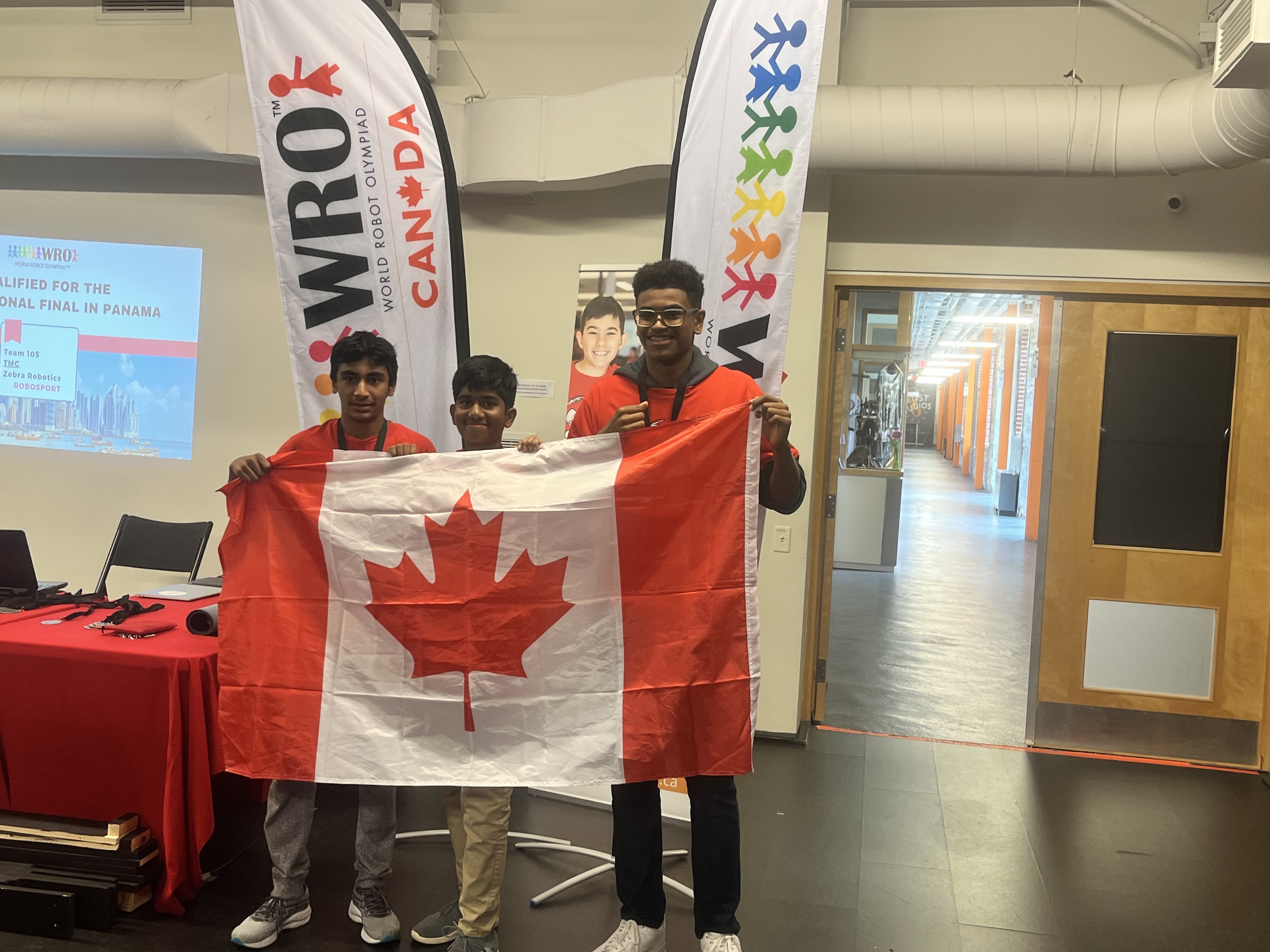
When the winners were announced, our team was honoured to hear that they placed Second in the Future Innovators—Senior category with their project on biofouling. History was made, as they stepped up to the podium to receive their award, as this is the first time Canada has ever made it into the top 3 since 2014, when Canada first joined WRO. Holding up the Canadian flag, Dave and Shourya stood proud of their accomplishments, excited to have written a paragraph in history.
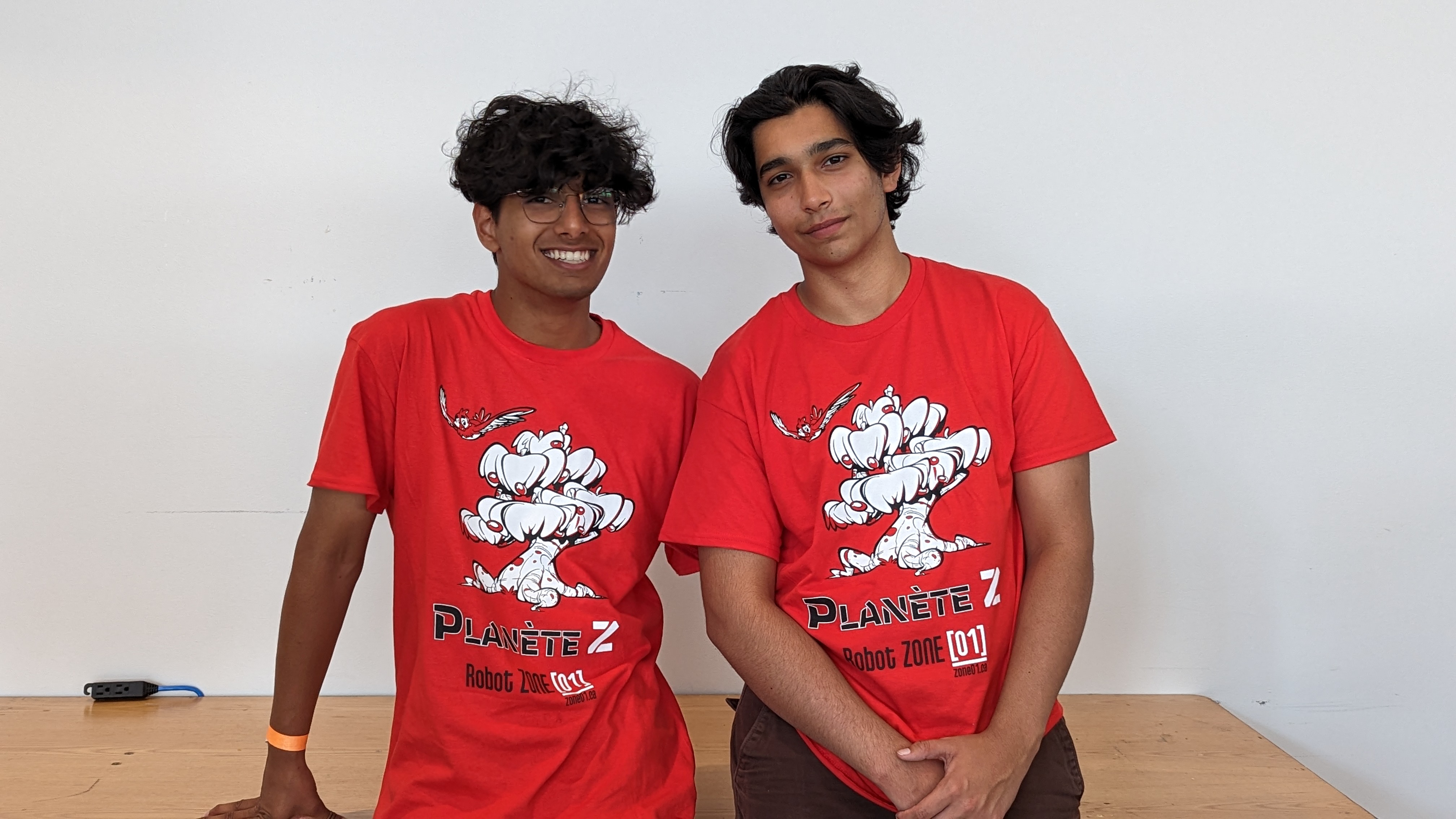
Dave and Shourya posing with their trophy
When asked how they felt about their win, Shourya said, “The most rewarding part of the competition was learning how to build more complicated and industrial robots aside from Lego, which could actually be used to benefit the world.” Dave commented, “The most rewarding aspect was establishing friendships and connections with participants from various countries. I gained valuable insights from diverse perspectives, including those of fellow competitors, investors, coaches, and representatives from other nations.”
If you get a chance, ask Shourya and David about their innovative project, as well as their experiences at WRO. They would be more than happy to share.
With the WRO Internationals over, we are proud to say that we successfully represented Canada on the world stage. Like our students, we learned a lot from the competition, and now know what we need to teach our students to better prepare them for future competitions. We will be ready for the next WRO competition, and we hope you will be there alongside us, cheering on the students once more. Thank you for reading!
Canada is consistently ranked in the top 5 countries for education, and it’s for good reason. We have targeted educational programs for a wide range of high school students in addition to a comprehensive governmental curriculum. Secondary school choices are particularly complex, especially for students interested in STEM fields where programs range from hands-on training to broader university-preparation programs. Many grade 8 students can feel overwhelmed by the decision, but it is important to work together to make a thoughtful choice because not all programs are offered in all schools, and there will be social and logistical challenges in addition to the academic ones. Remember that this is an exciting opportunity to find your child’s sweet spot for success.
Special secondary school programs range from comprehensive ones like Advanced Placement (AP) and International Baccalaureates (IB) to STEM-based technical ones. Students enter special high school programs starting in grade 9, so applications must be completed during grade 8. Check your local school districts for specific deadlines, but most informational sessions happen in the early fall, and applications are due in late fall or early winter. The Ontario Association of School Districts provides links to all Ontario school boards on their website: https://www.oasdi.ca/district-list/. All programs discussed here meet the regular, Ontario Ministry of Education curriculum.
The programs
Advanced Placement (AP) programs were developed in the United States in the mid-20th century, responding to a perceived lack of rigor at public schools after colleges and universities began accepting a wider range of students. In AP programs, students learn first-year university material, and if they earn a high enough score on a final exam, they can receive credit from universities.
Students in AP programs learn with other high-achieving students who experience the Ontario curriculum at a faster pace and in more depth before getting to university-level curriculum. Alumni of these programs report that they were well prepared for university courses. AP programs focus on core disciplines like math, English, French, science, etc., but some offer optional preparation for exams like Computer Science Principles. Students must take a minimum number of AP courses per year to remain in most programs.
When students apply for university, they can designate if a course was an AP course or not, though it’s unclear how this designation affects their chances for admission. It’s optional to take the final AP exams, and each costs $130 to take. The exams are graded with levels 1-5, with 5 being the most proficient. Final exam scores do not affect classroom marks. Students can choose to send their final AP exam scores to universities and colleges to which they are applying, just as they would with any entrance exams required in other countries.
For many competitive universities, AP exam scores are not a guarantee of credit and may only earn general credit instead of replacing course requirements. Since Ontario was one of the last provinces to offer AP programs, there are fewer universities in the province that take AP transfer credits. For example, scores on the AP Calculus exam are not awarded credit at the University of Toronto, while the University of Waterloo only accepts .5 credit if the student is not a math major.
International baccalaureate (IB) programs were conceived in Geneva in 1968 but launched in the United States in 1971. They are more comprehensive than AP programs, requiring competence in a wider range of subjects, more in line with liberal arts colleges. There is a deeper emphasis on writing, collaboration, and critical thinking. The writing focus of IB programs is especially good at preparing students for writing college entrance essays. Students complete a research paper and a community service project by the end of the program. The International Baccalaureate Organization monitors all schools who offer the program and reviews them every 5 years. Random student assignments are chosen for regrading at the international office every semester to make sure that teachers are grading in accordance with IB standards. Students do preparatory work in grades 9 and 10 and enter the Diploma Programme in grades 11 and 12. In a long-term study, secondary students who studied in an IB program reported that the program helped them prepare for college coursework, especially in terms of writing, critical thinking, study skills, and time management.
The IB does not specialize in STEM fields. Rather, the curriculum is focused on classic, liberal arts curriculum like literature, language, social sciences, sciences, math, and arts. The math curriculum, however, is rigorous. Computer science is an option for students to study within the science category of the curriculum, but the exams are written rather than demonstrating hands-on programming skills. There are two externally graded examinations in grade 11 and four in grade 12. International baccalaureate diplomas are recognized and esteemed around the world.
If a more applied program is what your child enjoys, there are lots of options. The Science and Technology (SciTech) program is a more hands-on, career-oriented program that features robotics and helps students hone their entrepreneurial skills. Students can participate in STEM competitions and even take certain AP exams if they desire. Graduates go on to universities like McMaster, but the program can also lead to the workplace. Guest speakers and special workshops, in addition to work with laser cutters and 3D printers, showcase the practical focus of the SciTech program.
The objective of the International Business and Technology (IBT) program is to prepare students for 21st Century “jobs that have not yet been created.” Students take six credits of IBT courses in grade 9 and 7 in grade 10, in addition to the standard Ontario curriculum. In grade 11 and 12, they focus on four courses in either business or technology, based on their earlier exploration. Technology courses include engineering, computer science, tech design, and robotics. Students can participate with VEX and First Robotics in addition to using 3D printers and a design lab, as available.
For an even more career-based option, there are the Specialist High Skills Major (SHSM) programs. These programs begin in grades 11 and 12, focusing on a very specific career option. Students take courses in their program of interest, much like they would in their major at college or university. The programs include sector-recognized certificates and training like hazardous materials use or CPR as well as cooperative education credit received for experience in a workplace related to the field of study. The program is designed for students going to university and going into the workplace after school. For example, students studying in the Information and Communications Technology SHSM may go on to be software engineers through university training, web designers and developers through college training, or computer network technicians after an apprenticeship. Not all SHSMs connect to the interests of students in STEM, so it’s important to do your research in the specific program. The most widely available and relevant program is the information and communications technology SHSM.
Enhanced learning programs are individualized instruction for gifted children, much like special education programs offer individualized instruction for children with special learning needs. Families must apply for these accommodations after having their child tested with the Canadian Cognitive Aptitude Test (CCAT) and using the Gifted Rating Scale (GFS) as required by the school’s In School Review Committee. At Tier 1, the student receives differentiated instruction and additional assessment in standard classrooms. At Tier 2, the student is eligible for the In-School Enhanced Learning Program. This offers support including independent learning and help with soft skills for planning, organizing, and thinking critically. At Tier 3, the student is identified as exceptionally gifted and qualifies for enhanced learning classes at the secondary school within their regional boundary. The tiers are meant to scale up or down the level of acceleration needed to keep the student challenged and engaged. Some schools have unique programs, depending on the needs and skills of the region. For example, Halton School District offers a special I-STEM program, which adds innovation on top of STEM focuses on science, technology, engineering, and mathematics. In this program, classroom learning is paired with mentorship and experience in workplaces and the community. In grade 9, students focus on design, shift to entrepreneurship in grade 10, and finally study innovation in grades 11 and 12. They end with a public presentation of work that solves a social, environmental, or economic issue in the world. Students receive an I-STEM certificate when they finish the program, along with valuable experiences that will recommend them for universities and colleges.
Challenges with applying
Special secondary programs that start in grade 9 have an application process. Again, check with your local school district (https://www.oasdi.ca/district-list/) Students must meet or exceed provincial standards for marks and learning skills in grade 7 and 8. Some write short essays or complete an application. In competitive districts like the Peel Region in GTA, the district then compiles a list of students who meet the program requirements based on the application and grades and then enters your child into a lottery for placement. Each successful application is randomly assigned a number by a computer, and enrollment offers are based on a lottery of those numbers. Remaining applicants who meet the requirements but did not get an offer are placed on a waitlist. When the deadline for accepting the first wave of offers is completed, new offers are given until the program is filled. Applying for multiple programs is fine, but as soon as a student accepts an offer, other applications to other programs are suspended. Thus, your child may be a successful applicant for multiple programs, may be on the waitlist for one, receive an offer on the other, and need to make some hard decisions.
African, Black, First Nations, Inuit, and Métis students do not participate in the lottery. If they meet program requirements, they are automatically accepted. Smaller private school boards often offer choices for ambitious secondary students in STEM without lotteries to determine placement. The applications can be fairly rigorous and often include essays and community/school involvement in addition to grades. There are usually application fees for special secondary programs, and there are costs associated with enrollment in the programs. IB and AP programs tend to have the highest fees, which also vary by district.
Finding the right program for your child depends on a lot of factors. As you and your child narrow the choices, it’s important to research the specifics of each program and what’s available in your region. Fall is when schools offer open houses and informational sessions on the different options.
The choice for your STEM child depends on overall academic motivation and goals. The more hands-on programs lend themselves to workplace and college goals while the AP and IB programs lend themselves to university goals. However, that is not a predetermination or a direct path. Students in more applied programs can certainly leverage those experiences to university applications. It is most important to choose a program that keeps your child engaged and invested in their education. Good marks and the ability to communicate knowledge and skills are the most important factors for success in post-secondary education, no matter which program they study.
At Zebra Robotics, our high school students come from different secondary programs, but they all have an interest in coding, robotics, or technology. No matter which program they study, supplemental, enhanced education like after-school and summer programs can help prepare students for university studies. In addition, competition in robotics and coding not only provides them with technical know-how but also prepares them to face the real world as they prepare for university and the workplace.
For more information on the GTA area, here are some resources to help you support your STEM secondary student:
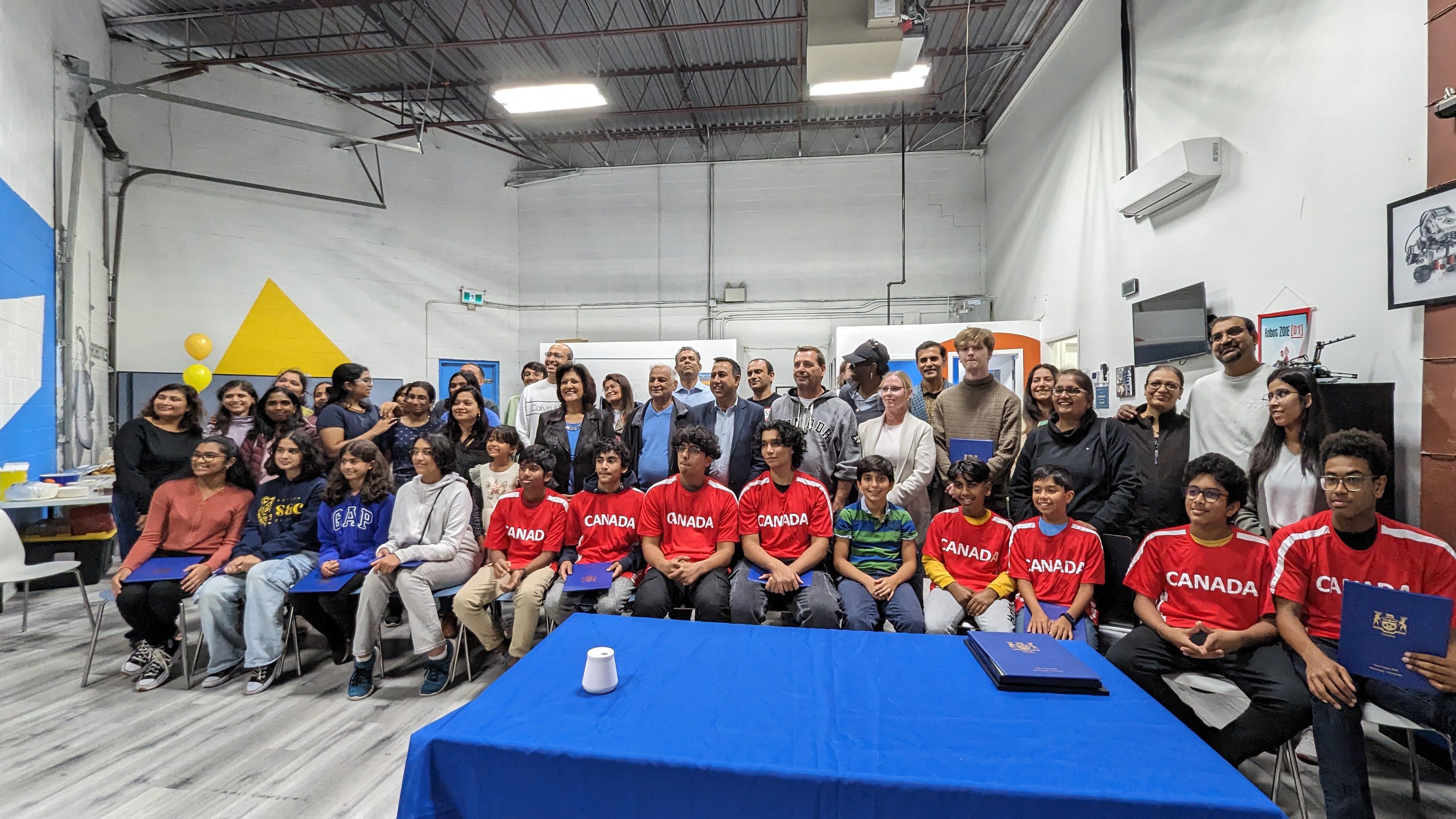
Just this past weekend, we had an incredibly important celebration for our national and international World Robotics Olympiad (WRO) competitors! Wanting to celebrate their achievements we had been hard at work setting up a small event for the kids this Saturday, with demonstrations, speeches, and of course, food. But behind the scenes, Jami had been toiling away on another secret project. Equipped with a silver tongue, she managed to invite and convince some of our local MPP’s to come down and show their support for our hard-working students as well! MPP’s Nina Tangri and Deepak Anand were more than delighted to make an appearance, and honour the competitors, even bringing special awards recognizing their triumphs.
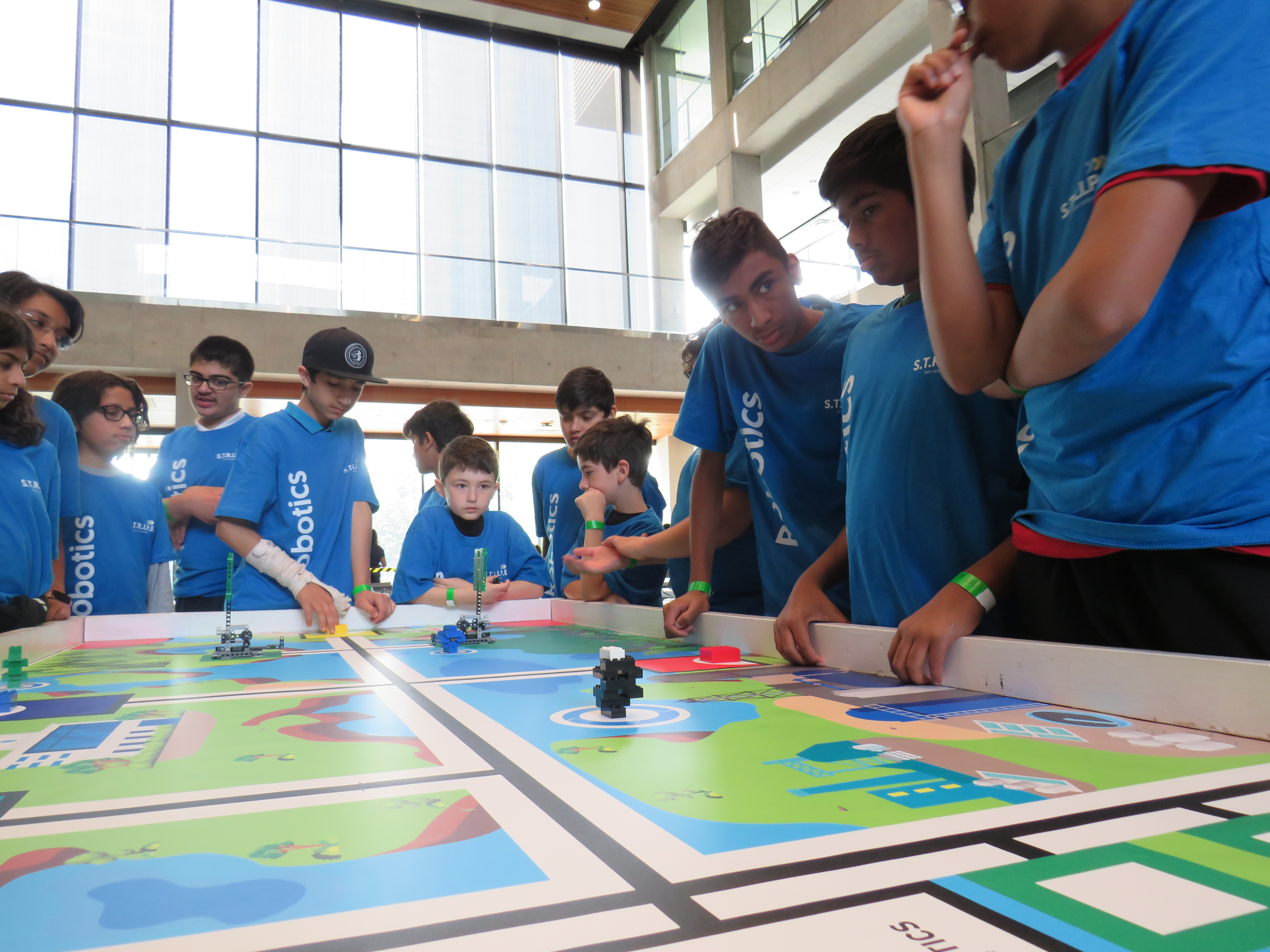
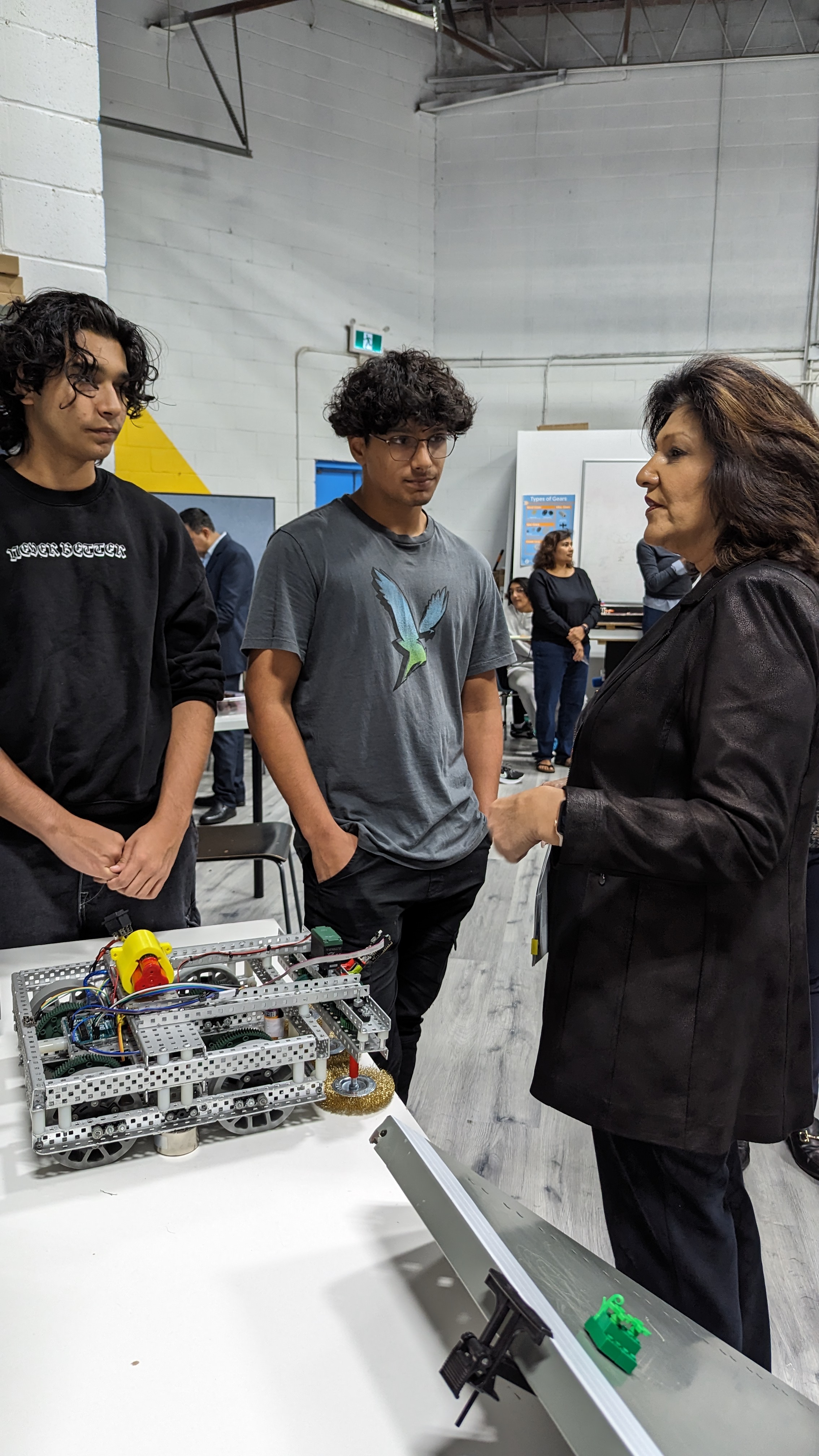
Parents were the first to arrive, catching up with one another, as well as sharing their experiences of the national finals. The kids mingled among each other, either grabbing food, or checking up on their robots, fine tuning them before the MPPs arrivals. Not too long after, the ministers rolled in, and the teams were ready to show off all their hard work. The Future Innovators delivered their well-crafted presentation and demonstration of their robot to combat biofouling. The RoboMission team showed off their robots’ agility and precision by picking up, carrying, and carefully placing rings. In a new twist on RoboSports, the autonomous robots played against the MPPs who tossed the balls back as if they were a robot team.
The Future Innovators Team show off their robot to combat biofouling. MPP Nina Tangri asks questions about the project.
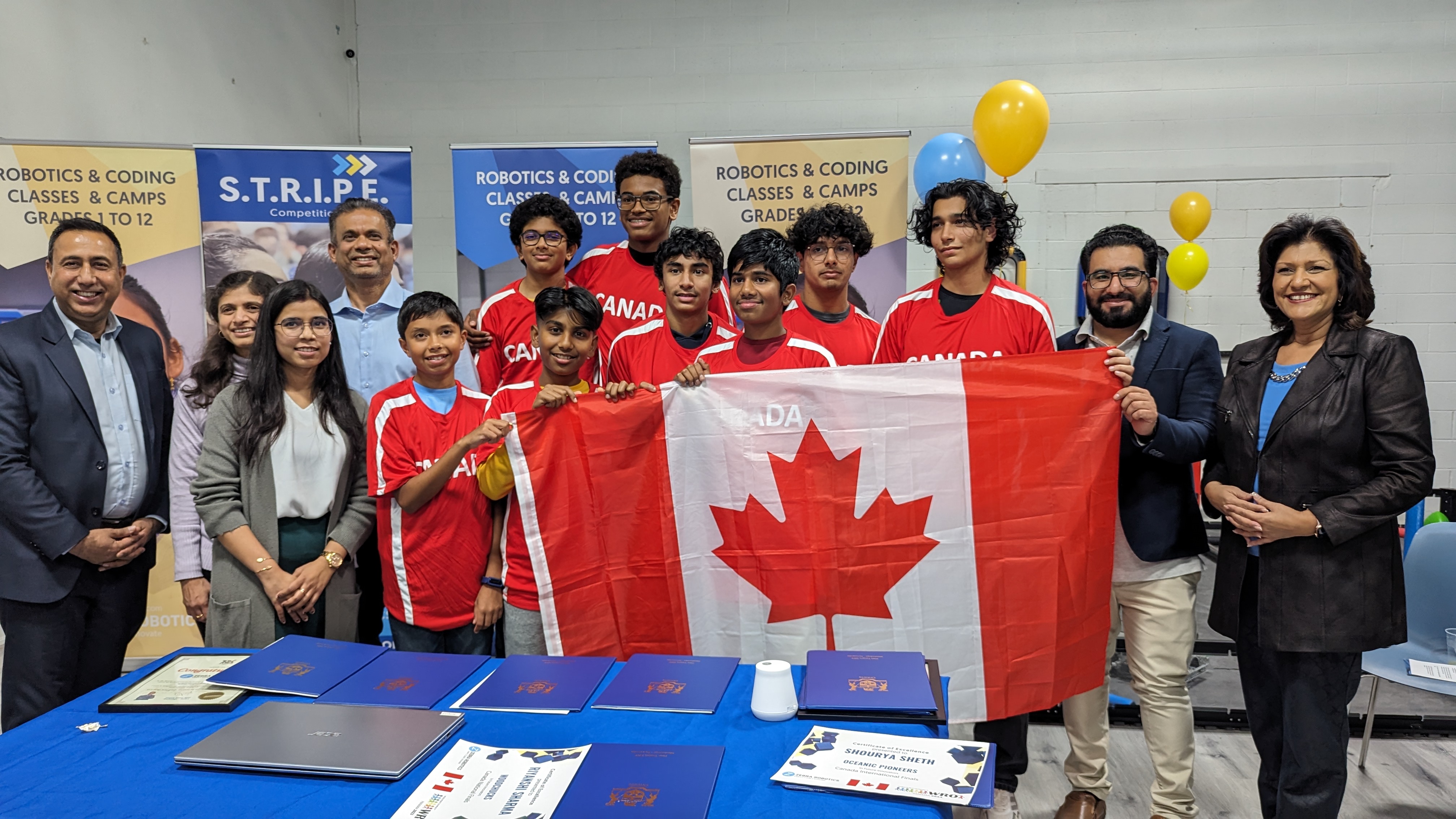
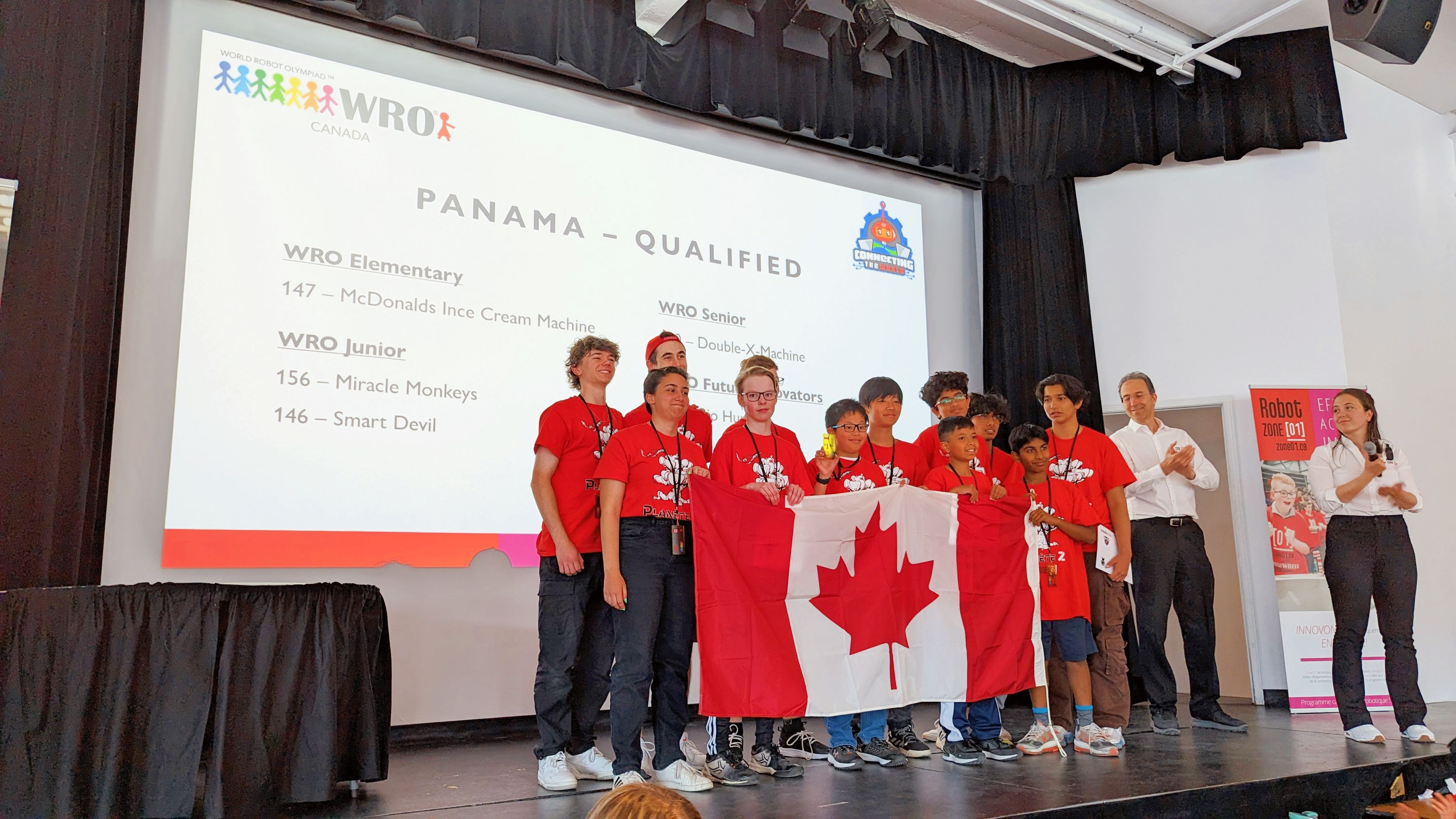
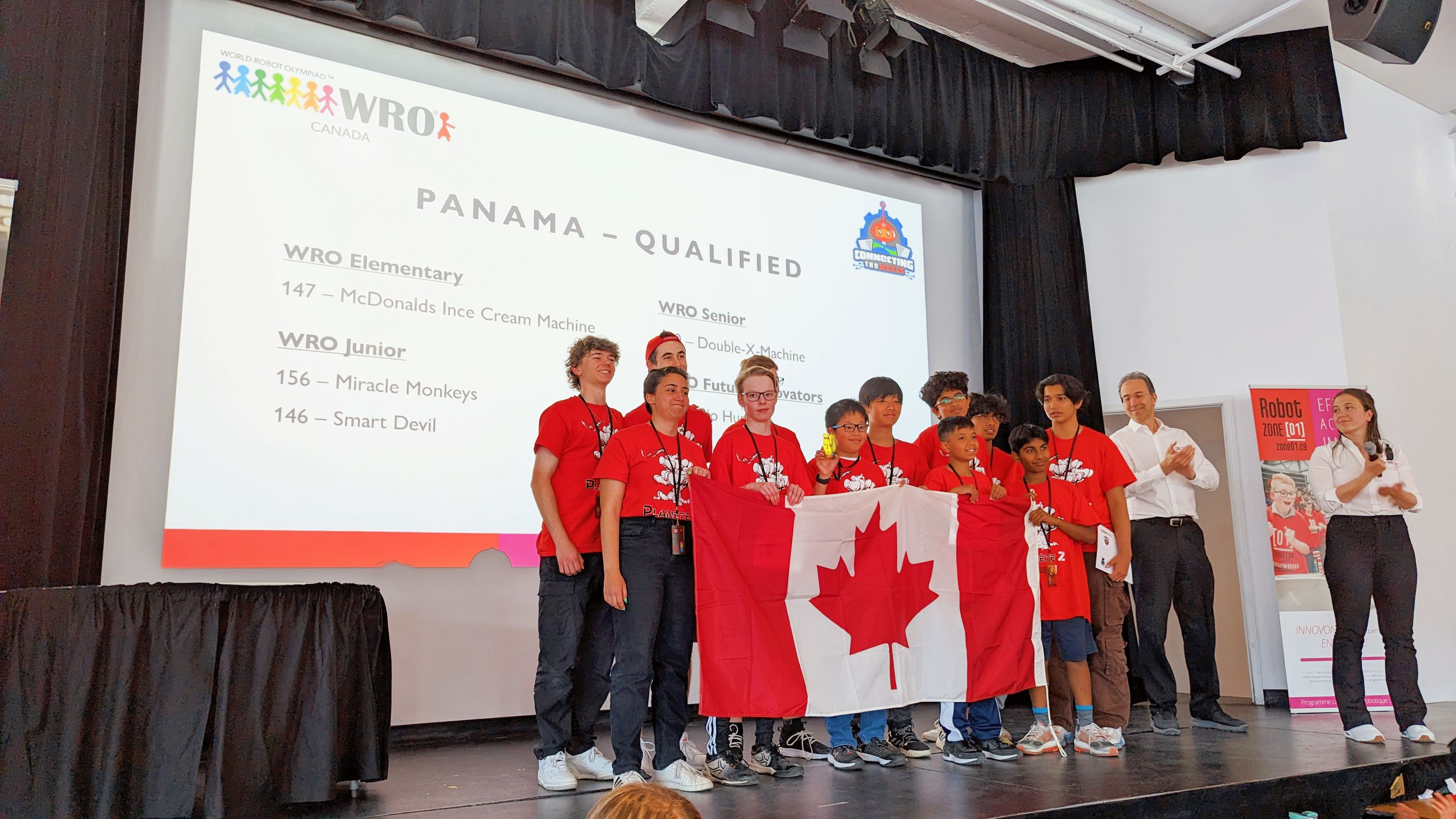
After the festivities, speeches were held by founder Satish, alongside the wonderful MPP’s. They congratulated the students and encouraged them to keep reaching for the stars, as who else but the next generation would be able to grasp them. Then each team was awarded a special certificate, recognition from the Government of Ontario for their accomplishments. Parents and coaches alike burst into applause as the teams received their awards, handed to them by both Nina Tangri and Deepak Anand. Finally, the teams going to Panama were presented with the Canada jerseys they will wear throughout the WRO competition, and they had a chance to pose with the Canadian flag.
The teams going to WRO Internationals pose with the coaches and MPPs Nina Tangri and Deepak Anand.
As the event came to a close, students went back to their parents, receiving smiles, hugs, and words of affirmation. It was a brilliant sendoff for our international competitors and a proud recognition of our national competitors after all their hard work.
Stay posted to our blog and social media for updates on the international teams as they travel to Panama in two weeks’ time. As we cheer on the international competitors, we are already gearing up for the FLL season and starting a new season of STRIPE Competition. Stay tuned for updates on both of those as well! Thank you for reading!
If you’ve been keeping up with our blog you might remember us previously mentioning that we were going to Panama for the World Robotic Olympiad (WRO) International. Two teams earned their spot through ingenious concepts, and hard work. If you haven’t read up on it, you can do so [here]. However, good things always come in 3s!
Just last weekend, in Kingston, Ontario, more of our teams battled for a spot in the WRO Internationals. The competition was not only fierce, but it was close. Two of our teams came close to victory that day with incredible performances that had people cheering. The first of the teams performed incredibly well, their robot avoiding obstacles and navigating on its own absurdly well. However, its competition was just as skillful, and both teams were neck and neck on the leaderboards. As a result, judges needed more time to review the performance of each robot and to double-check the tally of points to see who would come out on top. In the end, the judges gave their verdict, and our team came in second. A mere minor bump against an obstacle cost our team 2 points, and it was enough to drop us down to second place.
Team v^3, Future Engineers
While they won’t be going onto the WRO competition, they still came second overall, and performed exceptionally well at the event. They are proud of their hard work, as they put up such an impressive fight in the robotic ring. We too are proud of them and are eager to see their hard work pay off again next year. But they weren’t the only ones who were gunning for Panama.
Our other team also had a shot at the internationals, and they fought hard to try and get there. After performing very well in previous events, it came down to a tennis match to see who would go down to Panama in November. Their rival was another competent team, and had performed well so far, and so our team steeled itself for a hard fight.
The team preparing their bots for the tennis match
The first match was tight, with the tennis balls being slung back and forth at rapid pace. It looked like we would take the lead, but the other teams robots ensured that just wouldn’t happen. Slowly, but surely, they took the advantage and closed out the match in the lead. We had lost. But thankfully, that was only the first of 3 matches.
The second match began shortly after the first, and we were looking to avenge our previous loss. The balls went back and forth between the courts, but we gained the lead relatively quickly all things considered. The opposing team didn’t give up easily however, and we had to work to keep our advantage. But as the timer rang out, we firmly cemented our win, evening the scores between us and them.
It all came down to that 3rd and final match. Electricity was in the air as it began, both teams knowing what was on the line. The match was close. Everyone kept their eyes on the table, holding their breath and clenching their fists. As the balls flung, people started to lose count as to who was in the lead. We could have been leading. We could have been losing. But then, tragedy struck. As our robots flung the tennis balls, we noticed not as many were returning. One of the rival teams’ robots had gotten stuck. Squished between the wall, it lay motionless, unable, or unwilling, to fight any longer. As the buzzer rang out, we exploded in joyous celebration. We had won, securing our place in the internationals.
Ready to represent Canada in Panama!
Now, our teams gear and tool their robots to be ready for the big event. This November we will fight again, this time for Canada, as we once more try to secure first place in the WRO competitions. They will be flying out to Panama City in November, battling it out on the world stage between the 7th and the 9th. While tickets are unavailable, we will keep you informed on how the competition goes. We will see you again then!
Last month, Sunday June 4th, marked the WRO National Finals in which eleven Zebra Robotics teams fiercely competed using the knowledge and skills they acquired over the curriculum. This time and effort they put into learning and innovating paid off, as the teams collected six awards, including three first place positions, one second place position, and two third place positions. Of these award winners, two of the three first place positions are going to be representing Canada on the world stage, competing in the WRO International Finals in Panama against eighty plus countries!
But you might be wondering, what were the achievements that brought these Zebra students to the international stage?
The first team, who came in first place, was a high school team that focused on the issue of long-haul ocean freight ships. These massive cargo ships drive our supply industry, with many carrying 24,000 Twenty Foot Equivalent Units (TEU) worth of supplies across our vast oceans. They, however, face a major issue. As these ships have a decently long lifespan, many of them acquire lots of biomaterial on the underside of their hulls, things like algae, barnacles, tubeworms and more. This causes a whole host of issues and is referred to as biofouling in the industry. It is a problem that has plagued humanity since the dawn of sailing, but our bright minds came up with a solution.
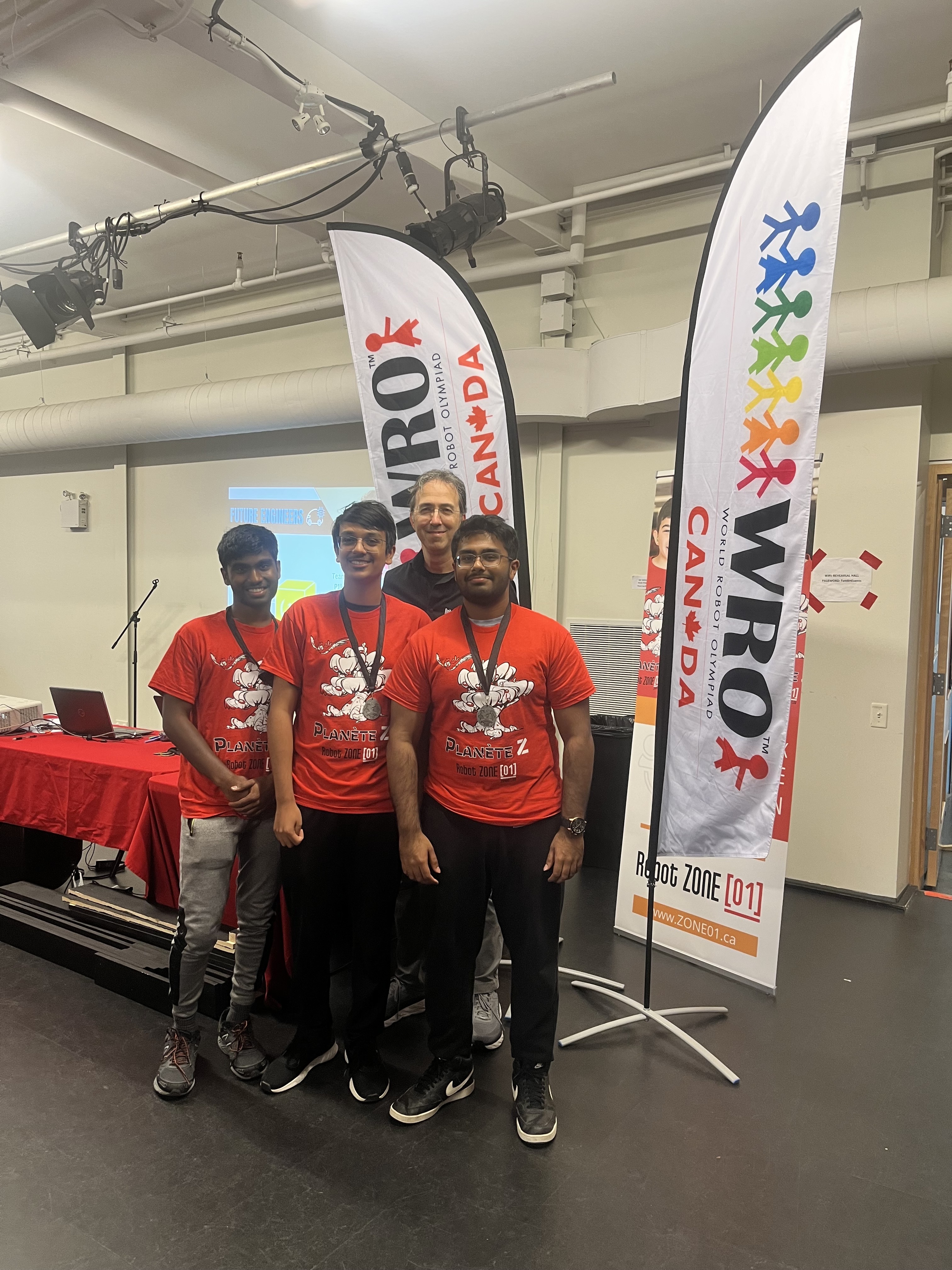
The first place highschooler team posing for a photo op.
The high school team designed a robot that can climb onto the underside of the container ships while they are docked, and work to remove the biomaterial on the underside of the ships while they are being loaded. During the demonstration of the robot, the students showed how it could climb the hulls of these ships, at one point having their robot climbing an almost vertical surface. The judges were clearly impressed by their design work, as well as the impact that this type of robot could have. If the technology moves forward, it will help to solve biofouling, which can help make cargo ships 20% more fuel efficient, help curb invasive species spread, and help lower maintenance costs, among many other benefits.
But they aren’t the only innovators on the world stage. Also in first place, is a group of middle schoolers, all grade seven. They designed and built a robot to compete in the Robot Mission category. Through their hard work and dedication during their time at Zebra Robotics, they managed to design a robot with an edge over the competition in this head-to-head robot matchup, earning them a spot in the WRO International Finals. There in Panama, they will compete once more in the Robot Mission category.
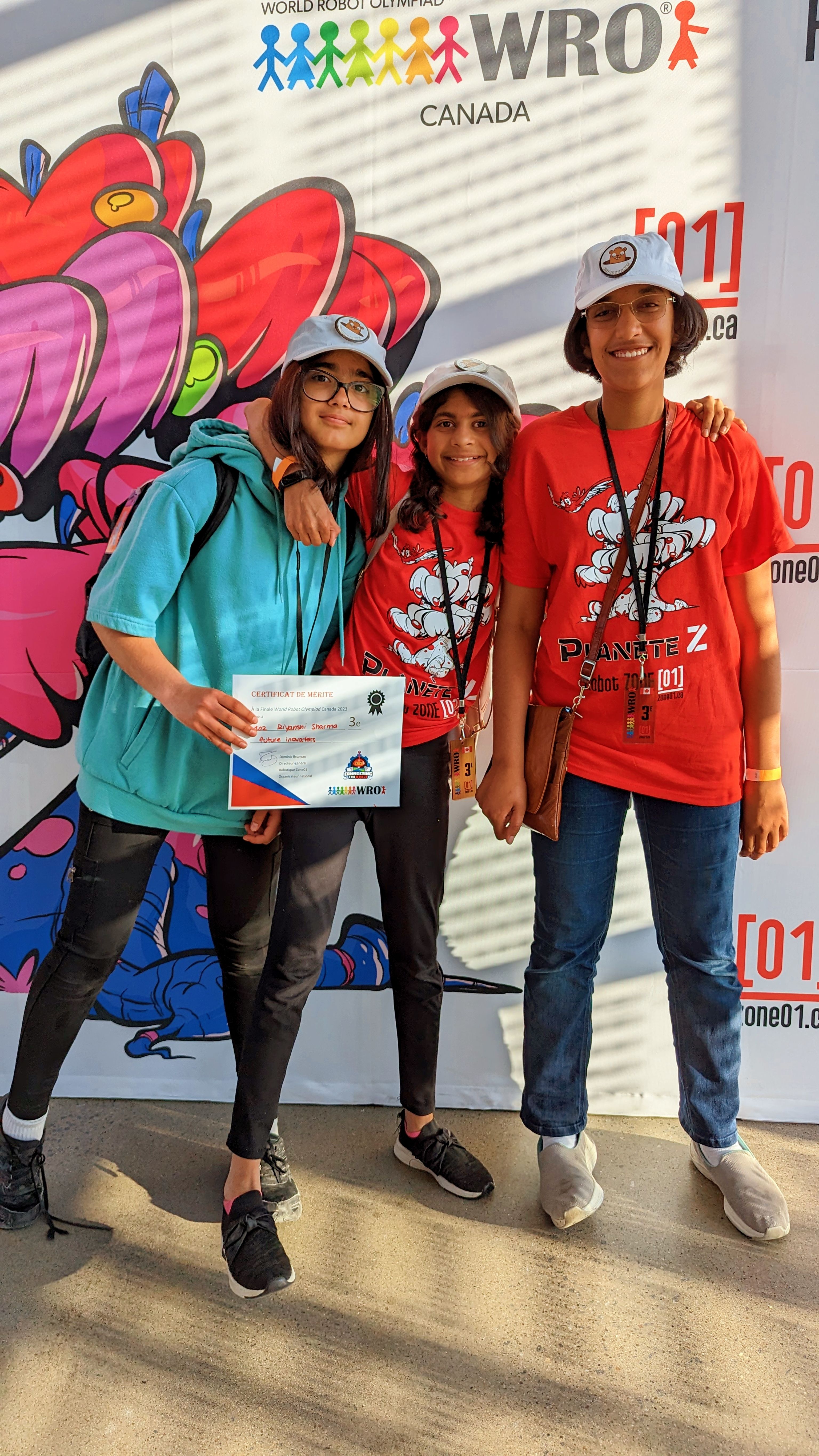
Of the teams that competed in the WRO National Finals, many got close to moving onto the international finals. While they didn’t quite make it, it doesn’t mean their ideas aren’t valuable. This is especially true with one of our third place winners who worked to design a solution to growing energy needs in the tech industry.
Currently, as more and more of our world moves online, more and more server space is needed to run it. These servers are often stored in massive data centers, of which there are over five thousand worldwide! These centers are great for storing the information needed, and they are in one location to make maintenance easier. But one of the large issues with them is that they need constant cooling, to ensure that the centers do not overheat. This consumes a massive amount of energy and can become quite pricey depending on the cooling system used. So, if data centers were to become more prominent, and more affordable, the cooling system costs would need to come down somehow.
This is where our third place innovators came in to offer a solution. Liquid cooling is already more efficient and cost effective than other methods of cooling, but it can be further refined. The team designed a mutually beneficial system that worked to take the heat of the data centers and put it to use. The cold water, heated up by the data centers, can be pumped out to other areas where the heated water can be deployed for human use. Thus, helping to reduce total energy costs used by the company/building, while also being more eco-friendly.
The third place team posing with their certificate.
That about covers it for now. We will have more news in November, when our teams compete on the world stage in Panama! Keep an eye out on our socials, or sign up for our mailing list to be notified of current events.