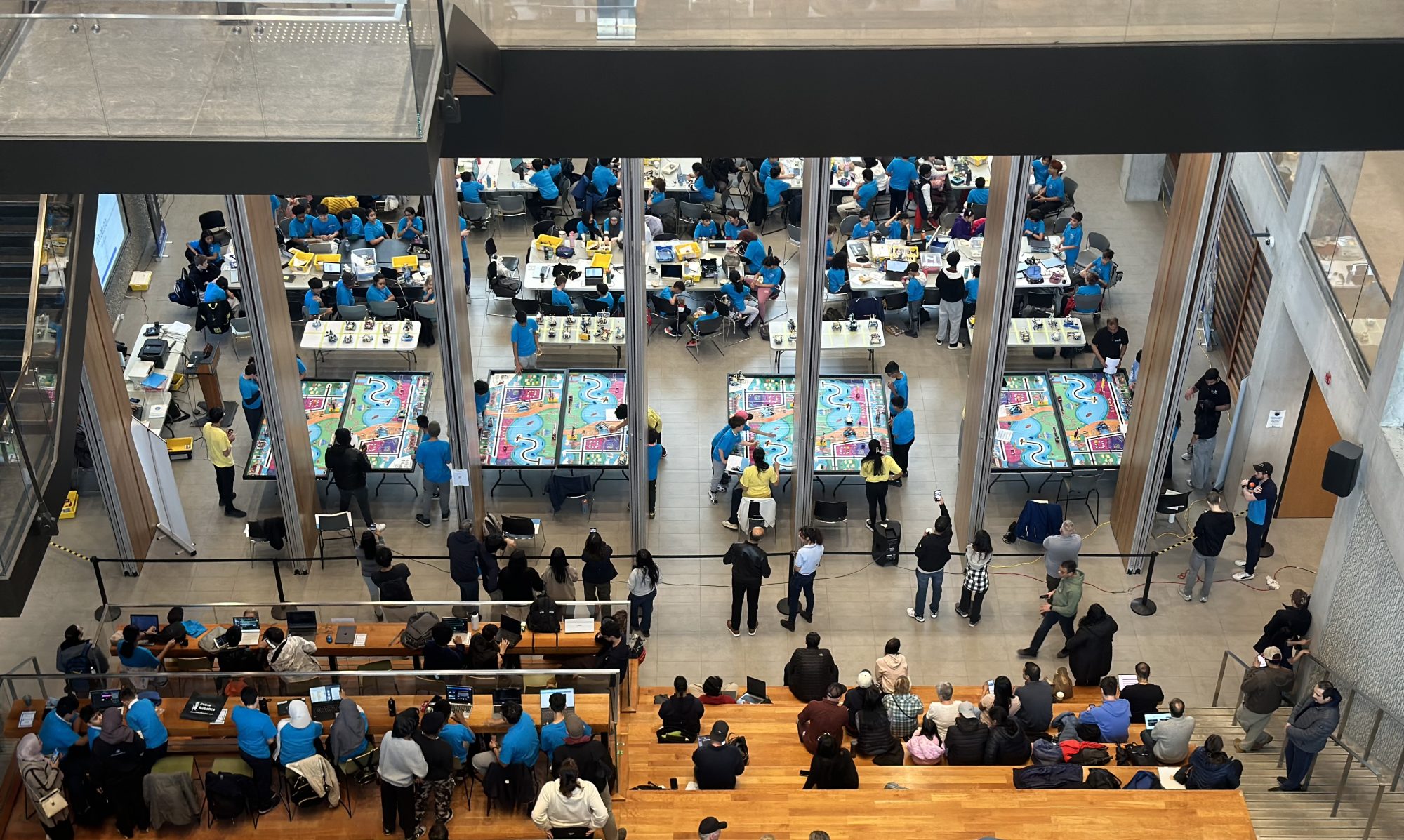
On September 12, 2026, three teams from Zebra Robotics Mississauga competed at the Zone01 RoboSports and Future Engineers National for the World Robot Olympiad, at École Secondaire Catholique Paul-Desmarais in Ottawa. Two of them came home with 1st Place, and the third with 3rd Place. All three have earned a place at a WRO International event.
Two 1st Places and a 3rd
In RoboSports, which in the 2026 rules is a game called Double Tennis, B-Teddy took 1st Place. The team is Tea Isono and Maria Jifin, and they now go to the WRO 2026 International Final in San Juan, Puerto Rico.
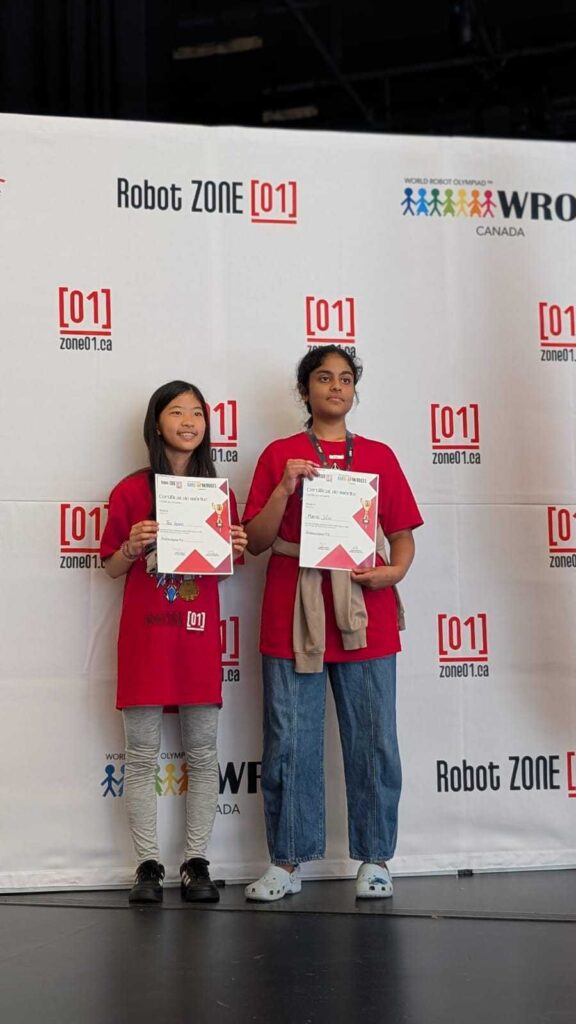
Tea Isono and Maria Jifin of B-Teddy, 1st Place in RoboSports
sinθ took 1st Place in Future Engineers, the self-driving cars challenge. Rajas Ganesh Salunke, Harshad Mahajan and Aarav Daudia are going to San Juan, Puerto Rico too.
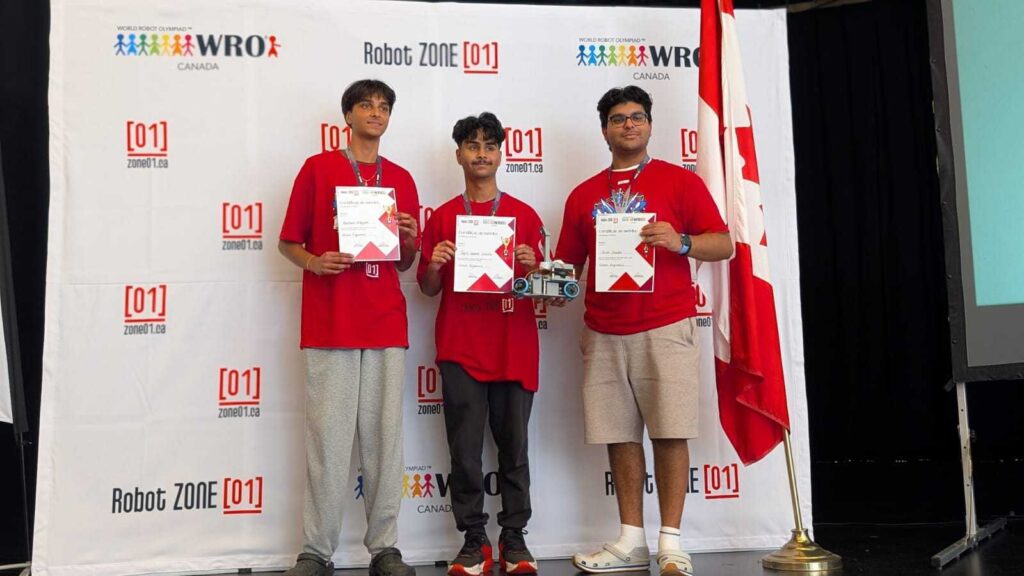
Rajas Ganesh Salunke, Harshad Mahajan and Aarav Daudia of sinθ, with their car
Click, Advik Bhagavatula and Rishy Grewal, took 3rd Place in RoboSports. Their result takes them to the WRO Americas Open Championship in Ontario, California.
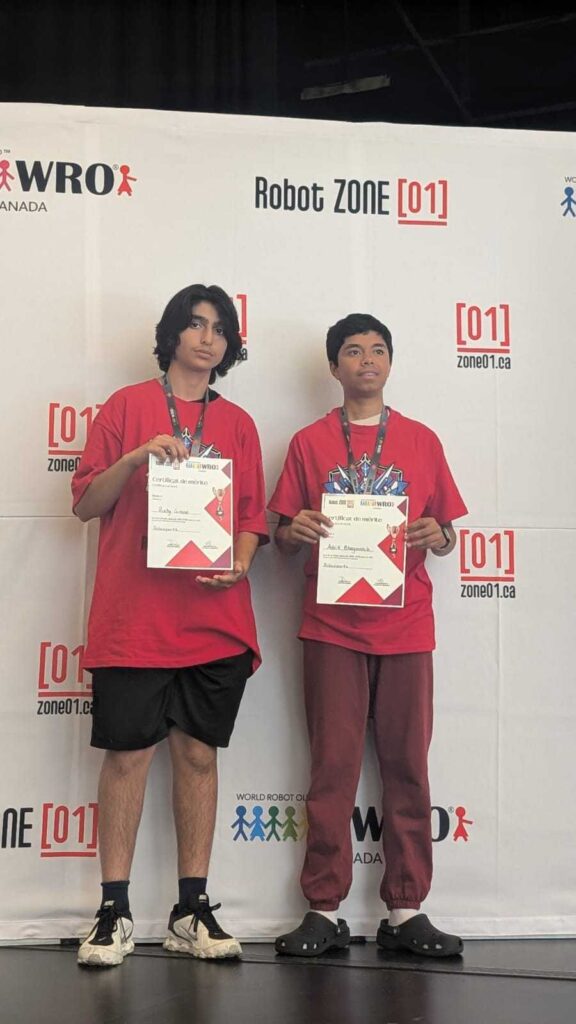
Rishy Grewal and Advik Bhagavatula of Click, 3rd Place in RoboSports
A new record for Zebra Robotics
A total of 8 teams from Zebra Robotics will represent Canada at WRO International events in Puerto Rico and the US, in the Elementary, Middle School and High School categories. That breaks the record Zebra Robotics set in 2025, when it sent 6 teams to WRO International events.
B-Teddy, sinθ and Click, the teams from Zebra Robotics Mississauga, are among the 8.
Inside sinθ’s self-driving car
Future Engineers is the WRO category where teams build a robot car with steering that drives around a track autonomously. Nobody controls it during a run. The car has to use its own sensors to work out where it is and its own code to decide what to do next. WRO describes the aim as bringing a current research challenge into schools and teaching students an engineering workflow by solving real-world problems.
sinθ built their car on Z-Bot, a robotics kit made by Zebra Robotics. At its centre is an ESP32 microcontroller with WiFi and Bluetooth. Around it, the kit works with a gyroscope, a Time-of-Flight distance sensor, a colour sensor, a small OLED screen, DC motors, servos and a HuskyLens camera. Zebra’s own code libraries, such as ZebraGyro, ZebraTOF and ZebraColour, give students simple commands for each part.
Where students learn to build one
Z-Bot is the kit students use in the Self Driving Vehicle (T1000) program at Zebra Robotics Mississauga. In that program, students design and build a custom autonomous car from start to finish. They learn to control motors, 3D print a chassis, and add sensors such as Time-of-Flight sensors, colour sensors and gyroscopes. Then they program the car in C++ so it navigates steadily and precisely, and finish by using those skills on real robotics challenges.
Read more about the Self Driving Vehicle (T1000) program
Why self-driving cars are worth learning about now
Transport Canada sees real potential in connected and automated vehicles. As automation improves, they may help reduce collisions, including by warning drivers early about a dangerous situation. They could improve mobility for Canadians, especially people with limited access to transportation. They could help reduce traffic jams, which would lower fuel use and emissions. They could also help avoid expensive accidents, save fuel, increase productivity and create new jobs, in fields from automotive manufacturing and digital technology to mining, farming and forestry.
Transport Canada is also clear that highly automated cars are not yet for sale to the public, and that it may take years or decades before Canadians use them. The engineers who close that gap are in school now. A Future Engineers car works on the same basic loop at a small scale: sensors read the world, code decides, and motors act. That is what sinθ built and raced in Ottawa.
What comes next
25–27 September 2026
WRO Americas Open Championship, Ontario, California
Click (RoboSports)
08–10 December 2026
WRO 2026 International Final, San Juan, Puerto Rico
B-Teddy (RoboSports) and sinθ (Future Engineers)
Congratulations to Tea, Maria, Rajas, Harshad, Aarav, Advik and Rishy, and to their families. We will share news from California and Puerto Rico.
Getting started
Students who complete certain streams at Zebra Robotics become eligible for real competitions, and the World Robot Olympiad is one of them. No prior experience is needed to start any stream. The first step is a free trial class, which comes before any commitment. Afterwards, staff follow up by phone to recommend a stream.