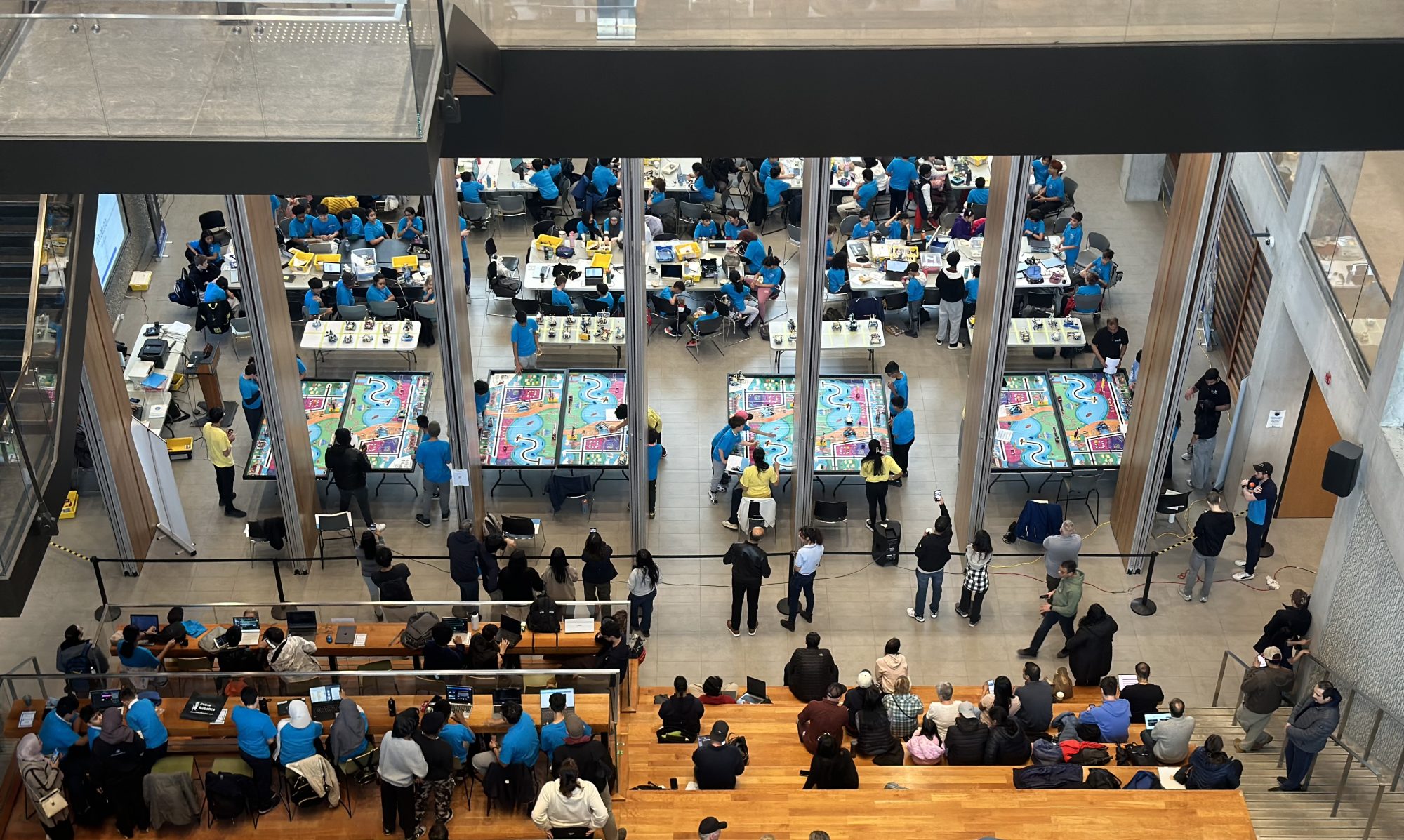
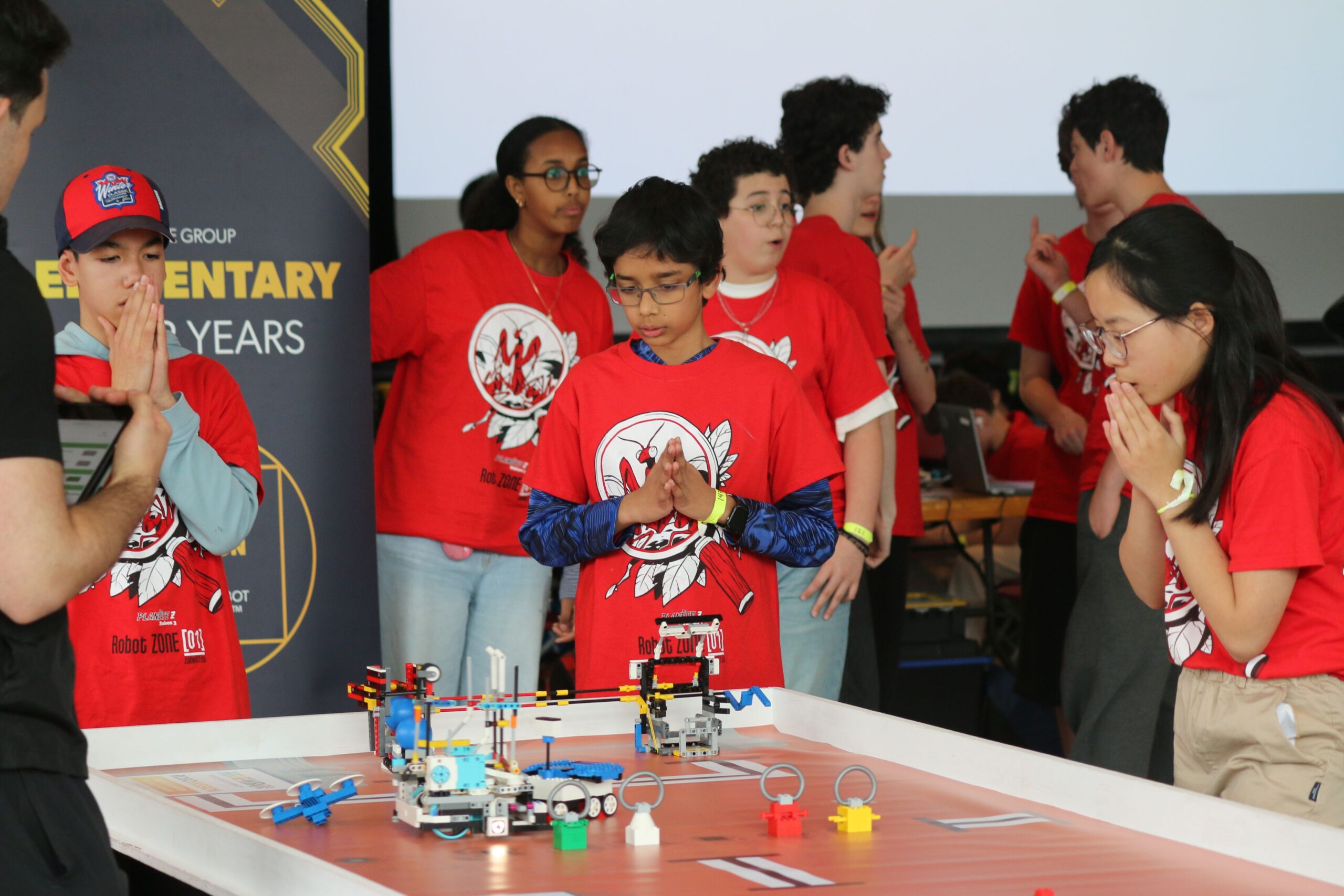
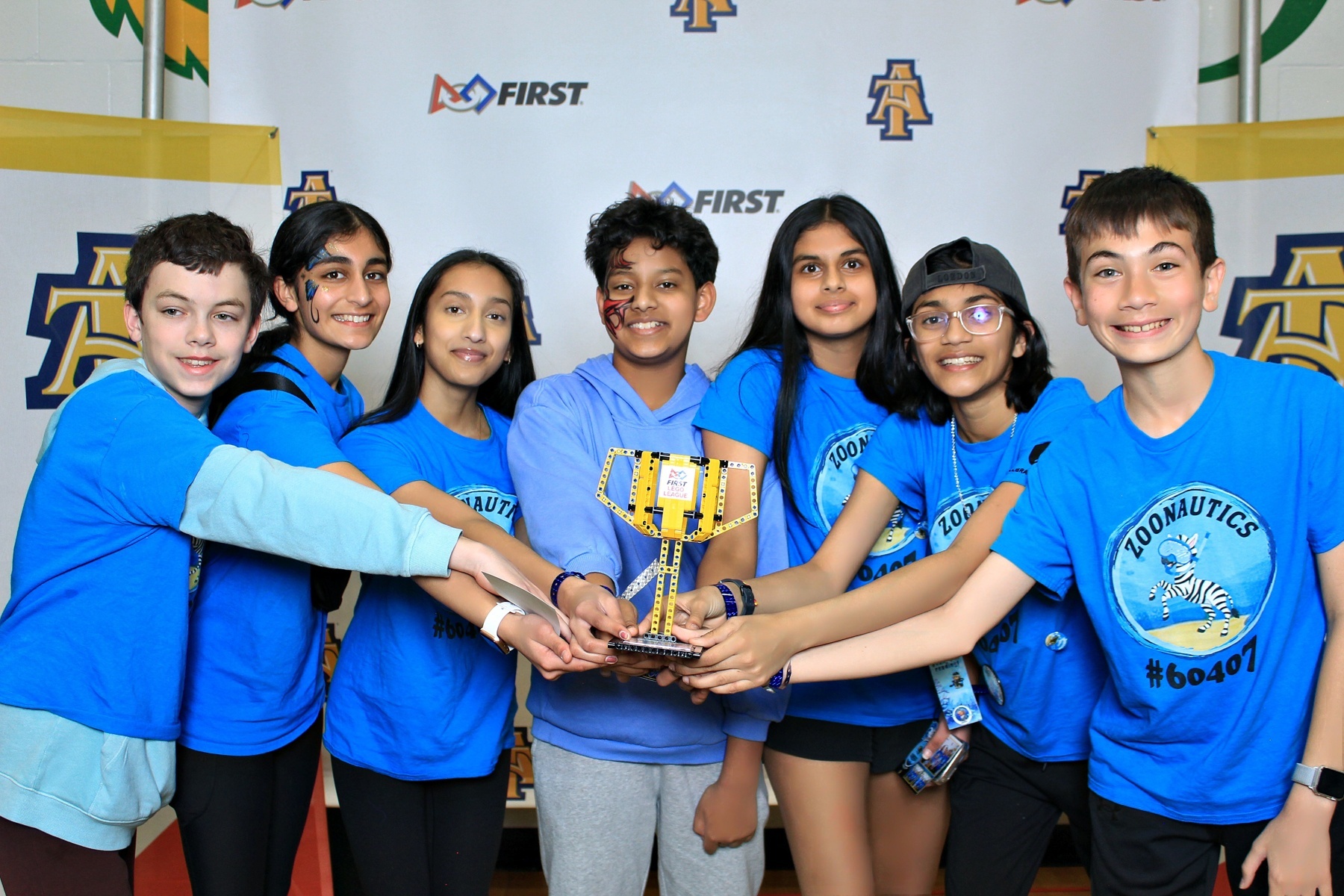
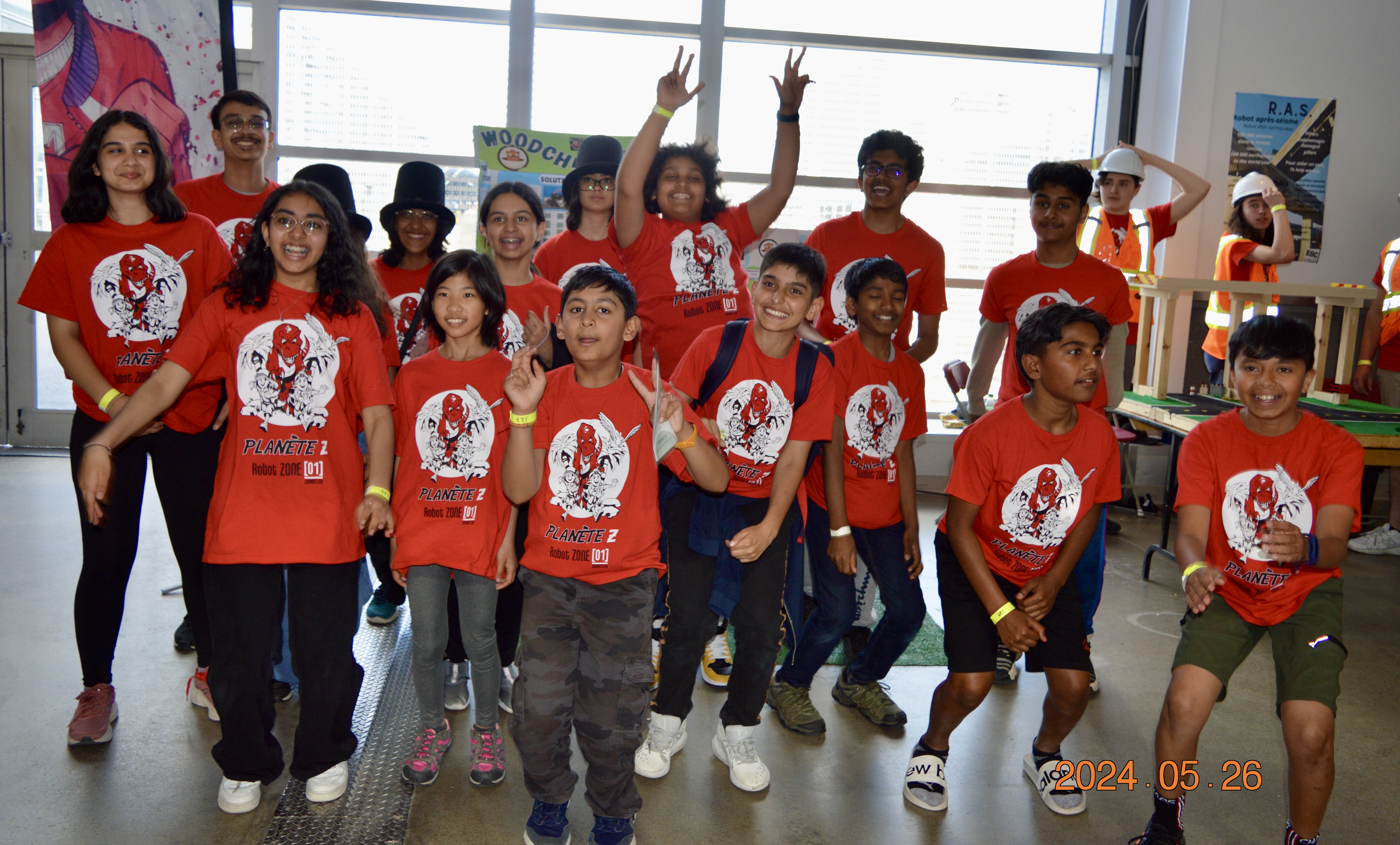
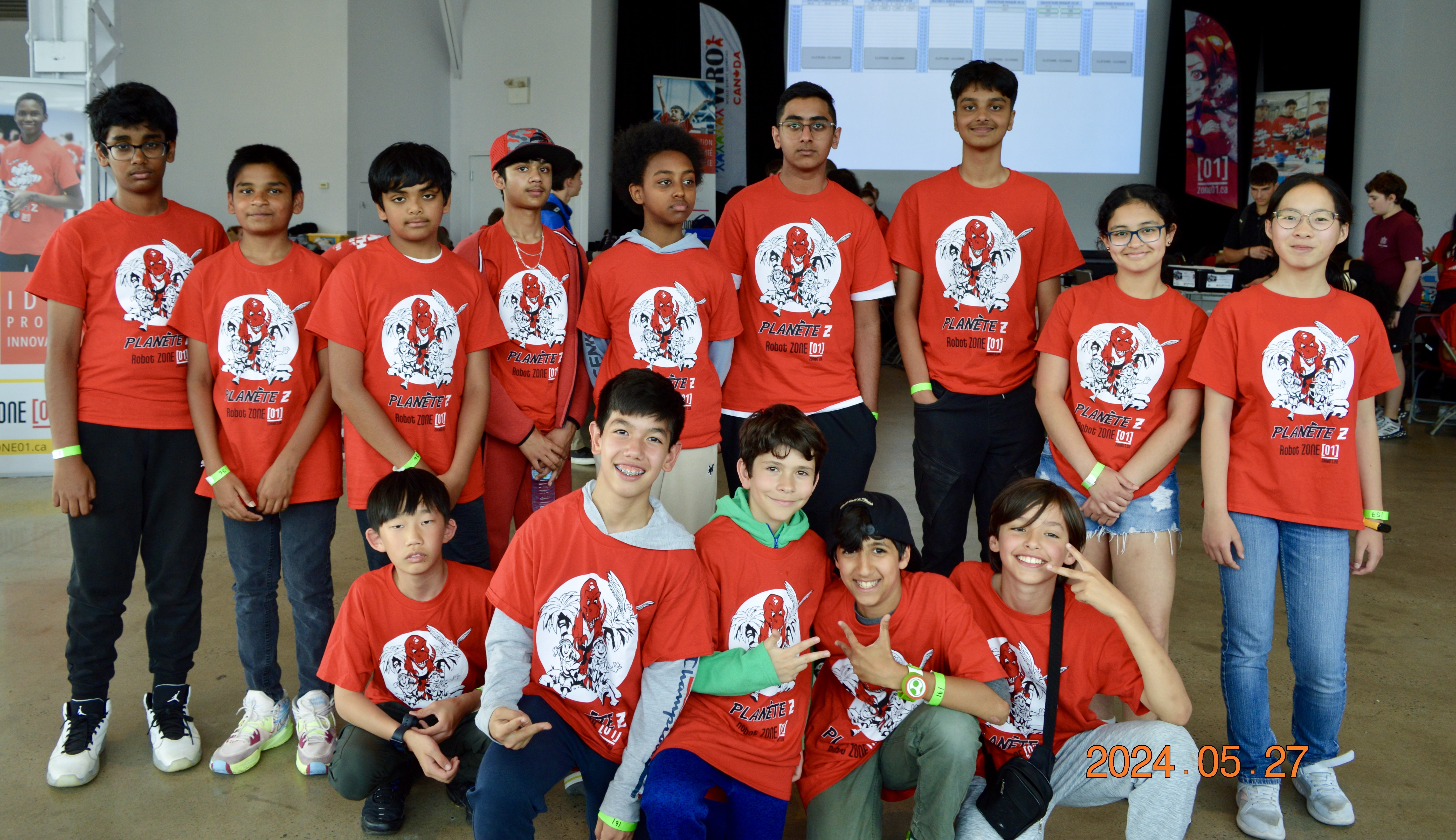
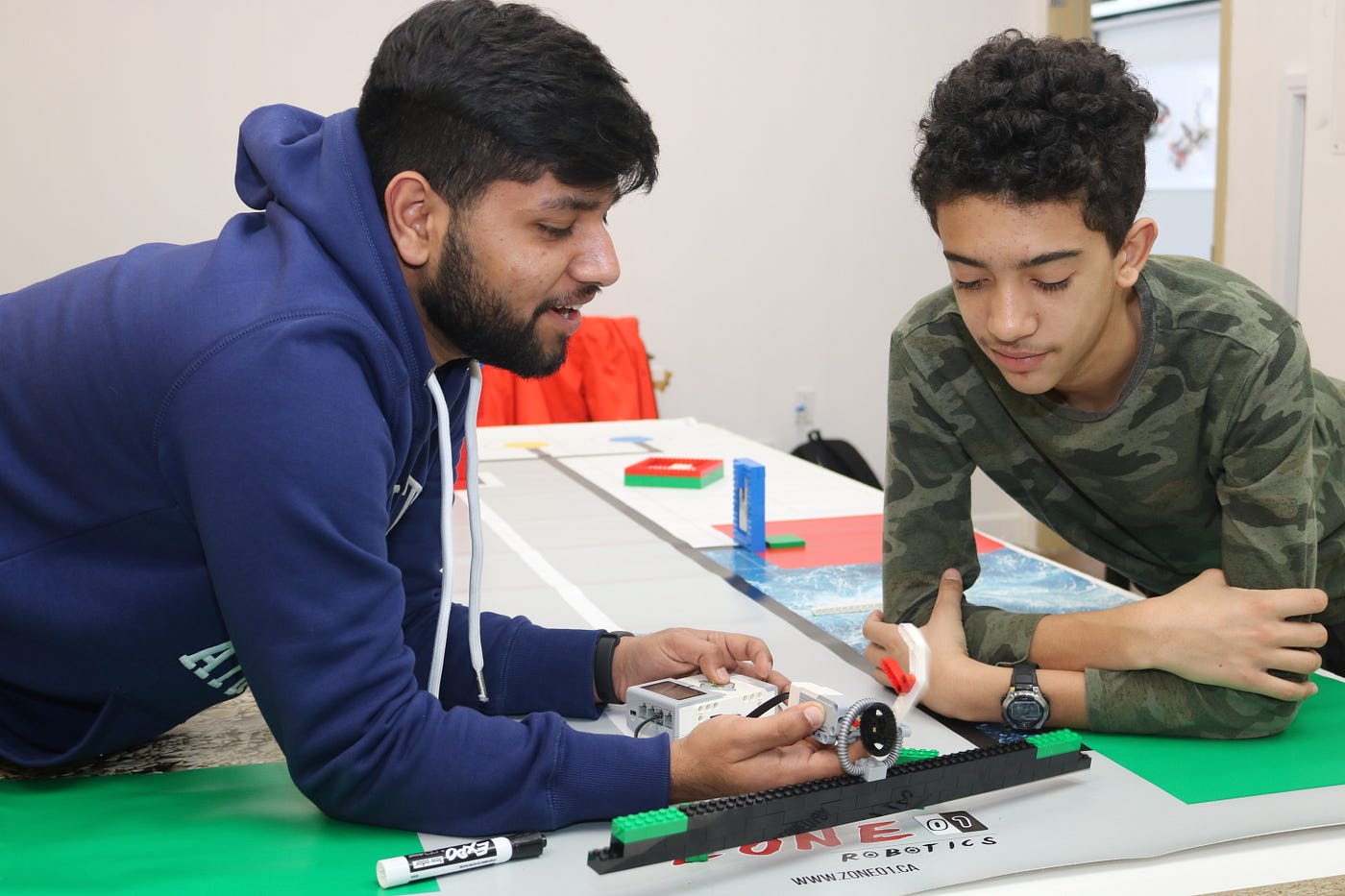
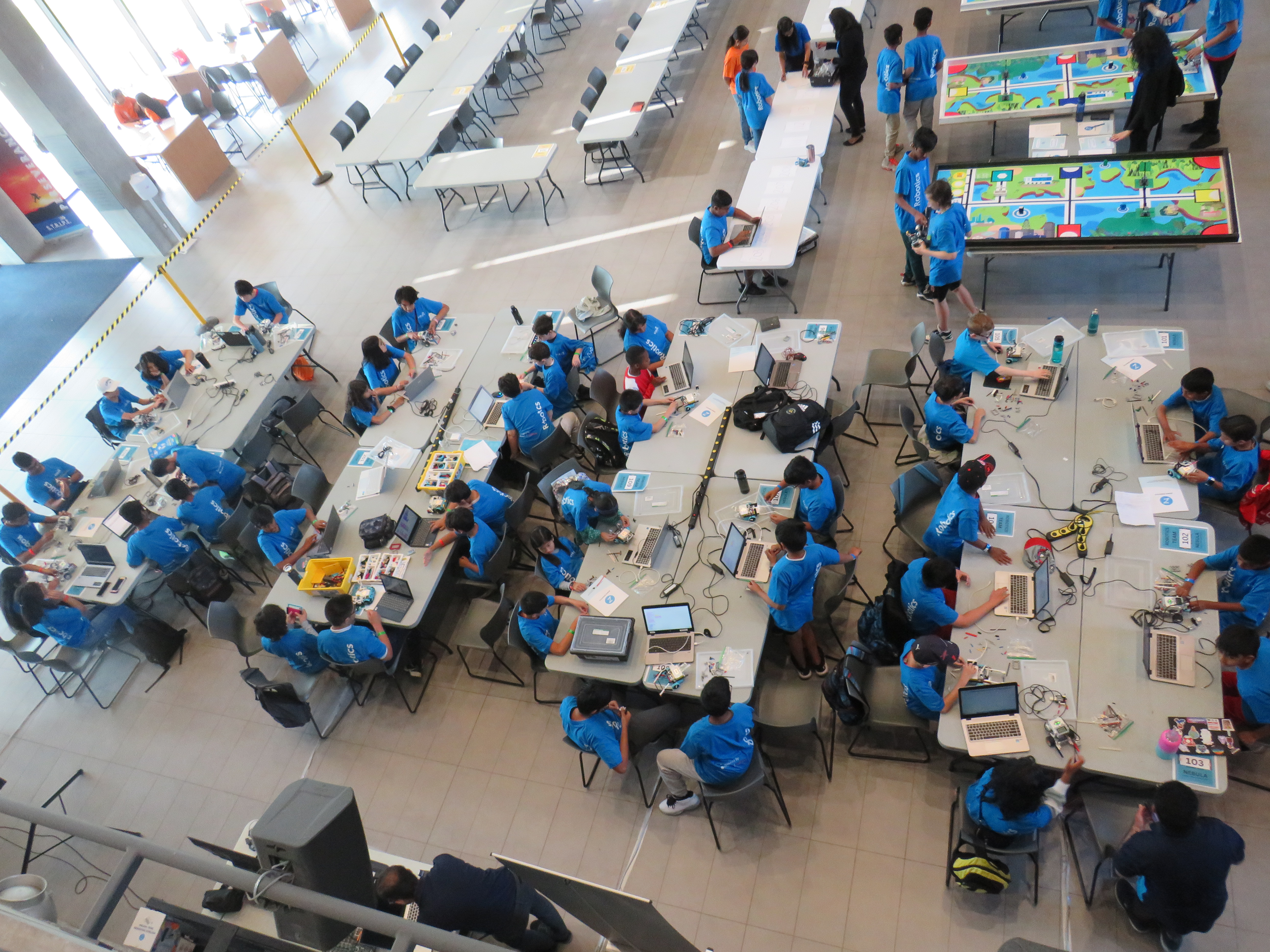
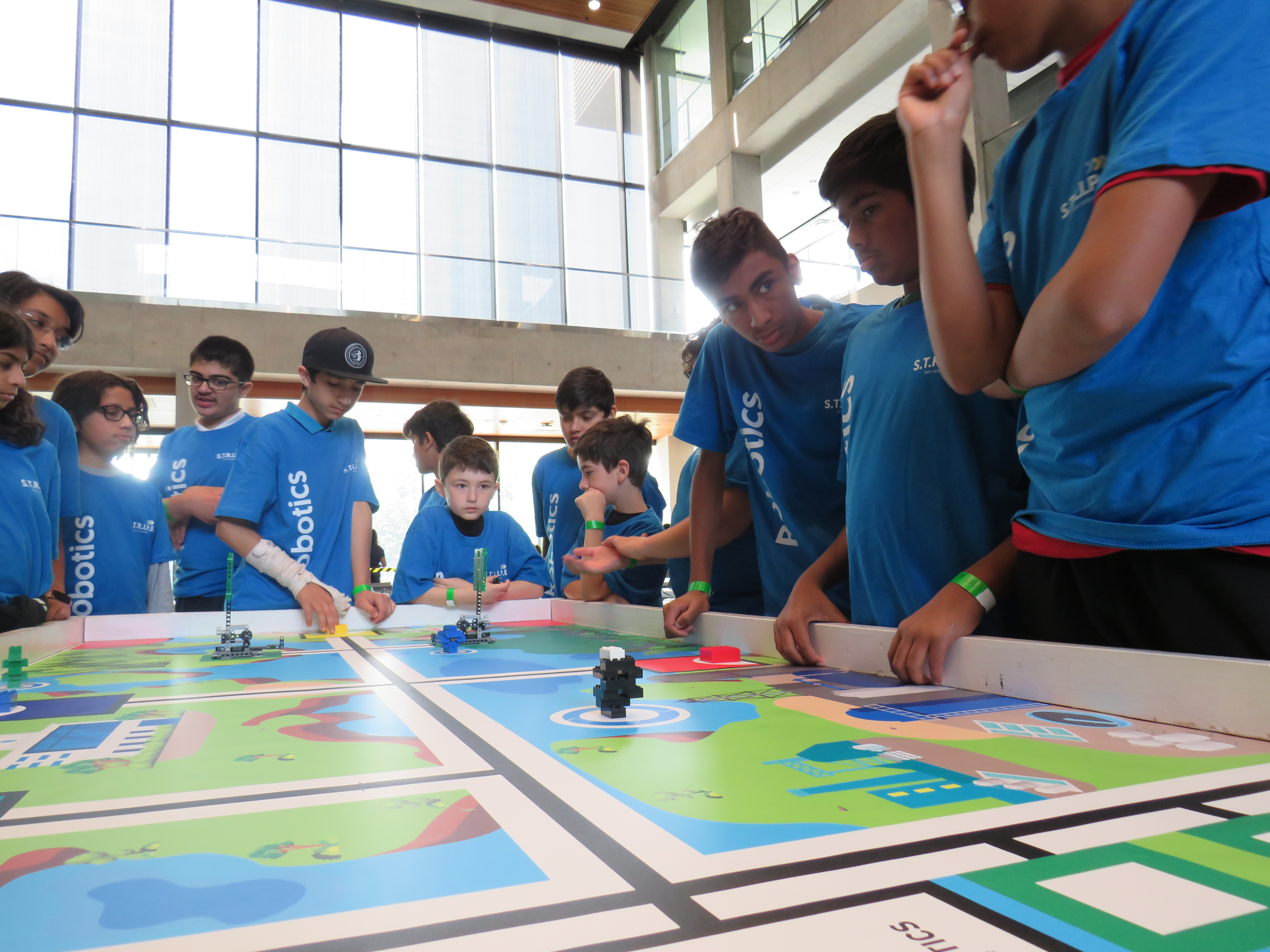
On September 12, 2026, three teams from Zebra Robotics Mississauga competed at the Zone01 RoboSports and Future Engineers National for the World Robot Olympiad, at École Secondaire Catholique Paul-Desmarais in Ottawa. Two of them came home with 1st Place, and the third with 3rd Place. All three have earned a place at a WRO International event.
Two 1st Places and a 3rd
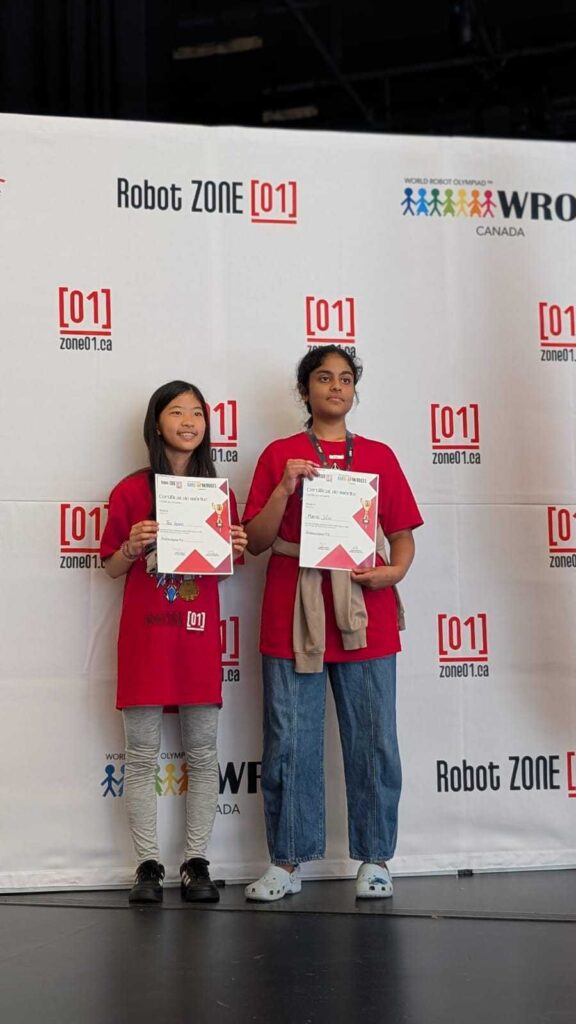
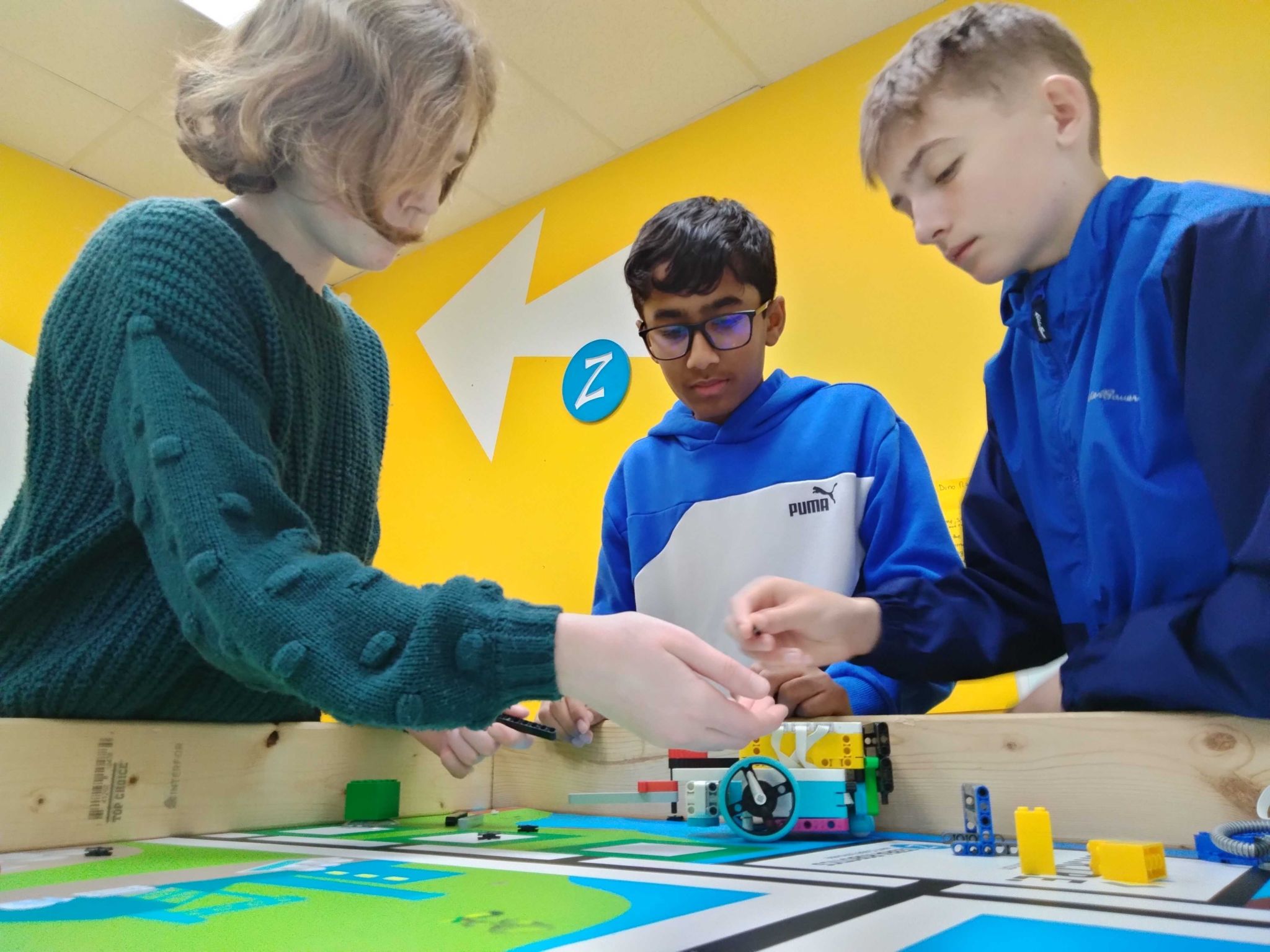
In RoboSports, which in the 2026 rules is a game called Double Tennis, B-Teddy took 1st Place. The team is Tea Isono and Maria Jifin, and they now go to the WRO 2026 International Final in San Juan, Puerto Rico.
Tea Isono and Maria Jifin of B-Teddy, 1st Place in RoboSports
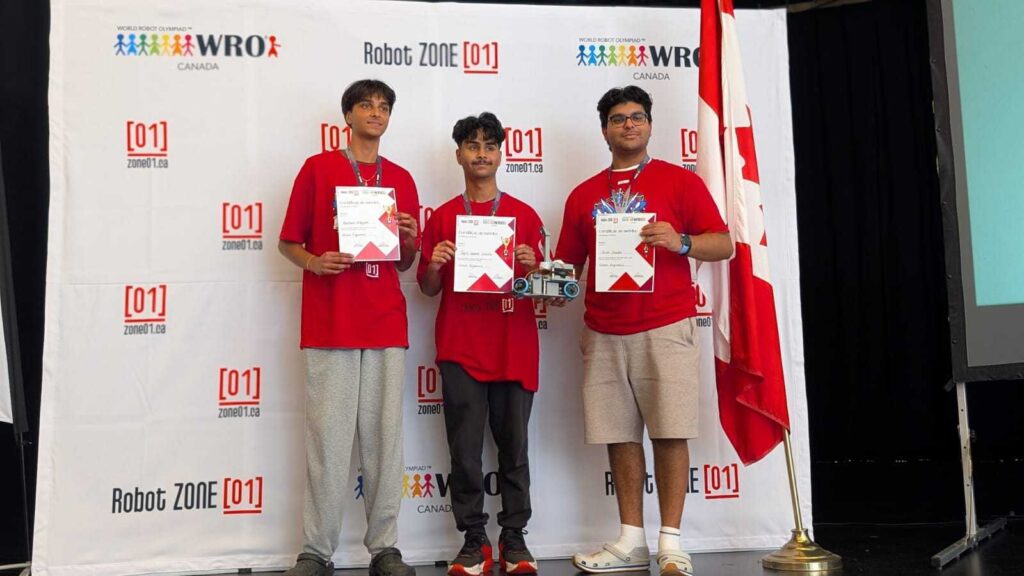
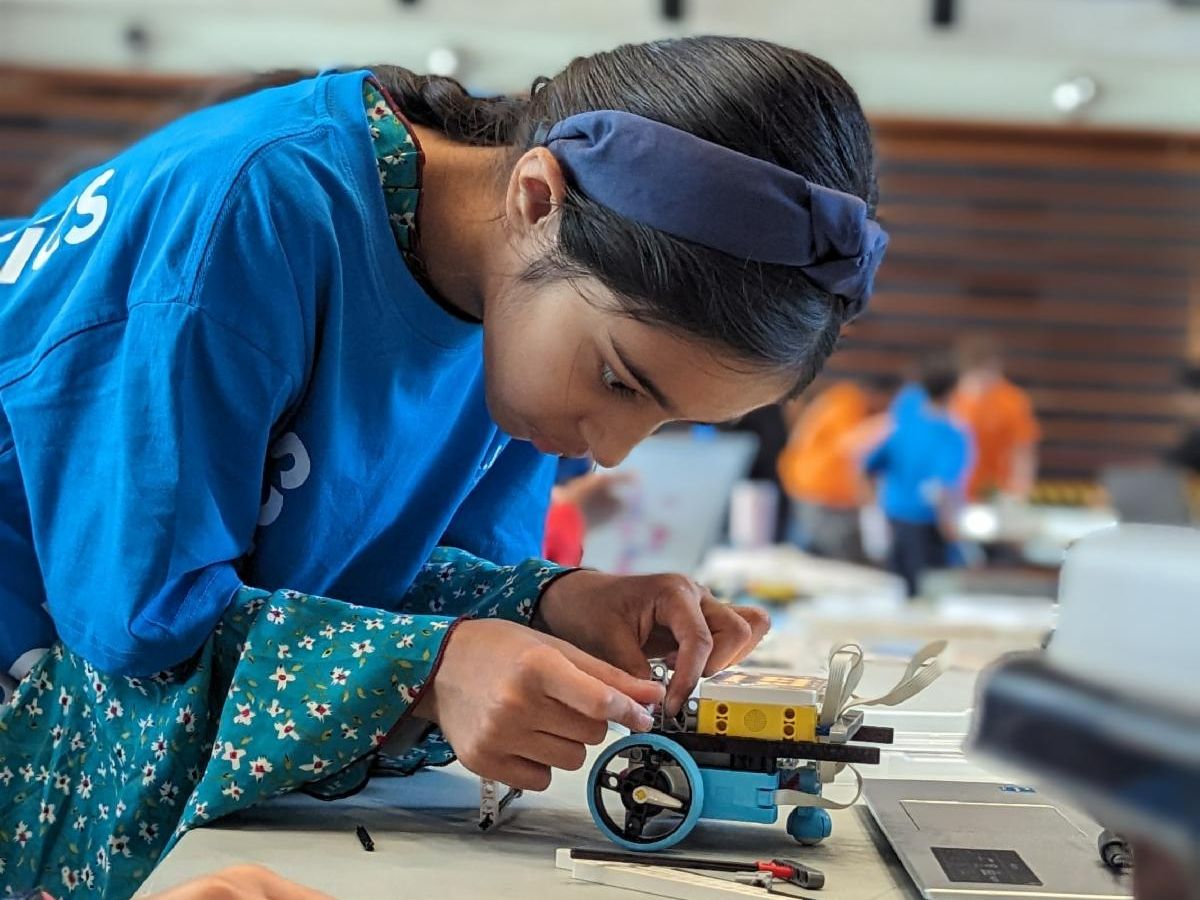
sinθ took 1st Place in Future Engineers, the self-driving cars challenge. Rajas Ganesh Salunke, Harshad Mahajan and Aarav Daudia are going to San Juan, Puerto Rico too.
Rajas Ganesh Salunke, Harshad Mahajan and Aarav Daudia of sinθ, with their car
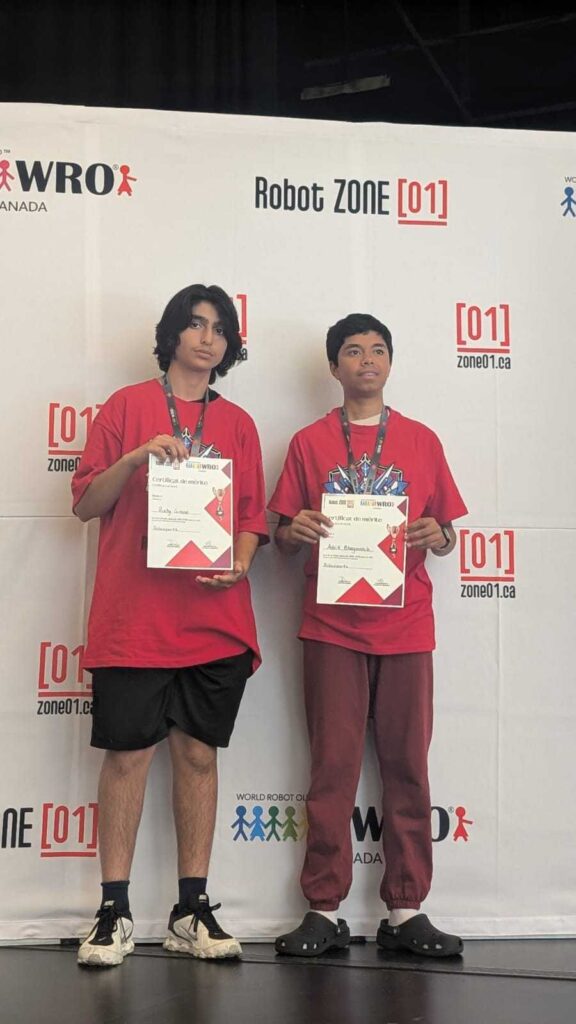
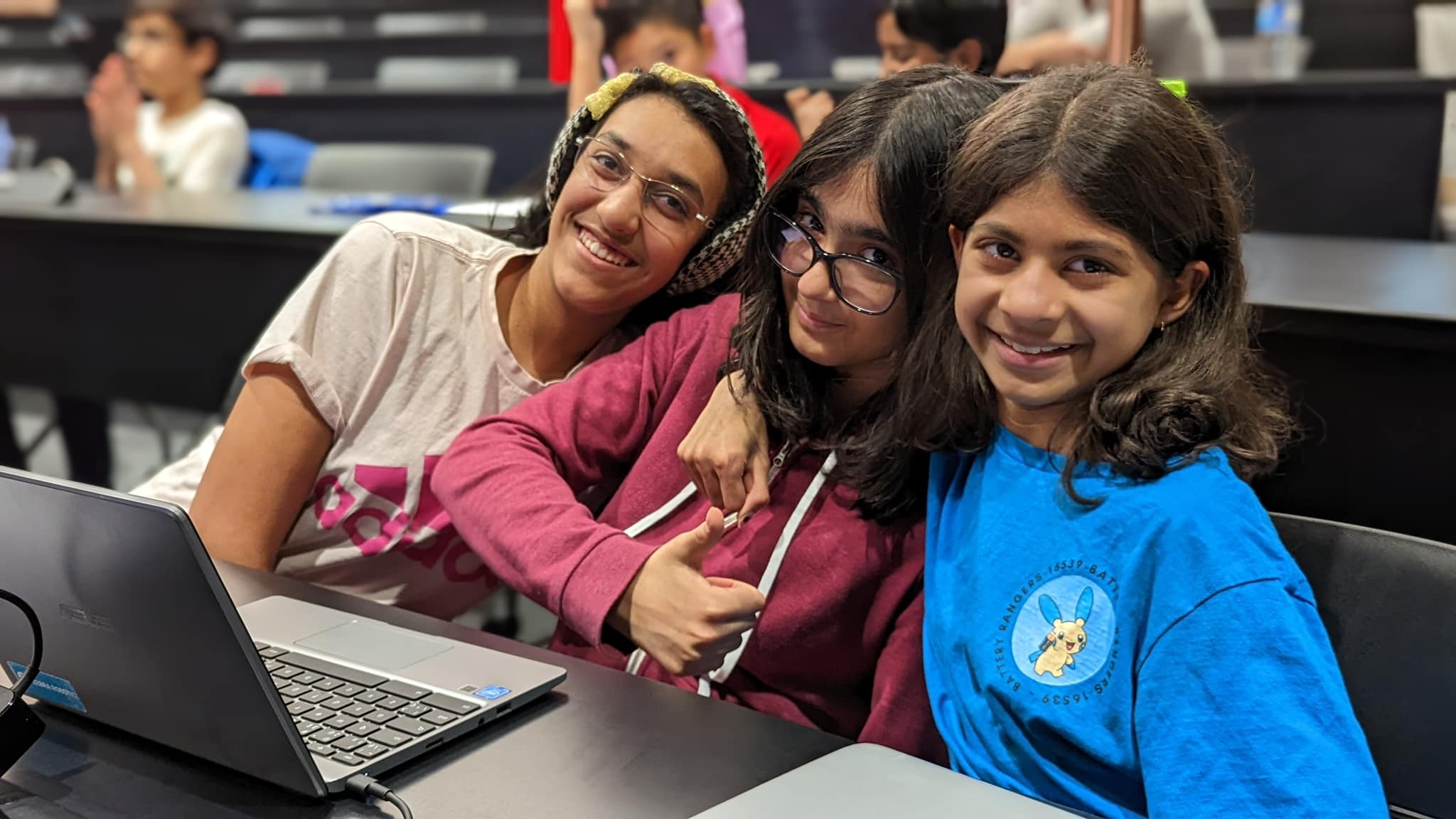
Click, Advik Bhagavatula and Rishy Grewal, took 3rd Place in RoboSports. Their result takes them to the WRO Americas Open Championship in Ontario, California.
Rishy Grewal and Advik Bhagavatula of Click, 3rd Place in RoboSports
A new record for Zebra Robotics
A total of 8 teams from Zebra Robotics will represent Canada at WRO International events in Puerto Rico and the US, in the Elementary, Middle School and High School categories. That breaks the record Zebra Robotics set in 2025, when it sent 6 teams to WRO International events.
B-Teddy, sinθ and Click, the teams from Zebra Robotics Mississauga, are among the 8.
Inside sinθ’s self-driving car
Future Engineers is the WRO category where teams build a robot car with steering that drives around a track autonomously. Nobody controls it during a run. The car has to use its own sensors to work out where it is and its own code to decide what to do next. WRO describes the aim as bringing a current research challenge into schools and teaching students an engineering workflow by solving real-world problems.
sinθ built their car on Z-Bot, a robotics kit made by Zebra Robotics. At its centre is an ESP32 microcontroller with WiFi and Bluetooth. Around it, the kit works with a gyroscope, a Time-of-Flight distance sensor, a colour sensor, a small OLED screen, DC motors, servos and a HuskyLens camera. Zebra’s own code libraries, such as ZebraGyro, ZebraTOF and ZebraColour, give students simple commands for each part.
Where students learn to build one Z-Bot is the kit students use in the Self Driving Vehicle (T1000) program at Zebra Robotics Mississauga. In that program, students design and build a custom autonomous car from start to finish. They learn to control motors, 3D print a chassis, and add sensors such as Time-of-Flight sensors, colour sensors and gyroscopes. Then they program the car in C++ so it navigates steadily and precisely, and finish by using those skills on real robotics challenges.
Why self-driving cars are worth learning about now Transport Canada sees real potential in connected and automated vehicles. As automation improves, they may help reduce collisions, including by warning drivers early about a dangerous situation. They could improve mobility for Canadians, especially people with limited access to transportation. They could help reduce traffic jams, which would lower fuel use and emissions. They could also help avoid expensive accidents, save fuel, increase productivity and create new jobs, in fields from automotive manufacturing and digital technology to mining, farming and forestry.
Transport Canada is also clear that highly automated cars are not yet for sale to the public, and that it may take years or decades before Canadians use them. The engineers who close that gap are in school now. A Future Engineers car works on the same basic loop at a small scale: sensors read the world, code decides, and motors act. That is what sinθ built and raced in Ottawa.
What comes next 25–27 September 2026 WRO Americas Open Championship, Ontario, California Click (RoboSports) 08–10 December 2026 WRO 2026 International Final, San Juan, Puerto Rico B-Teddy (RoboSports) and sinθ (Future Engineers) Congratulations to Tea, Maria, Rajas, Harshad, Aarav, Advik and Rishy, and to their families. We will share news from California and Puerto Rico.
Getting started Students who complete certain streams at Zebra Robotics become eligible for real competitions, and the World Robot Olympiad is one of them. No prior experience is needed to start any stream. The first step is a free trial class, which comes before any commitment. Afterwards, staff follow up by phone to recommend a stream.
The demand for STEM education continues to grow—and with it, the need to make these opportunities more inclusive. Zebra Robotics franchise owner, Lavanya Natarajan, in Brampton, Ontario highlights how one location is not only building a successful business, but also making a lasting impact by empowering girls to thrive in robotics and coding.
For many prospective franchisees, the decision to invest goes beyond financial return. It’s about building something meaningful.
Lavanya entered the space with a clear vision: “To create an environment where young students—especially girls—feel confident exploring STEM. By combining education with mentorship, the center fosters curiosity, creativity, and long-term interest in technology fields.”
Closing the Gender Gap in STEM
Despite recent progress, girls remain underrepresented in many STEM disciplines. Programs like Zebra Robotics help address this gap early by:
Encouraging hands-on learning in robotics and coding
Building confidence through competition and collaboration
For franchisees, this represents more than impact—it’s a clear market need that continues to expand.
A Business Model Built for Impact and Growth
What makes this opportunity especially compelling is the balance between mission and structure.
Franchise owners benefit from:
A proven curriculum in robotics, coding and technology
Ongoing training and operational support
Established brand recognition in STEM education
Scalable programs including classes, camps, and competitions
This allows owners to focus on growing their location while delivering consistent, high-quality educational experiences.
Building a Community Hub
Successful STEM centers don’t just teach—they become part of the local community.
In Brampton, the Zebra Robotics location serves as a hub for:
Parents seeking future-ready skills for their children
Students preparing for robotics competitions
Young learners discovering confidence in STEM for the first time
For prospective franchisees, this community integration drives both customer loyalty and long-term growth.
Why This Matters for Prospective Franchisees
Lavanya’s story illustrates a powerful reality: STEM education franchises offer a unique combination of purpose, demand, and scalability.
As industries continue to evolve, parents are increasingly prioritizing STEM skills—creating sustained demand for programs like Zebra Robotics.
At the same time, franchisees have the opportunity to:
Run a mission-driven business
Make a measurableimpact in their community
Build a recurring, education-based revenue model
Take the Next Step
If you’re exploring franchise opportunities, STEM education stands out as both a future-focused industry and a meaningful investment.
Zebra Robotics offers a pathway to combine entrepreneurship with impact—helping shape the next generation of innovators while building a business of your own.
If you are ready to take the next step, contact us to learn how Zebra Robotics can support your journey into franchise ownership.
Across the United States, schools and families are placing greater emphasis on STEM education to help students prepare for the future. Robotics, AI, and coding programs are becoming an important part of that journey, creating new opportunities for students while opening doors for entrepreneurs interested in the education sector.
As demand for technology-focused learning grows, many entrepreneurs are exploring how a robotics education franchise can provide both meaningful impact and long-term business potential.
Preparing Students for a Technology-Driven Future
Technology continues to shape the future of work, increasing the need for skills such as problem-solving, critical thinking, collaboration, and digital literacy. According to the U.S. National Science Foundation, approximately 36 million Americans worked in STEM occupations in 2023, accounting for one-quarter of the nation’s workforce. STEM employment is projected to grow by 6% through 2034, reflecting continued demand for technology-focused careers.
As a result, families in the U.S. are placing greater value on educational experiences that help students develop a strong foundation for future success. Robotics, AI, and coding programs provide hands-on opportunities for students to think creatively, solve real-world challenges, and work as part of a team. Beyond technical knowledge, students develop confidence, communication skills, and a growth mindset that can benefit them throughout their education and future careers.
Increased Investment in STEM Learning
With the shift toward future-ready learning, schools, community organizations, and parents continue to seek programs that prepare students for a rapidly evolving world. This demand is especially visible in fast-growing technology and AI hubs such as Tampa, Atlanta, Charlotte, and the Dallas-Fort Worth metro area, where investment in tech infrastructure and workforce development continues to expand.
Research from the Brookings Institution notes that regions building strong AI and technology ecosystems are also those with the highest long-term demand for STEM-skilled talent.
Advancements in artificial intelligence are increasing the importance of critical thinking, creativity, communication, and problem-solving. Robotics, AI, and coding programs give students opportunities to practice these abilities through engaging, project-based learning experiences that mirror real-world challenges.
A Franchise Opportunity Aligned with Industry Growth
For entrepreneurs looking to enter the robotics education sector, a Zebra Robotics franchise offers the opportunity to participate in a rapidly growing industry while delivering programs that meet the evolving needs of students and families.
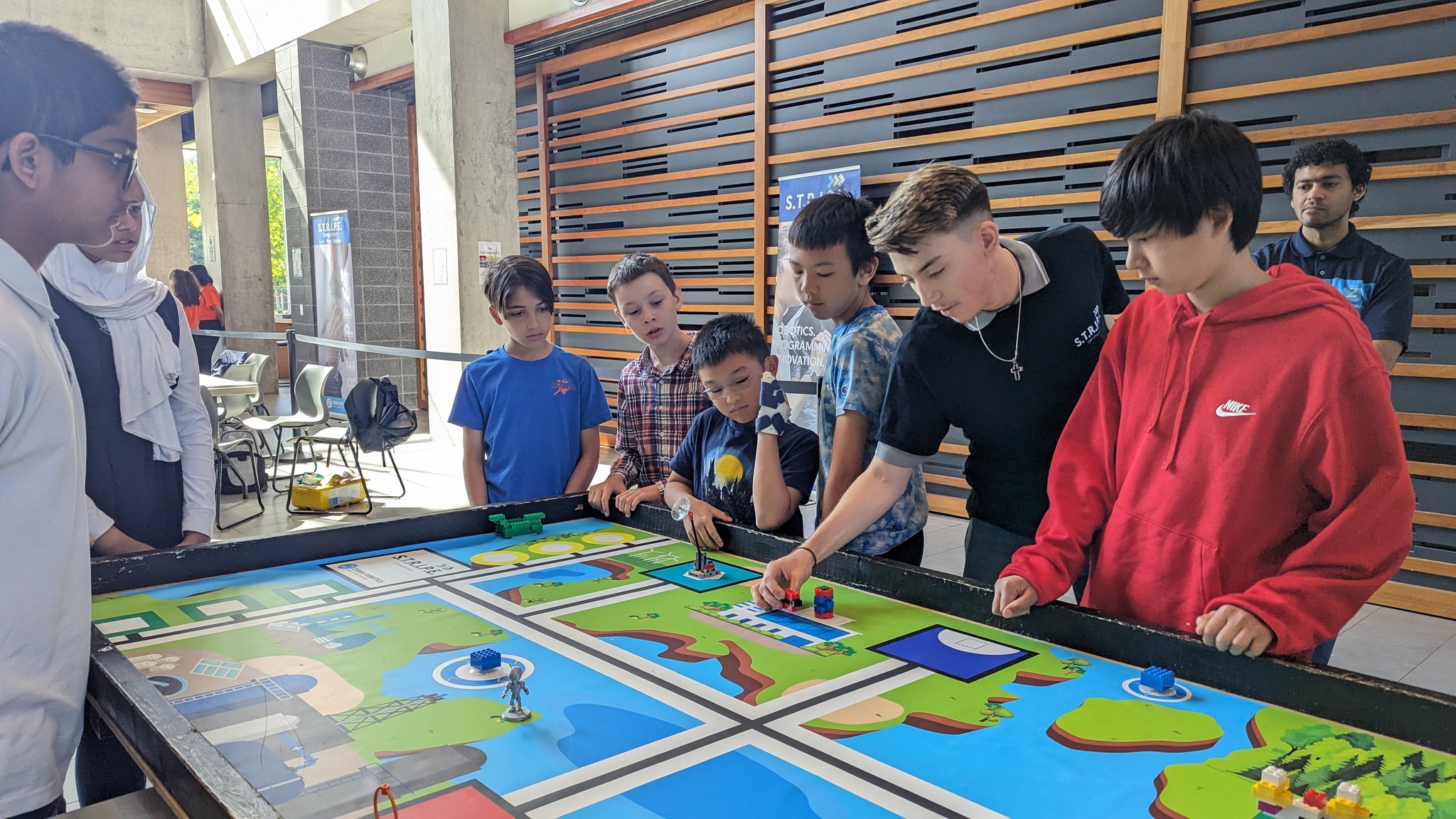
For more than a decade, Zebra Robotics has helped students gain skills in robotics, AI, coding, and technology through 70+ hands-on programs designed for a variety of ages and experience levels. Beyond weekly classes, franchisees can also offer camps, workshops, and competitive training opportunities that create multiple ways to engage students throughout the year. Students also have opportunities to participate in robotics, AI, and coding competitions, including STRIPE, our signature STEM competition. These experiences encourage teamwork, leadership, innovation, and real-world application of classroom concepts.
With more than 50,000 students served, 25+ locations across Canada and the United States, and 200+ competition awards earned by Zebra Robotics teams, we have developed a proven model supported by comprehensive training, operational guidance, marketing resources, and technology systems.
Join the Future of Learning
With a comprehensive curriculum, multiple program offerings, and a strong support network, Zebra Robotics provides entrepreneurs with an established path to business ownership while helping students develop future-ready skills.
Contact our team today to explore how a Zebra Robotics franchise can help you bring innovative STEM education to your community.
STEM education continues to transform how students learn and prepare for the future. Robotics, AI, and coding programs provide hands-on experiences that develop problem-solving skills, creativity, and teamwork. Families and schools across the country are seeking programs that equip students with skills for technology-driven careers, creating strong demand for high-quality enrichment.
This demand continues to accelerate. Industry projections show the STEM education market in North America reaching over $96 billion within the next 5 years, driven by the need for future-ready skills, AI-enabled learning, and hands-on education models. As technology continues to shape the workforce, these programs play a central role in preparing students for what comes next.
Zebra Robotics has been at the forefront of this movement, delivering engaging programs that foster collaboration and innovation across all age groups. This positions STEM education franchising with Zebra Robotics as an exciting opportunity for entrepreneurs looking to build a business grounded in purpose, impact, and long-term growth.
A Proven Path for Entrepreneurs
STEM education franchising offers structured entry into the education market. Franchise models provide established curriculum, operational guidance, and brand recognition that support a confident launch. Zebra Robotics equips franchisees with comprehensive training, marketing resources, and ongoing support to maintain high program quality.
With over 11 years of operational experience, 25+ locations, and 50,000+ students served, Zebra Robotics offers a proven and profitable business model. Entrepreneurs exploring education franchise opportunities benefit from a system designed for efficiency, strong retention, and consistent demand.
With clear processes in place, franchise owners can focus on building relationships, engaging their local market, and delivering impactful learning experiences.
Designed for Growth and Flexibility
Zebra Robotics programs adapt across multiple formats, including weekly classes, camps, workshops, and school partnerships. This flexibility allows franchise owners to reach a wide audience and maintain steady enrollment throughout the year.
A scalable structure supports long-term growth. Franchisees can expand offerings, increase capacity, and strengthen partnerships without added complexity. With 70+ in-house developed programs and both in-person and virtual delivery options, the model supports steady and manageable expansion.
This flexibility allows owners to establish a strong local presence while growing their business over time.
Building Strong Community Connections
Schools and community organizations actively seek engaging STEM programs that align with modern learning goals. These offerings fit naturally into those environments, creating strong partnership opportunities for franchise owners.
Zebra Robotics also emphasizes competition-based learning. Students participate in recognized robotics, AI, and coding competitions, where they develop teamwork, collaboration, and leadership skills. Over time, Zebra Robotics teams have earned 200+ awards across regional and international competitions, contributing to local pride and engagement.
By introducing these programs into their communities, franchisees create meaningful connections while supporting student growth and confidence.
Combining Purpose with Opportunity
Franchise ownership with Zebra Robotics brings together entrepreneurship and meaningful work. Owners deliver valuable learning experiences while operating within a high-demand, future-focused industry.
With millions of STEM-related roles expected in the coming years, demand for robotics, AI, and coding education continues to rise. This creates a strong foundation for franchise owners to build businesses aligned with long-term market needs.
Zebra Robotics encourages innovation in program delivery, community engagement, and business growth. Franchisees join a network focused on inspiring students while building successful, community-driven businesses.
Looking Ahead
Entrepreneurs who value education and innovation will find strong opportunities in STEM education franchising. With a proven model, adaptable programs, and growing demand, Zebra Robotics franchisees are equipped to build meaningful businesses that inspire future leaders in technology and STEM fields.
Start Your Franchise Journey
At Zebra Robotics, we empower franchisees to bring innovation, collaboration, and entrepreneurship together in one opportunity. Joining our network means delivering robotics, AI, and coding programs to your community while building a business rooted in education and growth.
If you are ready to take the next step, contact us to learn how Zebra Robotics can support your journey into franchise ownership and help you make a lasting impact.
The robots have been run, and the points have been totaled. It’s official: four Zebra Robotics teams are going to Turkey for the International World Robot Olympiad (WRO) in November! These teams have been working hard since regionals to make their dreams a reality. This work has paid off, as ALL FOUR TEAMS got first place in their respective categories!
WRO Teams Celebrate in Montreal
Team Agribots came first in the Elementary Future Innovators category! They redesigned their robot after the regionals to a more sleek-looking, polished design.
The Woodchucks came first in the Junior Future Innovators category! They spent a ton of time at Zebra knuckling down on their design, ensuring it would run well on the day of the competition.
Team -0.618 came first in the Senior Robomission category! This team set its sights high early in the season and has been studiously perfecting a robot based on advanced math and with an innovative, efficient design.
The Miracle Monkeys came first in the Junior Robomission category! No strangers to competition, they knew that if they put in the work, they would come out on top. And they did!
We are proud of all our teams, as they all took what they had learned over the years and skillfully applied their knowledge to design the best robots possible. We know they will represent Canada well on the world stage.
But the fun isn’t over yet! We have four more teams who may make it to international competition. We will know on Friday if two of our high-scoring teams will be able to compete in either Puerto Rico or Italy at WRO Open Invitationals. Zebra is also fielding teams in two additional categories whose regionals are in September: Future Engineers and Robosports. Stay tuned to our socials to see we are sending more teams to international competition!
Big wins at Zone01 Nationals!
Zone01 Teams Posing in Montreal
Also this week, Zebra teams competed in Zone01 Regionals. This Canadian competition ends at the national level, and since Regionals at the Ontario Science Centre, the teams have been hard at work engineering and recoding their robots. Focusing on bringing their times down and preparing for surprise challenges, our teams were excited to perform. And perform they did!
Team 2πR earned first place in the Junior category! Having scored first in the regionals with 110 points, they wanted to maintain that positive trend in the Nationals, and they most certainly did.
Team Untitled earned second place in the Elementary category! This team has been particularly focused this season, and they worked to ensure that their efforts wouldn’t go to waste.
Team JMX Robots earned third place in the Junior category! This team put a ton of time and effort into their robot, and that dedication helped them secure their first ever Nationals award.
We are proud of the teams that competed. Competition takes courage, as months of learning and preparation is distilled into three tiny runs. Competition teams learn a lot about themselves and how to meet challenges with persistence and resolve. And that, to us, is the purpose of competition.
Ontario offers many regional learning choice programs for elementary students heading into middle school. Finding a program that keeps your child engaged and empowered can help avoid some of the academic pitfalls of the transition from elementary to middle school. It may seem like a lot of pressure to apply for a special program when your child is in elementary school, but there is research that suggests that working with motivated peers in a challenging environment can keep students moving toward success.
It’s important to keep up student interest when transitioning to middle school.
Programs for students interested in STEM include the Middle Years Programme of the International Baccalaureate and the SciTech program. Students whose interest in STEM is entrepreneurial would thrive in the International Business and Technology (IBT) program.
The Middle Years Programme from the International Baccalaureate (IB) is the program designed for students from ages 11–16. It’s a 5-year program, but in most Ontario schools this program runs from grade 6–8, which is common for the curriculum. This program introduces students to a cohort of highly-motivated peers working on learning that is attached to real world applications, in addition to following Ontario’s standard curriculum. There are 8 subject areas for students to focus on, and they must spend at least 50 hours on instruction in each area. The areas include: language acquisition, language and literature, individuals & societies, sciences, mathematics, arts, physical & health education, and design. The IB Global Research department has studied the impact of their Middle Years Programme and found that IB students were “on-task” 87% of the time, compared to 73% of the time for general education students. That equates to 8.4 minutes more time on task per hour, and almost an hour for a whole day of school.
The sciences and mathematics programs will be most interesting for STEM students, but the middle grades are also a time to develop core competencies in a wide range of subject areas. Language, design, and social sciences (individuals & societies) are helpful to even the most die-hard STEM enthusiast. Communicating your ideas and seeing how they impact others is crucial for any field. Global contexts and critical thinking are all core components of the Middle Years Programme.
Being accepted to the IB Middle Years Programme does not guarantee acceptance into the IB Diploma Programme in secondary school. However, students who study in the Middle Years Programme will likely be better prepared for the Diploma Programme if they’re not ready to move on to something else.
For a more hands-on experience, students can choose a Sci Tech program. This program also follows Ontario curriculum standards but focuses on technological inquiry, including robotics, coding, 3D printing, and video editing/animation, where facilities allow. The program focuses on stewardship, competence, and insight as driving ideas for inquiry-based education. Where the standard curriculum would build one model or test one application, the sci tech program spends much more time on complex building projects and invests more time in hands-on activities. Students build and then re-design based on feedback so they can continuously improve their designs. Students in SciTech often compete in local competitions like the Beaver Computing Challenge at the University of Waterloo.
Just like the IB Middle Years Programme, being placed in the SciTech program in the middle years does not guarantee placement in secondary regional learning choice programs. Similarly, not getting into the elementary program does keep a student from being accepted into the secondary SciTech program. The two are independent of one another.
Students who like to innovate may thrive in the IBT program.
A program that combines technology with entrepreneurial skills is the International Business and Technology (IBT) program. Students are encouraged to have their own device to use daily for hands-on, collaborative learning with a business focus. In this program, technology is used to further business inquiry and facilitate risk-taking like public presentations and videos. There is less focus on the nuts and bolts of building and designing as there would be in the SciTech program, but if your child loves to design new plans or innovative responses to problems, the IBT program might be a good experience. Marketing, social media, and communication are big elements of this program as well.
Applications for Elementary programs are due at the end of January in the Peel Region, but check your local school for details. Information sessions are being held now. Here is a link from the Ministry of Education for finding your elementary school: https://www.app.edu.gov.on.ca/eng/sift/index.asp Admission is often based on marks and feedback from grade 4 and 5 teachers, among other factors.
For competitive programs, any student who meets the requirements for special elementary programs is put in a drawing for a place in the program. Your child could meet all the requirements and do well on the assessments but still not get a place in their chosen program. These are situations to remember that such programs are helpful and interesting but not deal breakers for your child’s future.
Since the elementary and secondary programs of choice are not linked, families might consider layering special programs to target the interests of their children. For example, an entrepreneurial STEM student might benefit from the IBT program in middle school and a more comprehensive Advanced Placement or IB program in secondary school.
Choosing a special elementary program is a balancing act between your student’s interests and inclinations and their emotional and social wellbeing. Your child’s happiness and motivation is the most important metric for making educational decisions in the middle years.
At Zebra Robotics, students can start learning about STEM as early as grade 1, with the basics of coding, robotics, and technology. Being involved in competition helps keep students invested in learning and can bridge the achievement gap between elementary and middle school. For more information, see www.zebrarobotics.com.
Canada is consistently ranked in the top 5 countries for education, and it’s for good reason. We have targeted educational programs for a wide range of high school students in addition to a comprehensive governmental curriculum. Secondary school choices are particularly complex, especially for students interested in STEM fields where programs range from hands-on training to broader university-preparation programs. Many grade 8 students can feel overwhelmed by the decision, but it is important to work together to make a thoughtful choice because not all programs are offered in all schools, and there will be social and logistical challenges in addition to the academic ones. Remember that this is an exciting opportunity to find your child’s sweet spot for success.
Special secondary school programs range from comprehensive ones like Advanced Placement (AP) and International Baccalaureates (IB) to STEM-based technical ones. Students enter special high school programs starting in grade 9, so applications must be completed during grade 8. Check your local school districts for specific deadlines, but most informational sessions happen in the early fall, and applications are due in late fall or early winter. The Ontario Association of School Districts provides links to all Ontario school boards on their website: https://www.oasdi.ca/district-list/. All programs discussed here meet the regular, Ontario Ministry of Education curriculum.
The programs
Advanced Placement (AP) programs were developed in the United States in the mid-20th century, responding to a perceived lack of rigor at public schools after colleges and universities began accepting a wider range of students. In AP programs, students learn first-year university material, and if they earn a high enough score on a final exam, they can receive credit from universities.
Students in AP programs learn with other high-achieving students who experience the Ontario curriculum at a faster pace and in more depth before getting to university-level curriculum. Alumni of these programs report that they were well prepared for university courses. AP programs focus on core disciplines like math, English, French, science, etc., but some offer optional preparation for exams like Computer Science Principles. Students must take a minimum number of AP courses per year to remain in most programs.
When students apply for university, they can designate if a course was an AP course or not, though it’s unclear how this designation affects their chances for admission. It’s optional to take the final AP exams, and each costs $130 to take. The exams are graded with levels 1-5, with 5 being the most proficient. Final exam scores do not affect classroom marks. Students can choose to send their final AP exam scores to universities and colleges to which they are applying, just as they would with any entrance exams required in other countries.
For many competitive universities, AP exam scores are not a guarantee of credit and may only earn general credit instead of replacing course requirements. Since Ontario was one of the last provinces to offer AP programs, there are fewer universities in the province that take AP transfer credits. For example, scores on the AP Calculus exam are not awarded credit at the University of Toronto, while the University of Waterloo only accepts .5 credit if the student is not a math major.
International baccalaureate (IB) programs were conceived in Geneva in 1968 but launched in the United States in 1971. They are more comprehensive than AP programs, requiring competence in a wider range of subjects, more in line with liberal arts colleges. There is a deeper emphasis on writing, collaboration, and critical thinking. The writing focus of IB programs is especially good at preparing students for writing college entrance essays. Students complete a research paper and a community service project by the end of the program. The International Baccalaureate Organization monitors all schools who offer the program and reviews them every 5 years. Random student assignments are chosen for regrading at the international office every semester to make sure that teachers are grading in accordance with IB standards. Students do preparatory work in grades 9 and 10 and enter the Diploma Programme in grades 11 and 12. In a long-term study, secondary students who studied in an IB program reported that the program helped them prepare for college coursework, especially in terms of writing, critical thinking, study skills, and time management.
The IB does not specialize in STEM fields. Rather, the curriculum is focused on classic, liberal arts curriculum like literature, language, social sciences, sciences, math, and arts. The math curriculum, however, is rigorous. Computer science is an option for students to study within the science category of the curriculum, but the exams are written rather than demonstrating hands-on programming skills. There are two externally graded examinations in grade 11 and four in grade 12. International baccalaureate diplomas are recognized and esteemed around the world.
If a more applied program is what your child enjoys, there are lots of options. The Science and Technology (SciTech) program is a more hands-on, career-oriented program that features robotics and helps students hone their entrepreneurial skills. Students can participate in STEM competitions and even take certain AP exams if they desire. Graduates go on to universities like McMaster, but the program can also lead to the workplace. Guest speakers and special workshops, in addition to work with laser cutters and 3D printers, showcase the practical focus of the SciTech program.
The objective of the International Business and Technology (IBT) program is to prepare students for 21st Century “jobs that have not yet been created.” Students take six credits of IBT courses in grade 9 and 7 in grade 10, in addition to the standard Ontario curriculum. In grade 11 and 12, they focus on four courses in either business or technology, based on their earlier exploration. Technology courses include engineering, computer science, tech design, and robotics. Students can participate with VEX and First Robotics in addition to using 3D printers and a design lab, as available.
For an even more career-based option, there are the Specialist High Skills Major (SHSM) programs. These programs begin in grades 11 and 12, focusing on a very specific career option. Students take courses in their program of interest, much like they would in their major at college or university. The programs include sector-recognized certificates and training like hazardous materials use or CPR as well as cooperative education credit received for experience in a workplace related to the field of study. The program is designed for students going to university and going into the workplace after school. For example, students studying in the Information and Communications Technology SHSM may go on to be software engineers through university training, web designers and developers through college training, or computer network technicians after an apprenticeship. Not all SHSMs connect to the interests of students in STEM, so it’s important to do your research in the specific program. The most widely available and relevant program is the information and communications technology SHSM.
Enhanced learning programs are individualized instruction for gifted children, much like special education programs offer individualized instruction for children with special learning needs. Families must apply for these accommodations after having their child tested with the Canadian Cognitive Aptitude Test (CCAT) and using the Gifted Rating Scale (GFS) as required by the school’s In School Review Committee. At Tier 1, the student receives differentiated instruction and additional assessment in standard classrooms. At Tier 2, the student is eligible for the In-School Enhanced Learning Program. This offers support including independent learning and help with soft skills for planning, organizing, and thinking critically. At Tier 3, the student is identified as exceptionally gifted and qualifies for enhanced learning classes at the secondary school within their regional boundary. The tiers are meant to scale up or down the level of acceleration needed to keep the student challenged and engaged. Some schools have unique programs, depending on the needs and skills of the region. For example, Halton School District offers a special I-STEM program, which adds innovation on top of STEM focuses on science, technology, engineering, and mathematics. In this program, classroom learning is paired with mentorship and experience in workplaces and the community. In grade 9, students focus on design, shift to entrepreneurship in grade 10, and finally study innovation in grades 11 and 12. They end with a public presentation of work that solves a social, environmental, or economic issue in the world. Students receive an I-STEM certificate when they finish the program, along with valuable experiences that will recommend them for universities and colleges.
Challenges with applying
Special secondary programs that start in grade 9 have an application process. Again, check with your local school district (https://www.oasdi.ca/district-list/) Students must meet or exceed provincial standards for marks and learning skills in grade 7 and 8. Some write short essays or complete an application. In competitive districts like the Peel Region in GTA, the district then compiles a list of students who meet the program requirements based on the application and grades and then enters your child into a lottery for placement. Each successful application is randomly assigned a number by a computer, and enrollment offers are based on a lottery of those numbers. Remaining applicants who meet the requirements but did not get an offer are placed on a waitlist. When the deadline for accepting the first wave of offers is completed, new offers are given until the program is filled. Applying for multiple programs is fine, but as soon as a student accepts an offer, other applications to other programs are suspended. Thus, your child may be a successful applicant for multiple programs, may be on the waitlist for one, receive an offer on the other, and need to make some hard decisions.
African, Black, First Nations, Inuit, and Métis students do not participate in the lottery. If they meet program requirements, they are automatically accepted. Smaller private school boards often offer choices for ambitious secondary students in STEM without lotteries to determine placement. The applications can be fairly rigorous and often include essays and community/school involvement in addition to grades. There are usually application fees for special secondary programs, and there are costs associated with enrollment in the programs. IB and AP programs tend to have the highest fees, which also vary by district.
Finding the right program for your child depends on a lot of factors. As you and your child narrow the choices, it’s important to research the specifics of each program and what’s available in your region. Fall is when schools offer open houses and informational sessions on the different options.
The choice for your STEM child depends on overall academic motivation and goals. The more hands-on programs lend themselves to workplace and college goals while the AP and IB programs lend themselves to university goals. However, that is not a predetermination or a direct path. Students in more applied programs can certainly leverage those experiences to university applications. It is most important to choose a program that keeps your child engaged and invested in their education. Good marks and the ability to communicate knowledge and skills are the most important factors for success in post-secondary education, no matter which program they study.
At Zebra Robotics, our high school students come from different secondary programs, but they all have an interest in coding, robotics, or technology. No matter which program they study, supplemental, enhanced education like after-school and summer programs can help prepare students for university studies. In addition, competition in robotics and coding not only provides them with technical know-how but also prepares them to face the real world as they prepare for university and the workplace.
For more information on the GTA area, here are some resources to help you support your STEM secondary student: