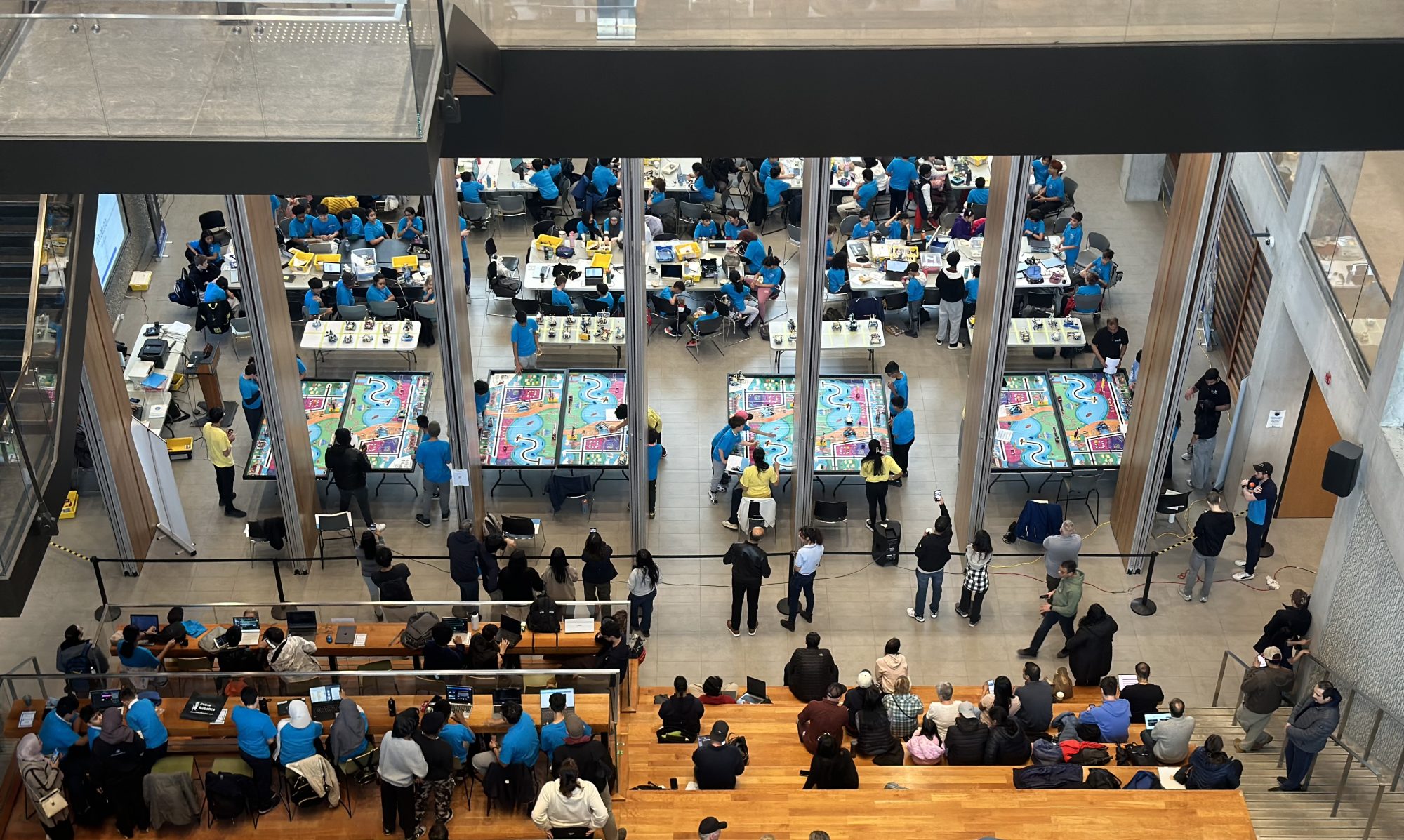
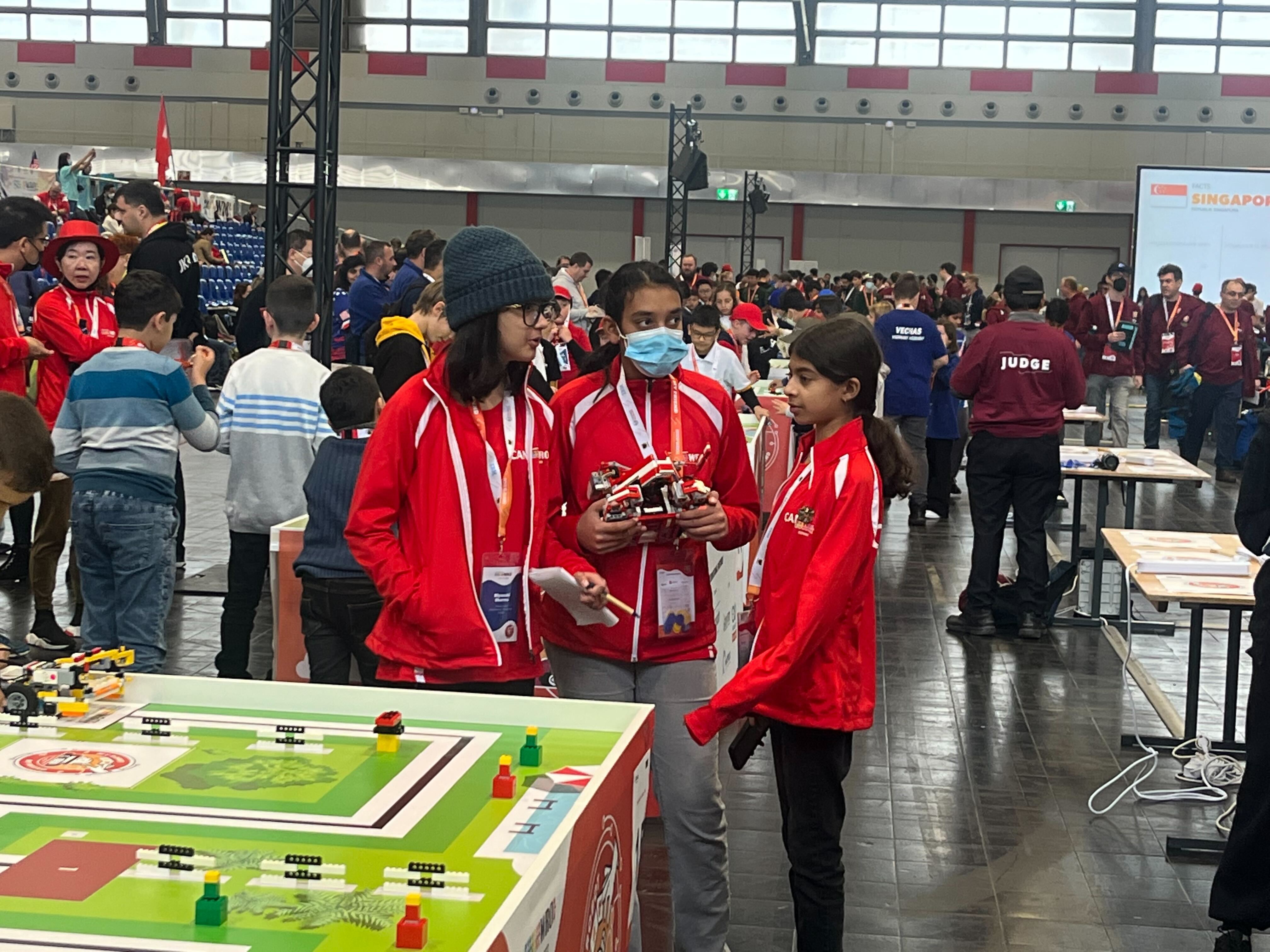
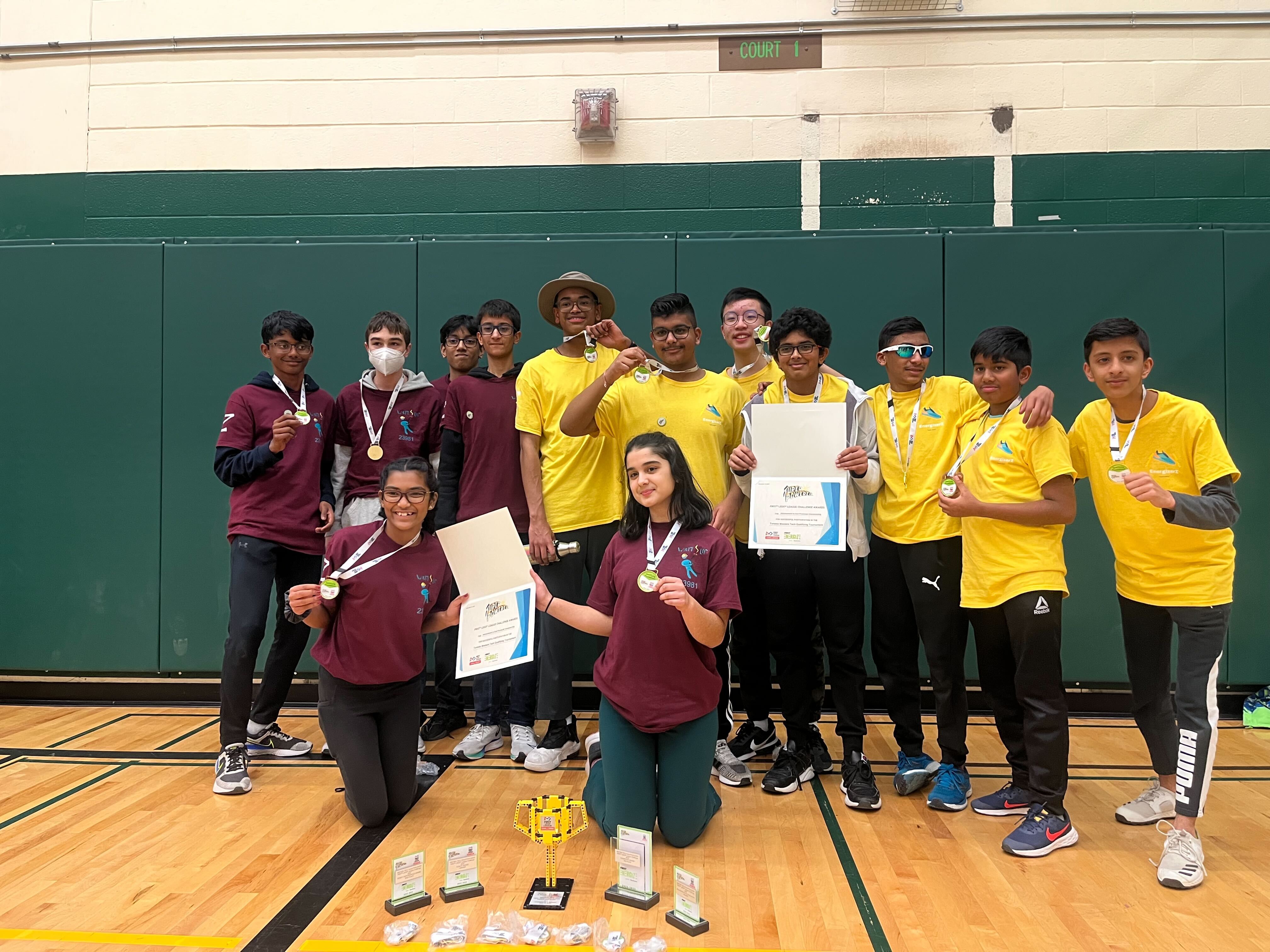
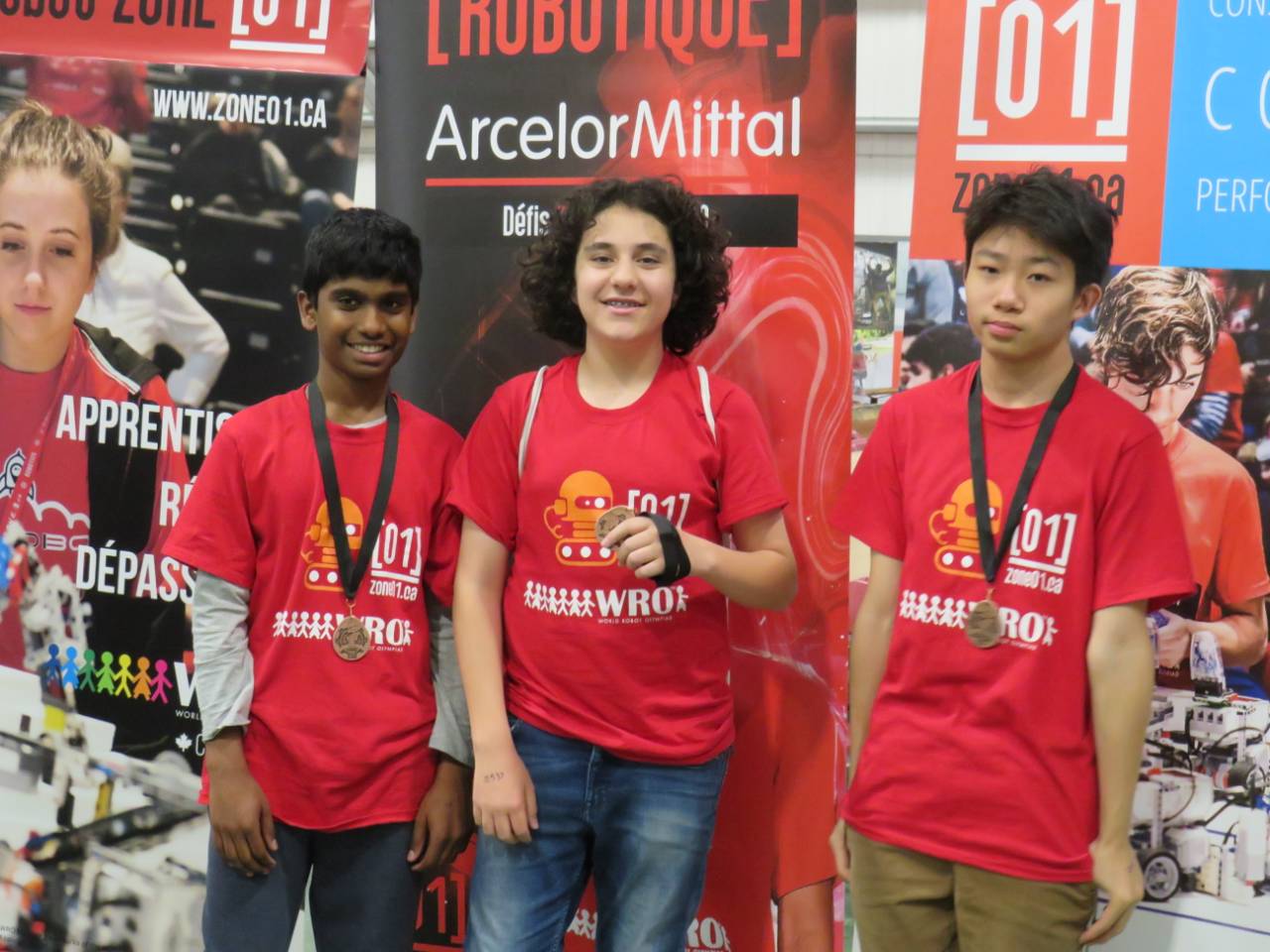
When it comes to STEM education and being immersed in the fields of Science and Technology there is nothing with quite the same effect as competing with like-minded individuals to test not only knowledge but collaborative ability, as well as critical and adaptive thinking. Competitions are a space where students can hone their skills sharply and be sure that the techniques, adaptations and understanding they gain will be memorable due to the fast-paced and exciting environment they were garnered. Competitions also allow students to showcase and elevate their dedication to STEM and STEM learning. It takes many weeks of preparation to refine and perfect their robots and their runs – placing students in the ideal environment to put their resolve and love of the technology as their first priority and really grow as STEM students, and ultimately, STEM professionals.
Zebra Robotics boasts an extensive competition history and is proud to have had more than 94 teams compete in renowned STEM competitions such as the First Lego League, Zone01, World Robotics Olympiad & Vex Robotics. Teams coming out of Zebra Robotics have won over 70 regional, provincial and even national awards across the last eight years. The established coding and robotics institute not only aims to sponsor students to achieve success at these high-level competitions, but also supports teams with hands-on coaching and mentorship as well as spaces to build and test their robots and regulation mats to time their runs, and more in their impressive student-centric centers. The approach of Zebra Robotics has always been self-paced for students, so students do all the design and programming of their robots, however, they are able to tap into a deep and robust support system that aids them on their journey to success. This guidance and support system helps alleviate the steep learning curve and shock of first-time competitors as well as support long-time competitors as they face higher degrees of pressure as they progress.
The vision for Zebra Robotics has always been to instill a love of STEM in all students with an interest and guide them into becoming the most versatile and adaptive professionals they can be. Competitions are a part of this mission and can serve an integral purpose in pushing students to their highest potential to achieve their short and long-term interpersonal and STEM skills.
Team 16539 OutsiderZ, and Team 4047, Fitnovators, FLL (First Lego League) teams from Mississauga, Ontario, participated in Western University and Waterloo qualifying tournaments respectively, won Core Value, robot design awards and are advancing to Ontario Provincials to be held the week of May 3rd virtually.
They were excited to form a team and start preparing for “2020 First Lego League” season. Due to COVID lockdown and restrictions to meeting in person, they delayed their kick-off meeting till mid-September 2020. They met 7 times in total between then and getting into another lockdown in November. During this time, they built a robot, strategized designed, and built extra attachments.
Team 4047: Fitnovators
They did not have time to program the robot before they went into virtual-only mode. They used that time to prepare for other aspects of FLL such as Innovation Research while waiting to hear back about lockdown relaxation rules. But unfortunately, they couldn’t meet in person. By January, they decided to practice for robot games virtually, by writing programs remotely and collaborating virtually. By mid-February 2021, with lockdown rules restricting them from practicing in person, they continued preparing for the Qualifying event virtually. Two team members decided to practice the entire team’s robot-run, a week before competition day.
They practiced for about 6 hours, in total, spread over three days, and were able to showcase a decent robot game score in 300s for the event. We need to look at this in contrast with a regular normal season, where the teams would have practiced for about 100+ hours before they go for the competition.
Kids were excited to see they were able to make progress in such a short time with their robot game and gave their 100%, preparing for their judging session. They did an awesome job, explaining all they have learnt during this FLL season, and how their team activities helped them overcome COVID fatigue. They learnt their advancement to provincials on a Saturday in late Feb/early March 2021, during the live broadcast of the tournament on twitch.tv. They are super excited. They are taking a week’s break and will start regrouping for provincials.
At Zebra Robotics, all the coaches are so proud of these kids, who stepped up to face the challenge given the constraints. Participating and learning are important for us, winning awards is icing on the cake. We look forward to working together in the coming weeks.
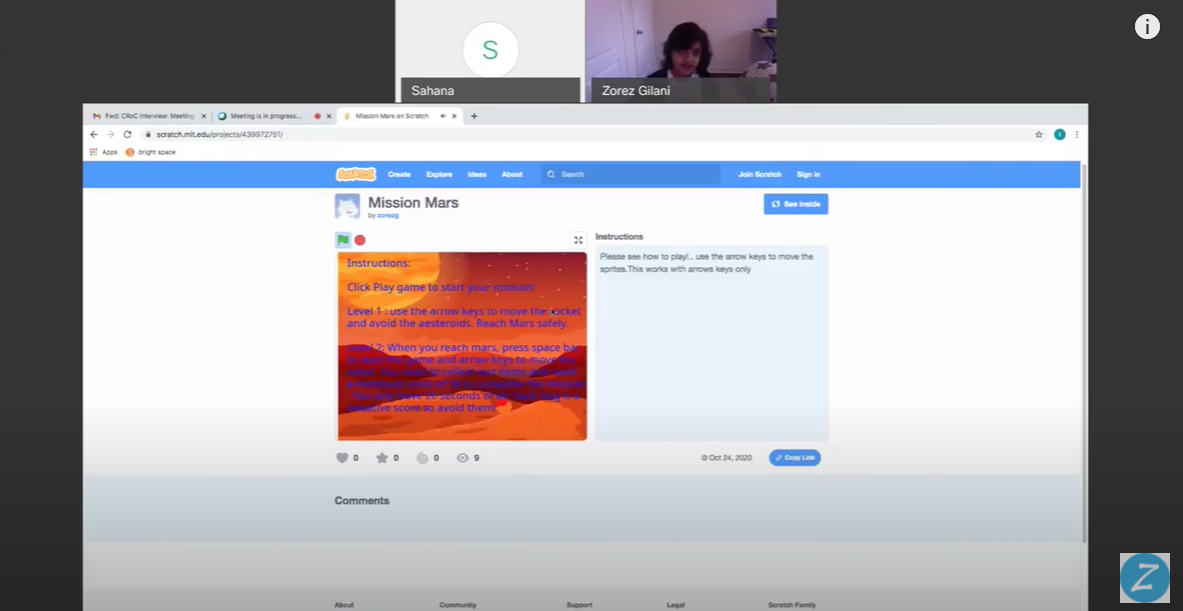
Zorez has been with Zebra for little more than a year, and he is very passionate about Coding. He has a developing interest in Robotics and is keen to learn to build. Here, in this video he presents about his project for CRoC 2020. He particpated in Junior category and won a Zebra Stripe.
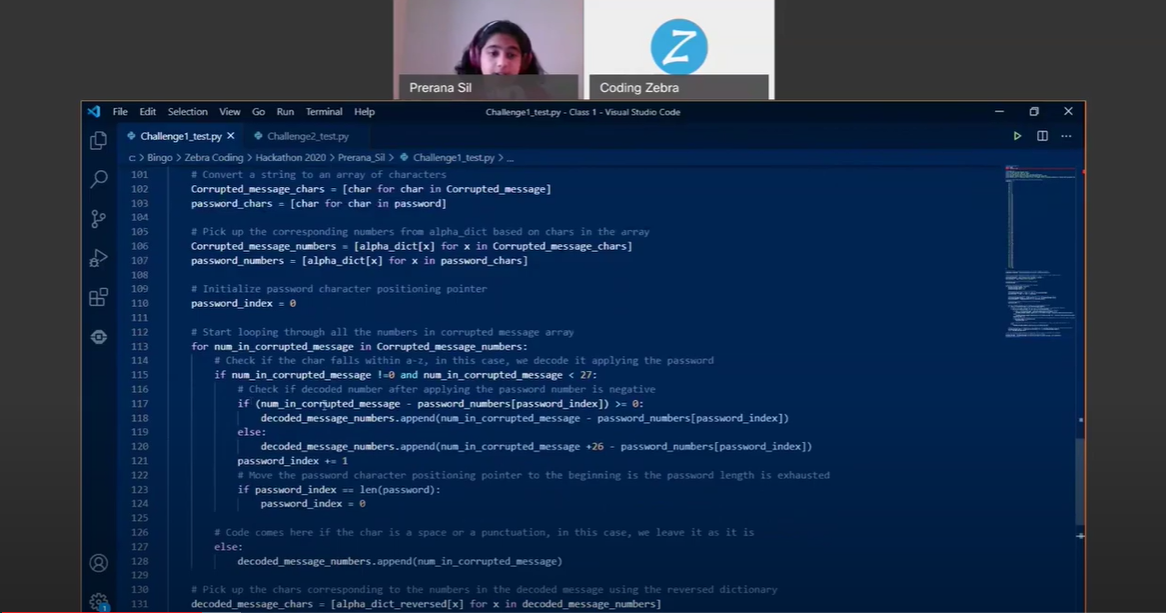
Meet Prerana, one of the Zebra Stripe winner in Python CRoC 2020. Zebra’s Virtual Coding Hackathon. You can watch her present her project, and her passion for Coding here.
Many of the high school students have been participating in Robotics and Coding competitions over the last several years while at Zebra Robotics. With Covid, and lockdown in Mississauga, Canada location, they decided to team up for something different.
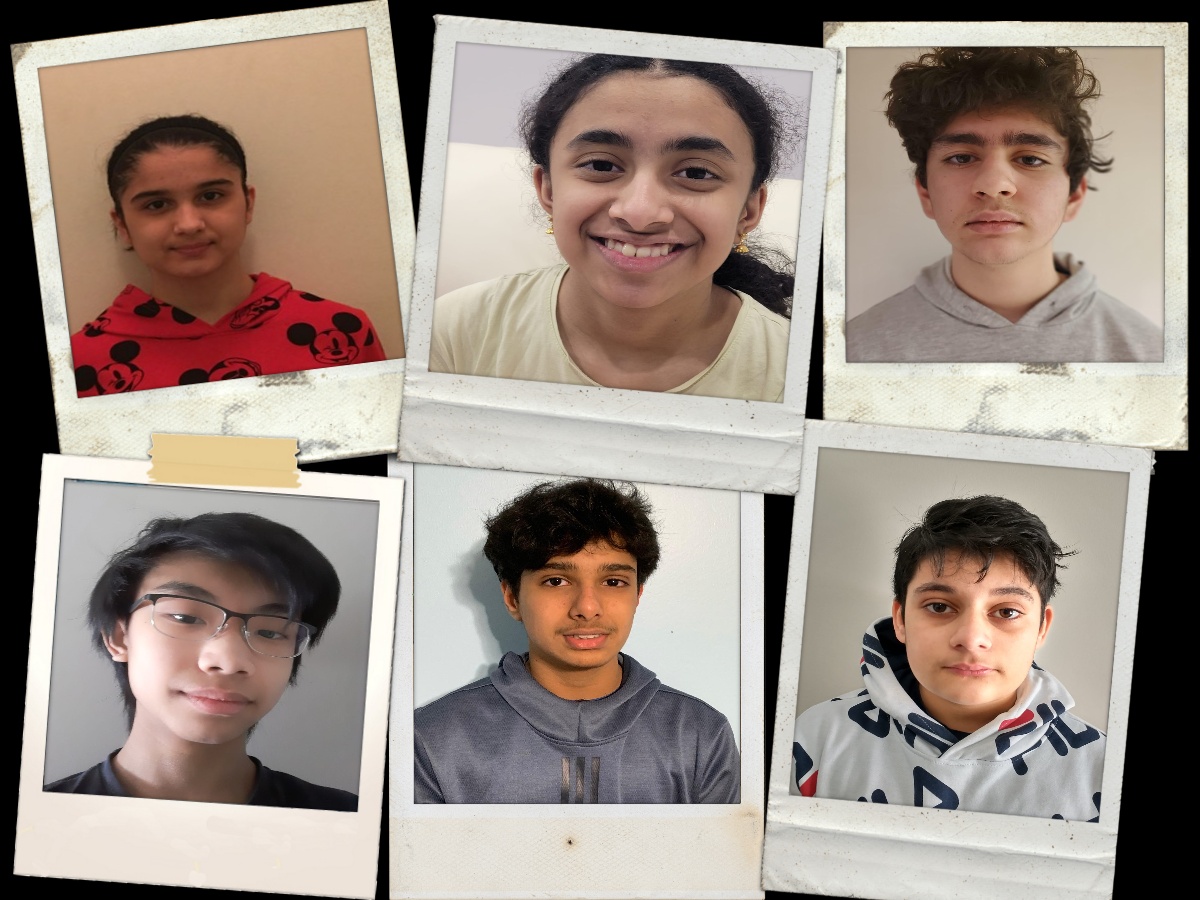
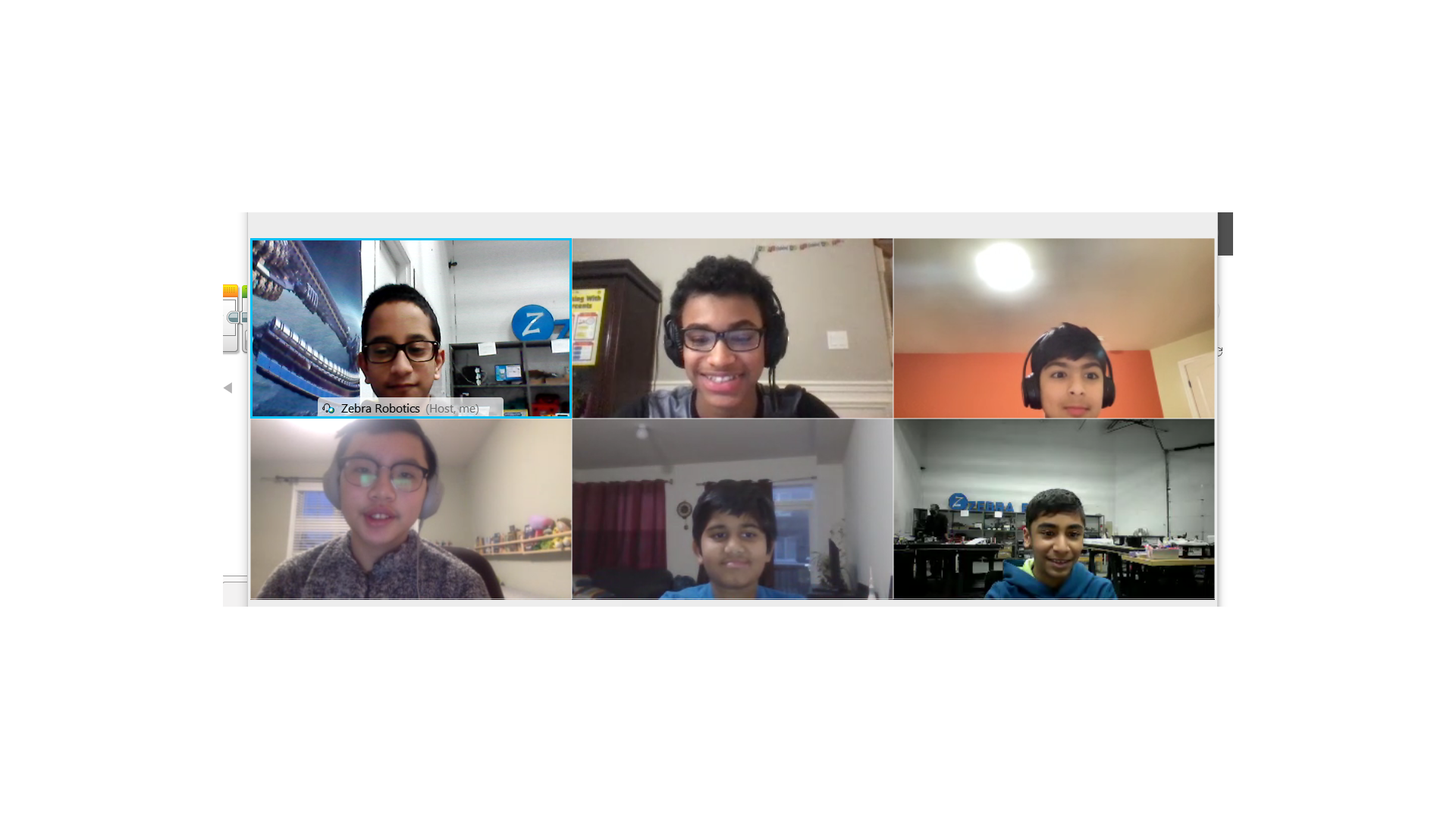
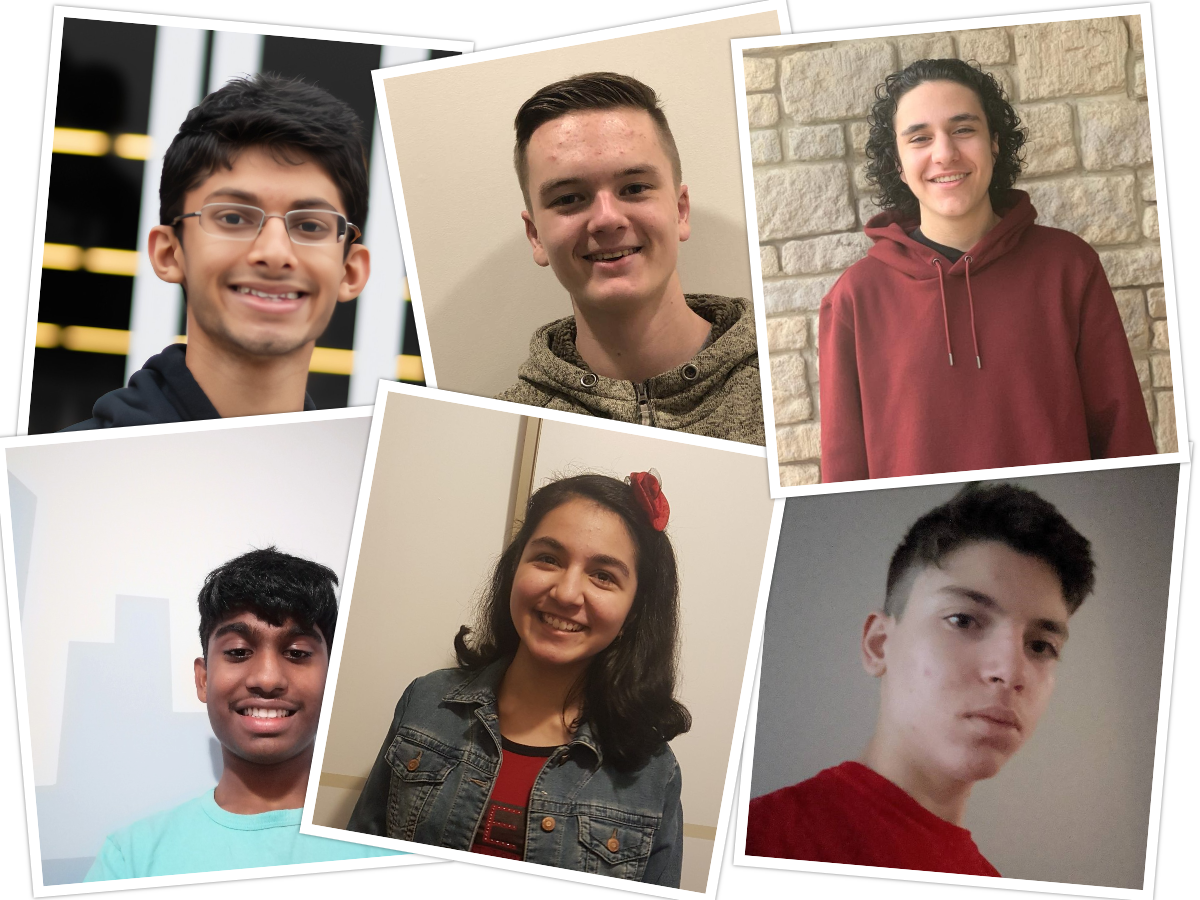
Group of six high school students, Nikhil, Daxsin, Adam, Vishal,Armina, and Josh came together and organized a Coding hackathon during the week of Hour-of-code. As the participant’s age group varied from Grade 2 to 12, they had to come up with several categories, that challenged participants appropriately, while givng them flexibility to choose challenges higher than their grade level, if they choose to.
Zebra Hackathon 2020 – Organizing committee
They worked over a three week period deciding on how the event will be conducted remotely, while the Zebra marketing and operations team, assisted them in getting the word out, and facilitating signups.
By the week of Zebra Hackathon 2020, they had received over 100 signps, from Canada, US , India and Srilanka. (they didn’t know how the word got out beyond Zebra locations in US and Canada, but hey, more the merrier was the attitude!).
The event lasted for about 3 hours, with results published within that time frame and winners, Zebra Bronze, Silver, Gold Stripe winners.
Overall the experience was very valuable, and participants had fun meeting like minded people across the countries during a tough lockdown we all were experiencing. After toiling for weeks preparing for the event and running it successfully, we asked the organizing team if they want to do it again, there answer was ” can we do this multiple times a year?”
note: to read about organizing committee member’s passion, and Stripe winners take on Hackathon and Coding in general, watch,search this blog.
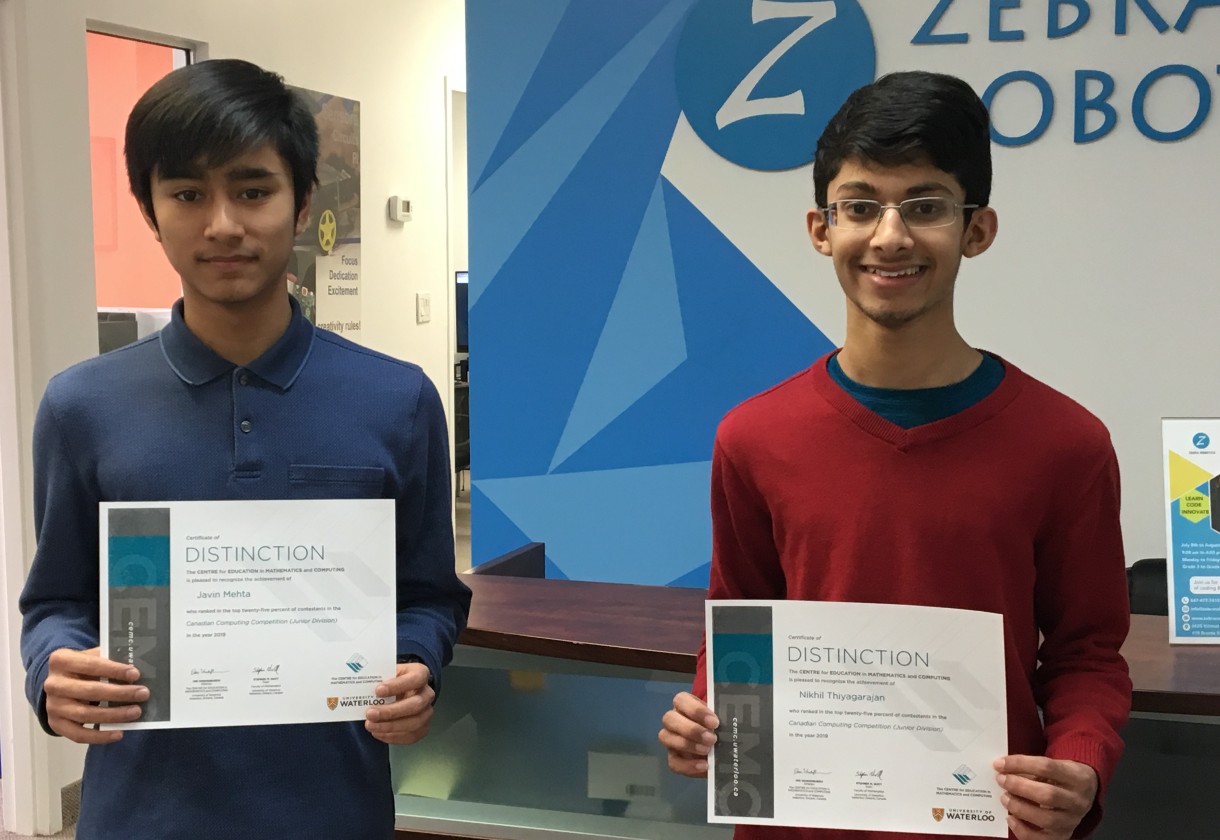
Nikhil and Javin have attempted University of Waterloo’s Canada Computing Challenge (CCC) a year earlier. They both scored in top 70 out of 3700+ students who attempted the challenge world-wide.
Considered one of the difficult computing challenges, University of Waterloo has been conducting these competitions annually. The time allotted for the challenge is three hours and students can attempt as many as five challenges in that period. Students can choose to program in languages such as C,C++, Python, Java among others.
Javin and Nikhil chose different programming languages to solve the challenges. While Javin went with Java as his choice to solve the challenges, Nikhil used Python. We are happy to celebrate our student’s achievements. Our coaches share their warm greetings, and it is always gratifying to see our students succeed. Good to see them persist and thrive.
ps: Picture was taken pre-covid. Mask is mandatory for students attending our classes, and so is adhearance to provincial public health guidelines.
This blog was written by FLAME-X team member Vishal Prakash, who has participated in two FLL seasons, for team Astroneers and FLAME-X. His team won awards at regionals and advanced to provincials.
The 2019-20 FLL season proved to be a very eventful and fun experience for my team and I. FLL is a competition that utilizes Lego Ev3 robotics to advocate for problems in the world. This year’s topic was called City Shaper and it centers around all the problems in the world relating to construction. There are 3 components to FLL: Robotics, Project, and Core Values.
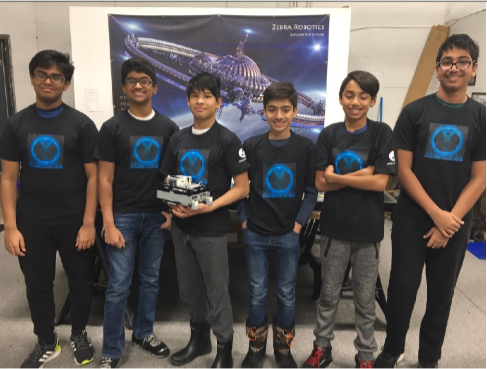
Flame-X members – L to R – Vishal, Samir, Ethan, Haris, Ishaan, and Praneeth
FLAME-X
ROBOTICS
In the Robotics component, the FLL team is supposed to build an Ev3 robot that has to complete a set of given challenges that are construction themed. Once each challenge is completed, a certain amount of points will be given to the team depending on the challenge. The building and programming can be done before-hand, and the robot only has to complete the challenges correctly on the day of the competition. Teams are also required to go in front of judges and present their robot, their game strategy, and how they built the attachments and programmed the robot. The judges evaluate the teams on how efficiently they built and coded the robot and also how they complete their challenges.
PROJECT
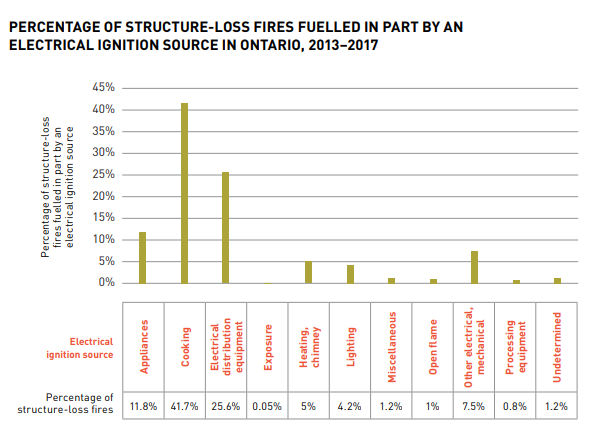
The Project component of FLL required much more time and work as well as a lot of perseverance and teamwork. The FLL team is supposed to research a problem related to the given topic, find a feasible solution for it, and then present it to the judges on the day of the competition. After looking at a lot of imminent problems relating to the theme, our team chose to research fires due to household appliances, especially stoves. We chose this problem because we found that there was not a good solution and that this problem was actually pretty big, especially in the older houses. After doing research on the problem, we came up with a solution. We called our solution Project F.L.A.M.E (Fire is Lame And Must be Extinguished). It will be attached over the stove and it utilizes thermal imaging, motion sensors, a smart plug, and also an IoT (Internet of Things) system. This system will monitor the motion in the house near the stove using the motion sensor. The thermal imaging will constantly be monitoring the temperature of the stove and if it exceeds a certain amount, the motion sensor will check to see if there is any motion nearby. If there is, the IoT will send a notification to the owner’s phone telling them to immediately turn off the phone. If there was not any motion, the IoT will make the smart plug cut the power to the stove and send a notification to the owner’s phone. After we found a good solution, we decided to build a prototype.
To present our project, we decided to do a skit where a father and son come back to see their house burned down as they had left their stove on. A firefighter recommends them to a group of scientists that are building the F.L.A.M.E. Then everyone goes back in time to see what would have happened if the F.L.A.M.E was monitoring the stove and it overheated. The F.L.A.M.E would have sent a notification to the dad’s phone and the skit ends. A team only has 5 minutes to present their project, so we had to adjust our skit while also making sure we managed to say everything we wanted to say.
CORE VALUES
The Core Values component of FLL represents the teamwork and sportsmanship shown by teams. Judges will constantly be walking around, monitoring us and checking how we act outside of the judging sessions and robot runs. In addition to that, we have to go in front of judges and do an activity that they give us. They check to see how we communicate with each other and how we make decisions as a team.
THE REGIONALS
The regional competition for the Peel Region happened at Rick Hansen Secondary School. This is the first level of competition before provincials and nationals. It started early in the day at 7:30 am and ended around 6:00 – 6:30 pm. Once our team got in a set up or table, or pit, with all our things, we went to the opening ceremony that introduced the judges and executives. After this, we had to go to our first judging session, which was Project.
PROJECT JUDGINGSESSION
We went into the judging room, introduced ourselves and began our skit. Overall our skit went very smoothly and we said everything we wanted to say. We then presented our prototype and showed how it worked and began to answer their questions. We answered the questions clearly as the judges were evaluating us on that as well. In fact, answering the judges’ questions is probably the hardest part of the judging sessions.
ROBOTICS & CORE VALUES JUDGING SESSION
After the Project judging, we went to our Robotics judging session. Here we present our robot, which we had named Sparky, and its components. We also talked about our attachments, how they worked, and our code. Similar to the Project session, we answered the judges’ questions. Our final judging session was Core Values. In this session, the judges gave us an activity and a time limit to finish it. The activity was to choose a part of a body and describe how the role you play in the team is similar to how the role that the part of the body you chose plays in the body. Then, we answered the judges’ questions.
After our first set of judging sessions, we waited for them to post the call-backs. Call-backs are for teams that did really well in each of their judging sessions, and it provides them an opportunity to present to a new set of judges for further evaluation and consideration for awards. We ended up getting call-backs for all three components and had to present again. After the judging sessions and lunch, the robot runs began. We had had a few practice runs before but these runs were the ones that would count and decided what place we would place among the teams. Each team gets 3 runs and the best score is the one that is considered. Our best run ended up being our second one where we scored 405 points. We were first place for a long time until another team scored 415 points and ended up finishing first place while we finished second.
Championship
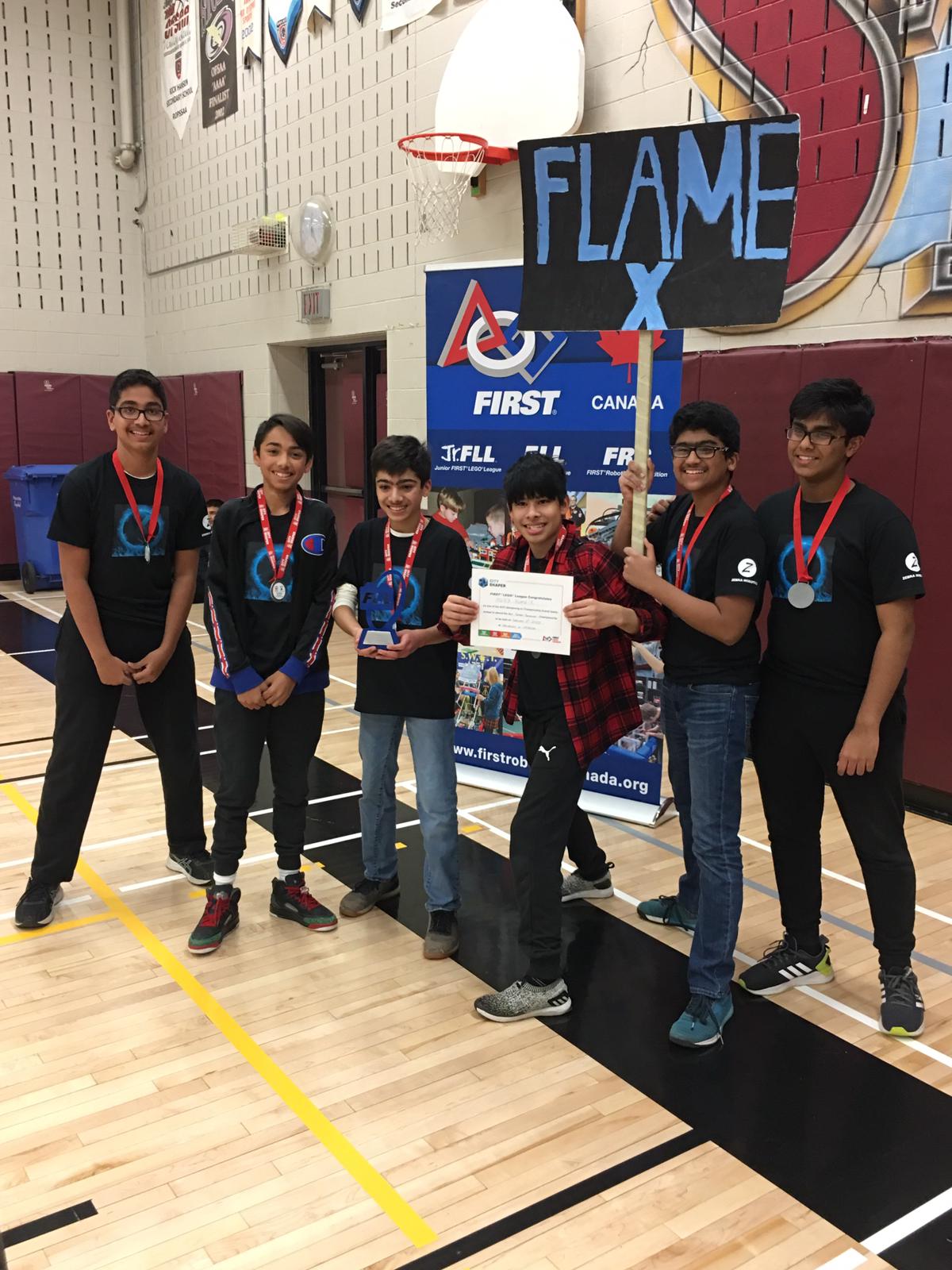
After all the runs were done, they started the awards ceremony. Though we finished second in the robot runs, we ended up coming first place overall and won the Champion’s Award. Three teams advanced to the provincials, which was to be held in the University of Waterloo, we were happy to be one of them.
The spirit of competition is one of those things we are all blessed with as children. But most of us tend to lose this competitive edge as we age. The good thing is, kids hardly ever have an ulterior motive when competing. For them, it’s merely about besting the other party while respecting the rules. And the childhood innocence that radiates during such competitions is a joy to behold.
WRO Junior High
More than the prize, however, kids also get to learn a whole lot from STEM competitions. This is owed to the fact that competitions provide a breath of fresh air. It takes kids away from the rigidity of classes and allows them to express themselves. While doing so, they also learn valuable skills like time management, communication, teamwork, abstract thinking, problem-solving, and so on.
How do we know this?, it is from working and experiencing with kids ourselves, over the last serveral years. As of Jan 2020, Zebra Robotics has fielded over 65 teams, both winning and ‘need-to-work-more’ experiences. The fact is , kids want to work and learn more when they participate in competitions and get new ideas for their robot design.
For STEM competitions to be effective, they should be less about the results and more about the process, just like any other educational endeavor for kids. Children should be taught that although winning is great, the journey is more important. That way, they have a better chance of imbibing the valuable lessons the competitions are set up to teach.